

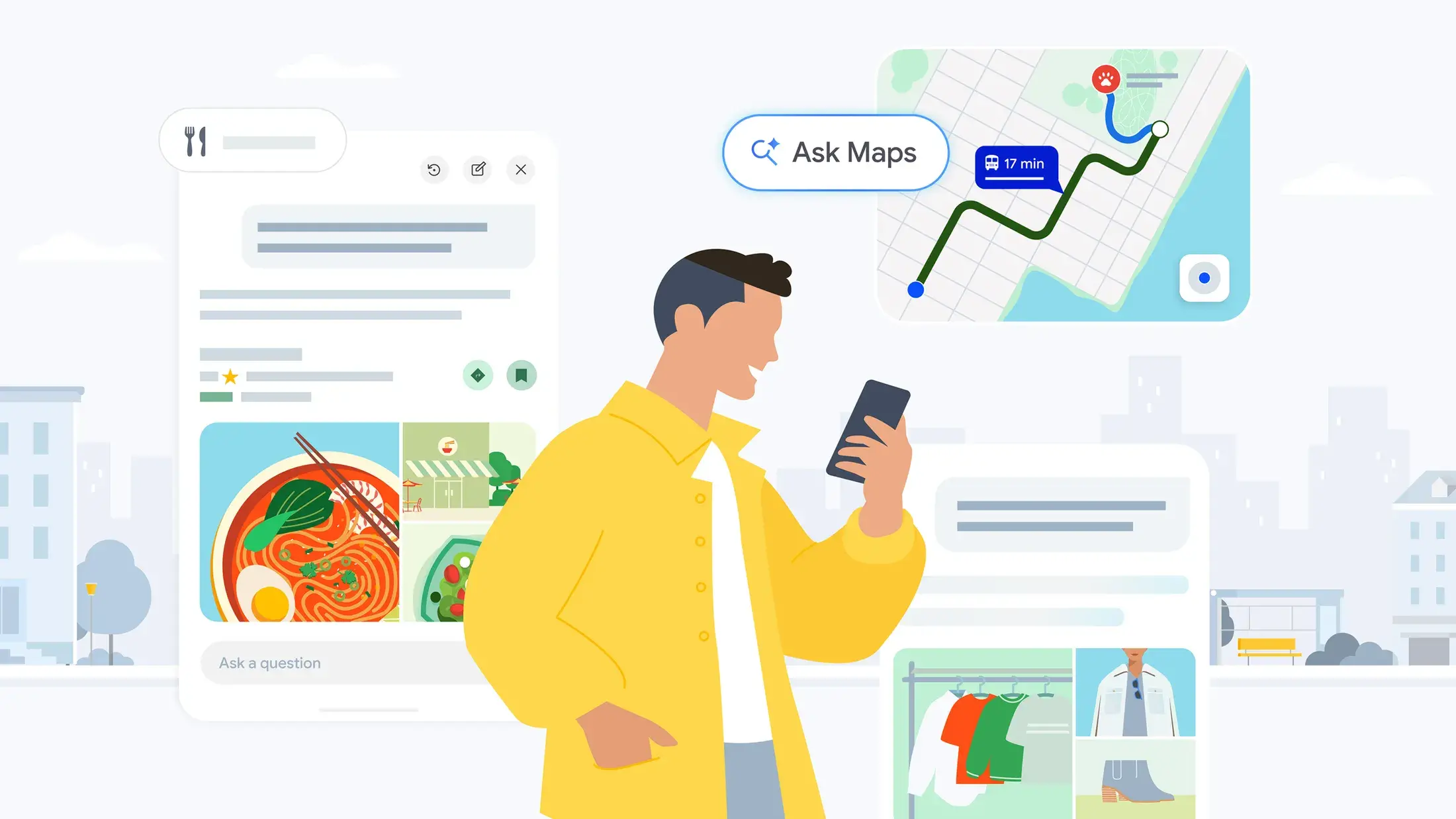
Google Maps has traditionally been the go-to app for directions, traffic updates, and discovering local businesses. But recent upgrades are transforming it into something far more ambitious: an AI-powered travel agent that can book a hotel room, order dinner, and plan an entire itinerary through simple conversation. The new capabilities reflect Google’s deeper push to integrate large language model technology into everyday products, blurring the line between search, recommendation, and transaction.
What the New AI-Powered Google Maps Offers
At its core, the enhanced Google Maps experience is built around conversational AI. Instead of typing keywords and manually combing through listings, users can now ask open-ended questions such as “What’s a good Italian place open late that delivers?” or “Find a pet-friendly hotel near downtown that costs less than $200 a night.” The AI then synthesizes results, distills user reviews, and presents organized suggestions—often with the ability to complete the booking or order right away.
This shift from search-and-browse to ask-and-act is a major leap. It means that Google Maps is no longer just a reference tool but a decision engine. For consumers, the convenience factor is enormous. The AI handles tasks such as filtering options by price, distance, ambiance, dietary restrictions, and even weather conditions. For example, a request like “book a hotel with a pool and breakfast under $150” could return a short list of curated options that match all those criteria.
Ordering Food Through a Conversation
One of the most talked-about features is the ability to order food directly through Google Maps using natural language. Users can say something like “get me a pepperoni pizza from a place that’s open now,” and the AI will present nearby pizzerias, compare delivery times and fees, and then let the user approve an order. The transaction is handled seamlessly through integrated partners, meaning the user does not need to install multiple food delivery apps or enter payment details on yet another website.
Behind the scenes, Google Maps uses artificial intelligence to analyze menu items, restaurant reputation, wait times, and previous customer ratings. It can even offer substitutions if a particular item is unavailable. For small independent restaurants, this could be a powerful way to reach customers, but it also raises concerns about prominence and fairness in how the AI selects one establishment over another.
Finding Hotel Rooms with AI Assistance
For travelers, the new AI-powered hotel booking capability is a game changer. Where previously one might visit a separate booking site or search through dozens of tabs, Google Maps now allows you to find and reserve a hotel room using the same conversational interface. Ask the AI for a hotel near a specific landmark, with parking and Wi-Fi, and it will return a comparison view. The assistant can show many photos, redemption policies, cancellation terms, and even suggest alternative dates if the requested dates are unavailable.
What sets this apart from standard hotel search is the AI’s ability to combine contextual signals from your daily life. For instance, the chatbot could infer that you are travelling for business because of your calendar metadata, and therefore recommend hotels with executive lounges or meeting facilities. It can also incorporate live forecast data to suggest properties with indoor pools on rainy weekends, or walkable neighbourhoods to avoid unpleasant weather during your stay.
How the AI Feature Works
The technical engine behind these features is a conversational layer built on Google’s Gemini models, specifically fine-tuned for geospatial and local commerce data. When a user submits a query, the model translates it into structured searches across Google’s extensive maps database, which contains information on over 200 million places globally. It analyses images, reviews, websites, and even trending queries to produce contextually relevant answers.
Google uses reinforcement learning from human feedback to improve the AI’s reasoning. The system is trained to ask clarifying questions when a request is ambiguous. For example, if a user says “book me a room in Manhattan for next weekend,” the AI may ask whether “Manhattan” refers to Manhattan, New York or Manhattan Beach, California. Once the destination is confirmed, the service then looks at user preferences such as star rating, brand loyalty, and past redemption patterns to narrow down the options.
The AI infrastructure also supports integration with third-party partners. Food delivery services, hotel management systems, and reservation platforms feed their inventory into Google’s API, allowing the company to pull live prices and availability. This is why the service can display up-to-date menus and room rates. When the user approves a purchase, Google securely passes the payment details and contact information to the partner, completing the transaction without requiring the user to navigate away from the map interface.
Implications for Consumers and Businesses
For consumers, the experience promises to eliminate the noise of endless search results. Instead of painstakingly comparing booking sites and delivery apps, a single AI interface can handle the grunt work. It saves time and reduces friction. For example, a family planning a last-minute road trip could ask Google Maps to identify a chain hotel with two queen beds, electric vehicle charging, and budget-friendly dining nearby—and have it all reserved within minutes.
Businesses, meanwhile, now must consider how their listings appear to AI systems. Because the large language model acts as a gatekeeper, restaurants and hotels that optimise their online profiles, respond to reviews, and keep their venue data accurate are more likely to be recommended. Those with out-of-date hours or unclear menus could be filtered out. Additionally, businesses that are willing to commission partnerships with delivery or booking platforms become more visible in the new interface, making the AI recommendation not purely impartial but influenced by commercial integration.
Privacy and AI Considerations
With all this convenience, though, significant privacy questions arise. The AI must digest a wealth of personal data—including location history, previous orders, hotel stays, and potentially even calendar events—to provide tailored suggestions. Google maintains that users have control over their activity settings and that the AI can operate in a privacy-conscious mode without storing personal details. Nonetheless, the more seamless and personalised the recommendations become, the greater the inherent trade-off between utility and personal data exposure.
There is also the question of algorithmic bias. If the AI over-indexes on mainstream venues or large chains, smaller local businesses may lose footfall. Google has repeatedly stated that its ranking is determined by relevance, distance, and prominence, but adding a conversational layer on top introduces subtle biases from the training data. Research in algorithmic fairness shows that conversation-based suggestion systems tend gently to skew toward the middle of the bell curve—meaning users may see fewer hidden gems and more well-known, heavily reviewed destinations.
Another point of concern is failure handling. When a user orders food or books a hotel through Google Maps, the AI is intervening in a high-stakes transaction. If the reservation is misplaced or the delivery is inaccurate, the user needs a transparent path to recourse. Google has implemented support mechanisms, but consumers should keep in mind that the intermediary generally does not take legal responsibility for the services provided by third-party establishments. This makes trust in the underlying partner network as important as the AI’s recommendation quality.
In response, Google has begun testing explanations within the AI chat—“these results are based on your past preferences and the restaurant’s 4.8 rating from 3,000 reviews”—so that users understand why certain options surfaced. This kind of transparency is crucial for building confidence. It also permits users to override the AI and demand broader lists, preserving a sense of agency.
The introduction of AI ordering and hotel booking within Google Maps signals a larger trend toward super-app features in Western markets. While apps like WeChat and Grab have long combined maps, social media, and commerce, the US and Europe are only now seeing a rapid convergence. Google’s position as an infrastructure provider grants it a distinctive advantage, as it already controls the underlying map data, the default location settings on many phones, and an Android operating system platform that envelops many daily tasks.
For the travel industry, this puts additional pressure on online travel agencies such as Expedia and Booking.com, as well as food delivery platforms such as DoorDash and Uber Eats. Users may increasingly bypass dedicated apps and instead delegate their tasks to the AI-driven assistant built into Google Maps. While it is too early to understand the full market disruption, the momentum is undeniable. Meta and Apple are pursuing comparable strategies, but neither has so far integrated food ordering and hotel booking directly inside a widely used navigation app.
The rollout has been gradual, starting in selected regions and limited partner ecosystems. Google has stressed that feedback from users is instrumental in shaping the final experience. In its early tests, users frequently asked for clearer price breakdowns, more flexibility when modifying existing reservations, and greater integration with loyalty programs. The product team claims that many of these capabilities will appear in subsequent updates, driven by continual machine learning refinements.
As the artificial intelligence behind Google Maps gets more sophisticated, the boundaries between map, search, itinerary planner, and wallet will continue to blur. The next logical step would be a full trip-planning assistant that identifies a weekend getaway, schedules driving directions with rest stops, books a table for Sunday brunch, and sends a departure reminder based on real-time traffic. In that world, the average consumer may no longer speak of “searching” on Google Maps—instead, they will expect to simply ask, and have the AI take care of the rest.
Source:Techopedia News