

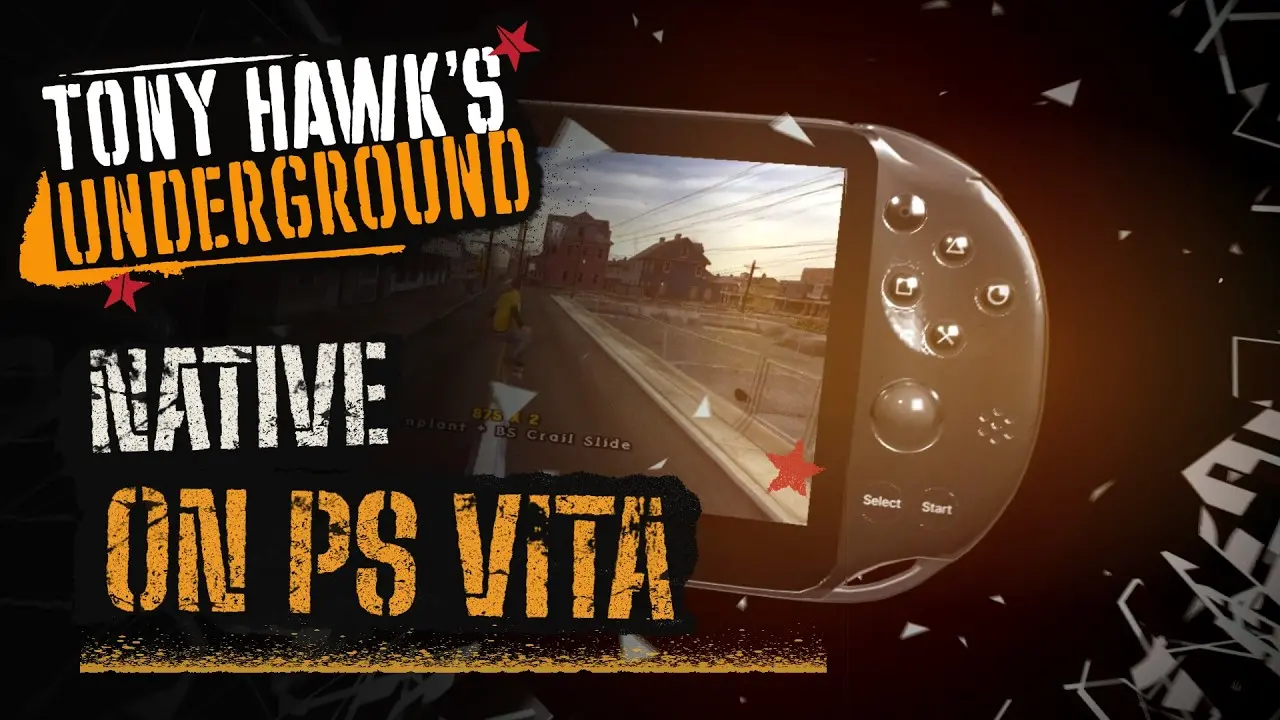
For years, the PS Vita library has been celebrated for its deep role-playing games, visual novels, indie darlings, and a handful of ambitious action titles. What it has never had, at least not in any official capacity, is a skateboarding game that could stand alongside the genre’s best. That changes now with the arrival of an unofficial native port of Tony Hawk’s Underground, the 2003 skateboarding classic originally released for the Xbox, PlayStation 2, and GameCube. The port is not an emulation wrapper or a streaming experiment. It runs natively on Sony’s handheld, powered by vitaGL, and it brings the complete game—story mode, create-a-skater, and all levels—to a console that many had written off as unlikely to receive such a release.
The project is developed by iwannagooutside, a name familiar to those who follow the PS Vita homebrew scene. According to the release information, the port is a full version of Tony Hawk’s Underground. That means players can work through the game’s narrative, build their own skater, and access every stage from the original release. Performance is also a major talking point: most levels run at around 60 frames per second, a figure that would have seemed improbable for a native Vita port of a sixth-generation console game only a few years ago. The achievement is made possible by vitaGL, a homebrew graphics library that translates OpenGL calls for the PS Vita’s hardware and has become a cornerstone of the system’s native porting efforts.
What the Tony Hawk’s Underground PS Vita Port Includes
Unlike a trimmed-down demo or a proof-of-concept, this port aims to preserve the complete Tony Hawk’s Underground experience. The story mode is intact, allowing players to rise from a local skateboarding nobody to a pro legend. The create-a-skater feature is included, so custom characters can be built and used throughout the game. Every level from the original release is playable, from the familiar training grounds to the sprawling urban environments that made the game a standout in 2003. The port also supports the game’s various modes, keeping the structure that fans remember.
There are, however, some hardware-specific caveats. The PlayStation TV, also known as PSTV, is not supported. Certain actions in the game require the PS Vita’s touchscreen, which the PSTV cannot replicate in the same way. That detail may disappoint players who prefer to play Vita games on a television, but it is a common limitation for homebrew projects that depend on the handheld’s unique inputs. For standard PS Vita owners, the touchscreen controls are part of the experience, and the port is designed around them.
Technical Requirements and How the Port Runs
The technical side of this release is as interesting as the game itself. This is not a port based on the PC version of Tony Hawk’s Underground. Instead, it requires the files from the Xbox USA version of the game. Players must extract the data from an ISO of the Xbox release that they legally own and place those files into ux0:data/thug/Data/ on their PS Vita. That path is specific to the Vita’s file system and is typical for homebrew that relies on external game assets. The choice of the Xbox version is unusual, but it reflects the data structure that the port was built around.
As with most ambitious homebrew projects, a modified PS Vita is mandatory. The port itself does not include any non-redistributable parts of the original game. It is a homebrew package that expects the user to supply their own legally obtained copy of Tony Hawk’s Underground for the Xbox. The project does not provide links to game data, nor does it offer assistance with custom firmware. Those are important legal and practical boundaries: the developers have released the code and compatibility layer, but they are not distributing the copyrighted assets that make the game work.
The use of vitaGL is central to how this port functions. VitaGL is a homebrew implementation of OpenGL for the PS Vita, and it has enabled a growing number of native ports that would otherwise be impossible. By translating graphics calls to the Vita’s GPU, vitaGL allows games originally built for much more powerful hardware to run on the handheld. The fact that Tony Hawk’s Underground can reach around 60 frames per second in most levels is a testament to both the library and the optimization work done by the developer. Some scenes may still see performance dips, as is common with homebrew ports, but the baseline is far higher than what emulation typically offers.
AI Assistance and Automated Testing in the Homebrew Scene
One of the more unusual details about this port is its development process. The project was reportedly completed with significant assistance from artificial intelligence and an automated testing system that ran on real console hardware. That combination is rare in the homebrew community, where projects are often solo efforts driven by manual debugging and community feedback. Automated testing on actual PS Vita hardware can help catch crashes, input issues, and performance regressions that might be missed in emulators. AI assistance, meanwhile, can speed up code translation, refactoring, and documentation. The result is a port that arrived with a level of polish that might surprise those who remember the early days of Vita homebrew.
None of this diminishes the work of the developer. AI tools and automated tests are aids, not replacements for a deep understanding of the hardware and the game. The port still required someone to set up the build pipeline, adapt the rendering path to vitaGL, handle input mapping, and ensure that the Xbox data files were read correctly. The involvement of AI is a sign of how homebrew development is changing, not a sign that the project was effortless.
Why Tony Hawk’s Underground Still Matters
Tony Hawk’s Underground was released in 2003 and quickly became a landmark in the skateboarding genre. Developed by Neversoft and published by Activision, it moved beyond the competition-focused structure of earlier Tony Hawk’s Pro Skater games and introduced a full story mode. Players created a skater and traveled across the United States and Europe, completing goals, building a reputation, and interacting with a cast of fictional and real-world skaters. The game also introduced off-board mechanics, allowing players to walk around environments, which opened up new ways to explore levels and complete objectives.
The game’s tone was irreverent and influenced by skate culture, Jackass-style stunts, and early-2000s humor. It featured a soundtrack that mixed punk, rock, hip-hop, and metal, and it became a touchstone for a generation of players. The Xbox version, in particular, was known for its improved visuals and performance compared to the PS2 and GameCube releases, which may explain why the port uses Xbox data. Bringing that version to the PS Vita is a notable technical achievement, because the Vita’s architecture is different from the original Xbox and because the game was never designed to run on a handheld.
For skateboarding game fans, the PS Vita has been a frustrating platform. The system received very few skate games, and none of them captured the feel of the Tony Hawk’s or Skate series. This port fills a gap that official publishers ignored. It also demonstrates what the Vita homebrew community can accomplish when a dedicated developer spends time with a classic title. The port is not just a curiosity; it is a playable, full-featured version of a game that many consider one of the best in the genre.
PS Vita Homebrew and the Rise of Native Ports
The PS Vita homebrew scene has evolved dramatically over the years. Early efforts focused on emulators, utilities, and simple games. More recently, developers have used tools like vitaGL to create native ports of PC and console titles. These ports are not emulated; they are compiled to run directly on the Vita’s ARM processor and PowerVR GPU. That distinction matters because native ports can achieve better performance, lower input lag, and more efficient battery usage than emulation. Tony Hawk’s Underground is the latest example of this trend, and it joins a growing list of games that have been adapted for the handheld through unofficial means.
The port’s requirements mean it is not for everyone. Players need a modded PS Vita, a legal Xbox USA copy of Tony Hawk’s Underground, and the ability to extract files from an ISO. The process is more involved than downloading a game from the PlayStation Store, but it is standard for homebrew of this type. The payoff is a native version of a classic game running at frame rates that many thought were out of reach. For those who already own the Xbox version and have a modded Vita, the barrier to entry is mostly a matter of following instructions and transferring data.
Availability and Requirements
The project’s information and download are available through the developer’s public repository and a homebrew catalog entry. No direct links are provided here, and users should be cautious about where they obtain game files. The homebrew itself does not contain any non-redistributable part of the original game. A modified PS Vita is required, and the developer does not offer help with custom firmware. The port was first reported on October 7, 2026, and the article was updated on October 10, 2026. It is tagged under Hack, Portage, Tony Hawk’s Underground, and Underground.
The port requires files from the Xbox USA version of Tony Hawk’s Underground, not the PC version. Those files must be extracted from a legally owned ISO and placed in ux0:data/thug/Data/ on the PS Vita. PSTV is not supported because certain actions use the touchscreen. Most levels run at around 60 frames per second.
Source:Planète Vita News