

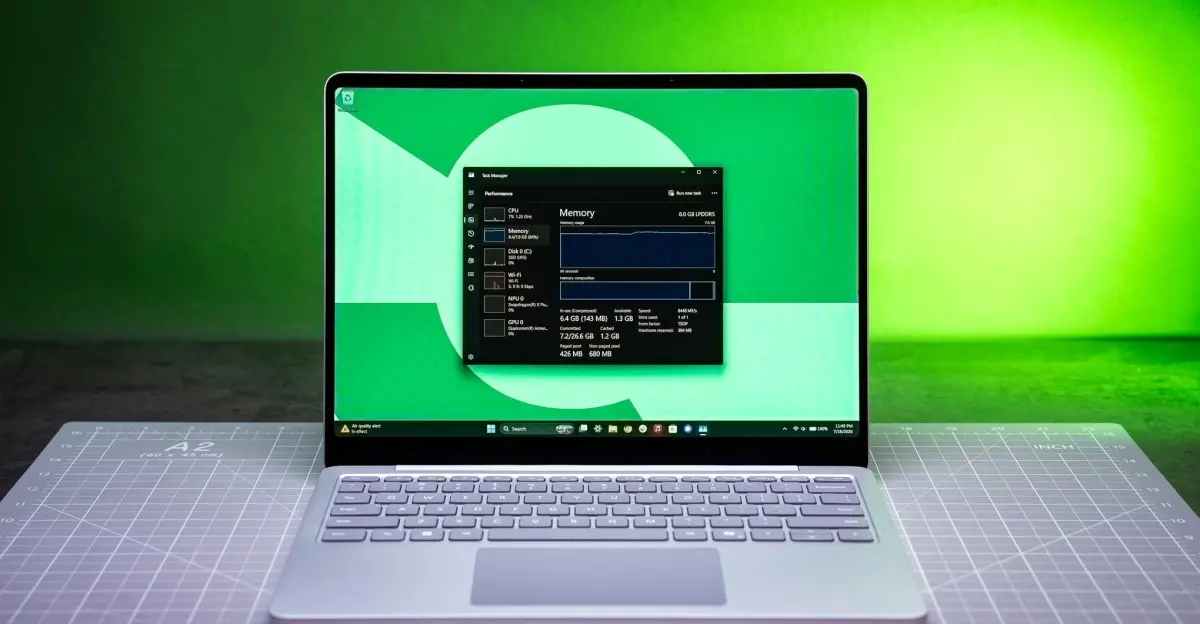
In the ever-evolving landscape of personal computing, the balance between hardware and software optimization remains a delicate dance. Nowhere is this more evident than in the latest iteration of Microsoft's Surface Laptop 13-inch, which ships with a mere 8GB of RAM at a starting price of $950. The result, as exhaustive testing reveals, is a machine that struggles under the weight of modern multitasking, even when running its own operating system—Windows 11.
Last year's model earned praise for its solid build, excellent keyboard, and long battery life, making it a worthy competitor to the MacBook Air. However, the 2026 version cuts RAM in half while increasing the price by $50, a direct consequence of the ongoing global memory shortage dubbed 'RAMageddon.' This shortage, driven by surging demand for AI accelerators and high-bandwidth memory, has sent DIMM and LPDDR prices skyrocketing. As a result, manufacturers are forced to offer entry-level configurations with just 8GB—a specification many experts deemed insufficient years ago.
Testing the 8GB Surface Laptop: Real-World Performance
To evaluate how well Windows 11 operates on 8GB of RAM, a series of real-world tasks were conducted. The test unit featured a Qualcomm Snapdragon X Plus processor, 256GB UFS storage, and a 13-inch touchscreen display. Immediately after a fresh boot, Task Manager reported that Windows 11 consumed 4.2GB of RAM—over half of the available 7.6GB (after system reservations). With just six Chrome tabs open, Slack, and Signal, memory usage climbed to 6.7GB, leaving almost no headroom.
The most telling moment occurred during a Microsoft Teams call. When the host played a short video, the entire system froze for several seconds. Similar hangs happened sporadically while editing Google Docs, even without background applications. These freezes, though brief, are unacceptable for a brand-new $950 laptop. The experience contrasts sharply with the 2025 model, which handled similar workloads without a hitch thanks to its 16GB RAM.
Modern users often juggle multiple browser tabs, productivity apps, and communication tools. With 8GB, any attempt at serious multitasking leads to constant paging to the SSD, causing noticeable lag. The 256GB UFS storage, while adequate for light use, further compounds the issue with slower random read/write speeds compared to NVMe drives found in more expensive configurations. Even Microsoft's official hardware requirements for Windows 11 list 4GB as the minimum, but that assumes minimal background activity. In practice, 8GB forces users to monitor their memory usage constantly, a workflow that kills productivity.
The macOS Alternative: How Apple Handles 8GB
Apple's MacBook Neo, also equipped with 8GB of unified memory, demonstrates that the software platform matters enormously. In comparable tests, the Neo handled multitasking more gracefully, managing a dozen Chrome tabs, Slack, and Spotify without noticeable stuttering. macOS is known for its efficient memory compression and swap management, leveraging the tight integration between Apple's silicon and operating system. Windows 11, by contrast, has a larger memory footprint and less aggressive memory optimization, partly due to legacy support and a less streamlined codebase. This gap means that while 8GB might be borderline acceptable on macOS, it is simply inadequate on Windows 11 for any user beyond the most casual browsing and email.
Why 8GB Is Back: The RAMageddon Crisis
The return of 8GB as a default configuration is not a choice driven by user preferences but by economic realities. The global RAM shortage, initially triggered by the pandemic-era chip crunch, has been exacerbated by the explosive growth of AI data centers. Companies like Nvidia, Microsoft, and Google are gobbling up the vast majority of DRAM and HBM supply, leaving consumer electronics manufacturers scrambling. Samsung, SK Hynix, and Micron have prioritized higher-margin memory chips, reducing output of traditional LPDDR5. As a result, the price of 16GB and 32GB modules has doubled in some markets, pushing OEMs to offer 8GB SKUs to hit lower price points.
At Computex 2026, several major laptop makers—Dell, Acer, and Asus—announced upcoming models with 8GB of RAM. This signals a wider industry trend that could last for years. The entry-level Surface Laptop is just the first high-profile casualty. Current projections indicate that the shortage may not ease until 2028, meaning consumers will be stuck with 8GB as the baseline for budget-friendly Windows laptops.
Implications for Longevity and Value
Purchasing a laptop with only 8GB of RAM in 2026 raises serious questions about long-term usability. Operating systems and applications only grow more resource-hungry with time. Windows 11 itself is expected to receive major feature updates that could increase memory requirements. A machine that chokes on day one is unlikely to remain functional for five years, the typical lifespan of a premium laptop. Storage is also a concern—256GB UFS fills quickly, especially with the growing size of system files, app data, and media. Users who expect to edit photos, compile code, or run virtual machines will find 8GB laughably inadequate.
The price-to-performance equation has shifted unfavorably. Last year's 16GB Surface Laptop cost $900, providing a better experience and better future-proofing. Now, $950 buys half the memory and less storage. The premium for 16GB is $200 more, bringing the total to $1,150—a steep increase for what is essentially the same hardware with more RAM. For that price, a MacBook Air with 16GB remains a compelling alternative, or even a MacBook Neo for $700, which offers a smoother 8GB experience. The value proposition of Windows laptops has taken a severe hit.
Can Microsoft Fix This?
Microsoft has publicly stated its commitment to improving Windows 11 performance and reliability, especially on lower-cost hardware. Yet the company bears some responsibility for the RAM shortage, as its massive investments in AI infrastructure have soaked up supply. The irony is not lost: Microsoft's AI ambitions are directly harming its flagship Surface line. While optimizations could reduce memory usage—such as trimming background services, improving memory compression, and offering a streamlined 'S Mode' experience—these measures would likely require a fundamental rethinking of Windows architecture. A quicker fix would be to simply mandate 16GB as the minimum for new Windows laptops, but that would raise prices and hurt sales in a competitive market.
Until then, consumers are left with a difficult choice: pay a premium for 16GB, settle for a compromised 8GB experience, or switch to a different ecosystem. The 8GB Surface Laptop, despite its excellent build and battery life, is a cautionary tale about the collision of hardware constraints and software demands. Even Microsoft, the creator of Windows 11, could not make the combination work well. That does not bode well for the wave of 8GB Windows laptops about to hit the market.
Source:The Verge News