

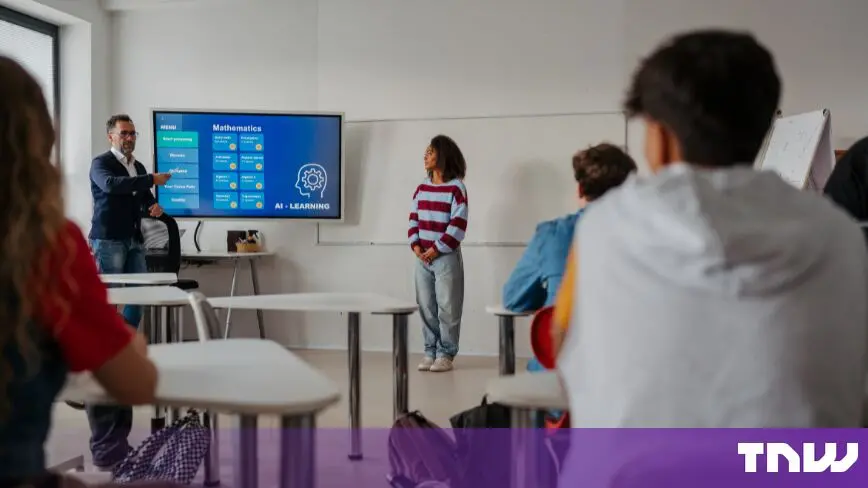
Fei-Fei Li thinks schools are worrying about the wrong thing. The danger of AI in classrooms is not that students will use it to cheat, she argues, but that it will strip away their reason to learn at all. She made the case on the science podcast Huberman Lab, in an episode released on Monday.
“The absolute bad outcome is that our young generation, their agency and human-level motivation of learning and living is taken away by tools,” said Li, the Stanford computer science professor widely known as the godmother of AI. “It should not be taken away by humans nor should it be taken away by machines.”
Used badly, she said, the tools could leave a generation that has not “properly developed the brain.” She is just as wary of the opposite reaction. “Both things worry me,” she said. “Either denying the tool or taking away agency and motivation.”
A legendary career in AI
Li is one of the most influential figures in modern artificial intelligence. She is the Sequoia Professor in the Computer Science Department at Stanford University, the co-director of the Stanford Human-Centered AI Institute, and a founding co-director of the Stanford Institute for Human-Centered Artificial Intelligence. Her pioneering work on ImageNet, a large visual database designed for visual object recognition software research, helped spark the deep learning revolution that transformed the field over the past decade.
Her perspective on education is shaped by years of teaching and mentoring students at some of the world’s most competitive institutions. She has seen firsthand how technology can either empower or diminish young minds. Her recent comments on the Huberman Lab podcast reflect a growing concern among educators and technologists that the rapid adoption of generative AI in schools is happening without a clear understanding of its long-term effects on cognitive development and intrinsic motivation.
The core concern: agency and motivation
Li’s central worry is not that students will use ChatGPT or similar tools to cheat on assignments. That is a manageable problem, one that schools have faced with new technologies for centuries. What keeps her up at night is the possibility that AI will make students feel that their own thinking no longer matters. If every question can be answered instantly by a machine, students may stop asking questions altogether. They may lose the drive to persist through difficulty, to struggle with complex ideas, and to experience the satisfaction of solving a problem on their own.
“I know where I’m stuck,” Li said, recalling her own undergraduate struggles with organic chemistry. “I have the motivation to learn. I just need guidance.” She explained that as a premed student, she found the subject extraordinarily difficult. Teaching assistant hours were limited, and professors had only so much time for questions. With a chatbot available, she said, she would have asked far more questions and gotten the help she needed without losing her drive to understand the material.
This distinction is crucial, she argued. When a student is engaged and genuinely curious, AI can act as a powerful tutor, offering explanations and guidance that fit their pace and style. But when a student is disengaged or overwhelmed, AI can become a crutch that makes it easier to stop thinking altogether. The same tool can be a bridge or a barrier, depending on how it is used and why.
The evidence is still forming
The debate over AI in education is not just philosophical. Empirical studies are beginning to paint a complex picture. A report from Oxford University Press published last year found that students using generative AI were gaining speed while losing depth of thinking. They completed assignments faster, but their answers were more superficial and less nuanced. This suggests that AI can encourage what researchers call “cognitive offloading,” the tendency to rely on technology for mental tasks that we used to do ourselves.
Another study by MIT researcher Nataliya Kosmyna found that people given generative AI to help with essay writing performed worse over time than those who used Google or no aid at all. The study raised concerns that AI might be undermining the very skills it is supposed to enhance, such as critical thinking, planning, and synthesis. However, these findings are not universally accepted. In December, four researchers published a formal comment on Kosmyna’s study, questioning its sample size, its EEG analysis, its reporting consistency, and its transparency. They praised the underlying dataset but argued that the results could be read more conservatively.
The skepticism is healthy, but the trend is clear. Vivienne Ming, chief scientist at the Possibility Institute, told Business Insider earlier this year that most AI users she studied were reaching for it to think less. This is the same pattern that Wharton researchers have labelled “cognitive surrender.” It also shows up in workplaces, where research suggests that junior employees who rely heavily on AI never learn to debug problems on their own, stunting their professional growth.
A middle path between banning and handing over
Li’s alternative sits between the two extremes of banning AI outright and handing it over without any guardrails. Banning the tools, she says, is both impractical and unwise. Students will use them anyway, often without guidance, which may be the worst of both worlds. They will hide their use, eliminate the possibility of transparent discussion, and lose out on the opportunity to learn how to use AI responsibly. On the other hand, simply letting AI do the work for students is equally damaging.
The key, Li argues, is to design educational experiences that presuppose an active, motivated learner. AI should be deployed at the moment when a student is stuck and wants to move forward, not as a replacement for the struggle that precedes understanding. She wants schools to treat AI as a way to go deeper into a subject, not as a shortcut around the hard parts. That means rethinking assignments, assessments, and even the role of the teacher.
For example, instead of asking students to write an essay from scratch, a teacher might ask them to critique an AI-generated essay, identify its flaws, and improve it. Instead of banning calculators, math classes now use them after students have learned the underlying concepts. The same logic applies to AI. It should be introduced only after students have demonstrated that they can do the work themselves, and then it can be used to amplify their capabilities.
Implications for schools and parents
Li’s comments arrive at a moment when school districts across the United States and around the world are struggling with how to respond to generative AI. Some have banned ChatGPT from classrooms and school networks, while others have embraced it as a tool for personalized learning. Many are stuck in between, unsure of what policies to adopt or how to train teachers.
The stakes are high. If schools get this wrong, Li warns, we could raise a generation that is dependent on machines for even the most basic mental tasks. They may be exceptionally good at prompting AI and evaluating its outputs, but they may never learn to generate truly original ideas. They might lose the patience to read long books, the resilience to fail and try again, and the confidence to ask big questions without an immediate answer.
At the same time, Li is not a doomer. She believes that AI, used well, could make future students “way smarter than us because they are superpowered.” She envisions a future where every student has access to a tireless tutor that never gets frustrated, that can explain concepts in a thousand different ways, and that can challenge them to think deeper. The key is to ensure that the student remains in control, setting goals, choosing questions, and directing their own learning.
“Let’s find a way to keep our children and students’ motivation and agency,” she said on the podcast. That requires moving beyond the simplistic debate about cheating and instead focusing on the more important question of how AI affects human development. It requires designing tools and curricula that place the student at the center, not the technology. And it requires a collective effort from educators, parents, policymakers, and technologists to ensure that AI becomes a tool for human flourishing, not a substitute for human effort.
Li’s personal experience with organic chemistry is a reminder that learning is often hard and messy. But that struggle is precisely where growth happens. If AI can help students through that struggle without removing it altogether, it will have done its job. If it simply makes the struggle disappear, it will have failed the very generation it was meant to serve. The choice, Li suggests, is ours to make.