

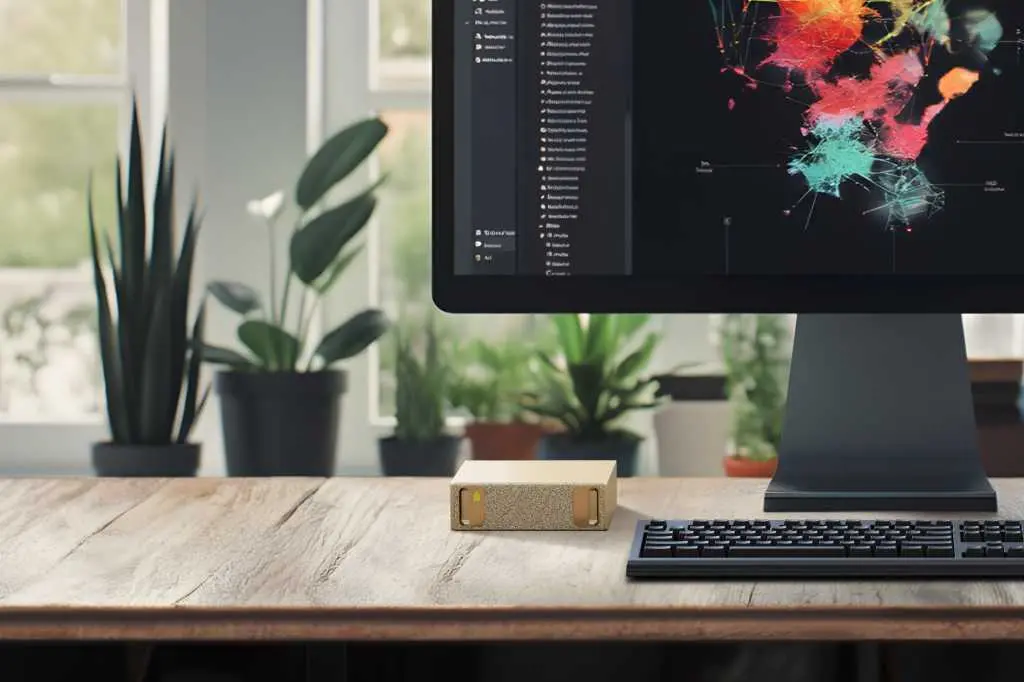
Artificial intelligence has traditionally been associated with giant data centers and racks of specialized servers. Yet a growing slice of AI work can now be handled by the same computers already found on a person's desk or in a home office. Nvidia is betting on that shift with a free software tool that lets users turn multiple PCs into a local AI processing cluster.
The tool, named Nvidia Personal AI Router, or PAIR, is available now as a beta. It can connect computers running Windows, macOS, or Linux that are connected to the same network. Once those systems are linked, PAIR can feed AI inferencing jobs to the machines and collect the results for the user through a single interface. In practice, this means a handful of personal computers can behave as one shared environment for running AI models.
A closer look at PAIR
PAIR is not an attempt to sew multiple graphics cards together into a single piece of virtual hardware. Nvidia was explicit on that point. The software manages workloads at the task level, distributing units of work to different machines on the LAN rather than creating a virtual GPU spanning multiple systems. A job that can be broken into parallel chunks can therefore run across several PCs, while sequential or tightly coupled work may not benefit in the same way.
Because PAIR runs over a private network, data used for inferencing does not have to leave the building to reach a cloud provider. That privacy advantage is likely one of the main attractions for users who work with sensitive code, health-related information, personal documents, or proprietary models. Instead of sending prompts and outputs through an outside API, the local cluster handles the entire interaction.
The systems do not even need to be identical. Nvidia says PAIR works with DGX Spark desktop supercomputers, PCs containing RTX GPUs, and certain MacOS devices. This heterogeneous approach is important because many homes and offices have a mix of hardware. A user might have a high-end Windows desktop downstairs, a MacBook in the bedroom, and a Linux mini-PC in the closet; all three can participate in a cluster, each handling tasks appropriate to its capability.
Where PAIR fits in AI workflows
Inferencing is the stage of AI use when a trained model applies its knowledge to new data. It requires less raw processing power than training, but it still benefits from a good GPU or a specialized accelerator. A local cluster can make efficient use of the hardware that is already sitting partly idle in daily work. During a long rendering job or an overnight batch process, PAIR can feed leftover cycles to latency-sensitive tasks or queue jobs for when systems are free.
That model could be particularly attractive in an office setting. Many companies spend heavily on GPU cloud instances even though employees have capable workstations that are often not fully loaded. Enterprises looking to put idle desktop compute capacity to work could use PAIR as a low-cost way to handle internal AI tools. IT departments can install the software on approved machines and route internal, low-risk inferencing away from public cloud resources. This approach also reduces the volume of data crossing the corporate firewall.
For professional users and prosumers, PAIR can support the growing ecosystem of local AI assistants. Instead of buying a single high-end workstation, a person could combine a less powerful laptop and an older desktop to achieve useful speed. Because Nvidia controls the software stack with broad support from its own GPUs, deeper integration with CUDA-based applications is likely to improve over time.
The hardware that can join
At the high end, Nvidia's DGX Spark serves as a compact desktop supercomputer for researchers and developers. A small deployment could combine a DGX Spark with a handful of RTX-equipped desktops to gain extra throughput for demanding models. On the lower end, laptops with RTX GPUs and Macs with Apple-silicon chips can handle lighter inference chores. PAIR can activate whichever machine is most appropriate for a job, and because it supports multiple operating systems, there are no hard constraints that force a homogeneous environment.
Nvidia has not positioned PAIR as a replacement for enterprise data-center platforms such as AI Enterprise or DGX Cloud. Instead, PAIR belongs to a more personal tier of computing, similar in spirit to the rise of home labs that hobbyists use for virtualization and storage. The software lets users experiment with distributed AI, learn how to split workloads across nodes, and still access familiar desktop interfaces when they need human oversight.
The name Personal AI Router also tells a story about the direction Nvidia sees for AI appliances. A traditional network router directs traffic based on rules and paths. PAIR does something similar for AI inference requests: it looks at a problem, decides which local resource can handle it, and then forwards the work to that resource. This kind of routing intelligence is increasingly valuable as users run multiple models for different tasks.
Security and privacy considerations
Keeping inference jobs on a local network removes the risk of sending data to a centralized service where it could be logged or inspected. For privacy-conscious users, this is a meaningful advantage. However, a local cluster is only as secure as the network it runs on. If an attacker gains access to the LAN, they might be able to intercept prompts or results. PAIR also introduces another vector to consider: an AI job could move from one machine to another, which means an infected computer might spread tainted code to other nodes. Administrators should apply standard security practices, such as segmenting traffic, enabling full-disk encryption, and keeping client software patched.
The beta label is a reminder that PAIR is not yet a mature enterprise product. Users may encounter rough edges, installation quirks, or a smaller list of supported accelerators. Nvidia is likely to use feedback from the beta to stabilize performance, add features, and broaden compatibility. The company has a history of turning nascent experimental tools into full product categories, so the current beta deserves attention even if early deployments are primarily for experimentation.
Why distributed local inference is gaining traction
The trend toward running large language models off-device has not disappeared, but many developers have decided that local execution is essential for certain use cases. Voice assistants, code completion, image editing, and custom support chatbots can run faster and more predictably when user data never leaves the premises. A local cluster also operates without the sustained subscription costs of an API service after the hardware has been bought.
There are limits, of course. A handful of PCs cannot yet run the largest frontier models at high speed. The massive memory footprint of a 400-billion-parameter model will not fit on an RTX gaming card. But many open-weight models are now designed for modest hardware, and new quantization techniques shrink model footprints while retaining a good portion of their quality. PAIR is not intended to replace hyperscale cloud data centers; it is meant to offer a complementary layer for responsive, private, and low-cost inference.
Nvidia's move also highlights a broader industry interest in making AI infrastructure more flexible. Enterprises are already exploring hybrid clouds in which some workloads stay on-site and others go to hyperscalers. PAIR essentially adds a hybrid edge approach to the PC fleet. By allowing a company to unlock value from desktops that are already paid for, Nvidia is not only promoting its GPUs but also encouraging a hardware ecosystem where idle PCs have ongoing jobs.
Who should try PAIR
Home users are the primary audience. People who own several machines can begin experimenting with distributed inference without any extra cost. Developers can test how different models split across devices and identify where performance bottlenecks emerge. Students can learn about scheduling and distributed computing using familiar equipment.
Small businesses may also see an opportunity to run internal AI services on machines that employees already have. Even a modestly sized office with five RTX-based PCs could assemble a useful cluster for document summarization, automated data entry, or code assistance. Larger enterprises may hesitate to rely on beta software, but they can evaluate the platform with non-critical workloads and build experience that will help if Nvidia later introduces enterprise-grade features.
The current beta version of Nvidia PAIR is available for download now. As the user community grows, more tutorials and example configurations are likely to appear, making it easier to build a first cluster. Nvidia is providing the software for free, a sign that the value lies in expanding the reach of its ecosystem rather than in charging for the tool itself.
Source:InfoWorld News