

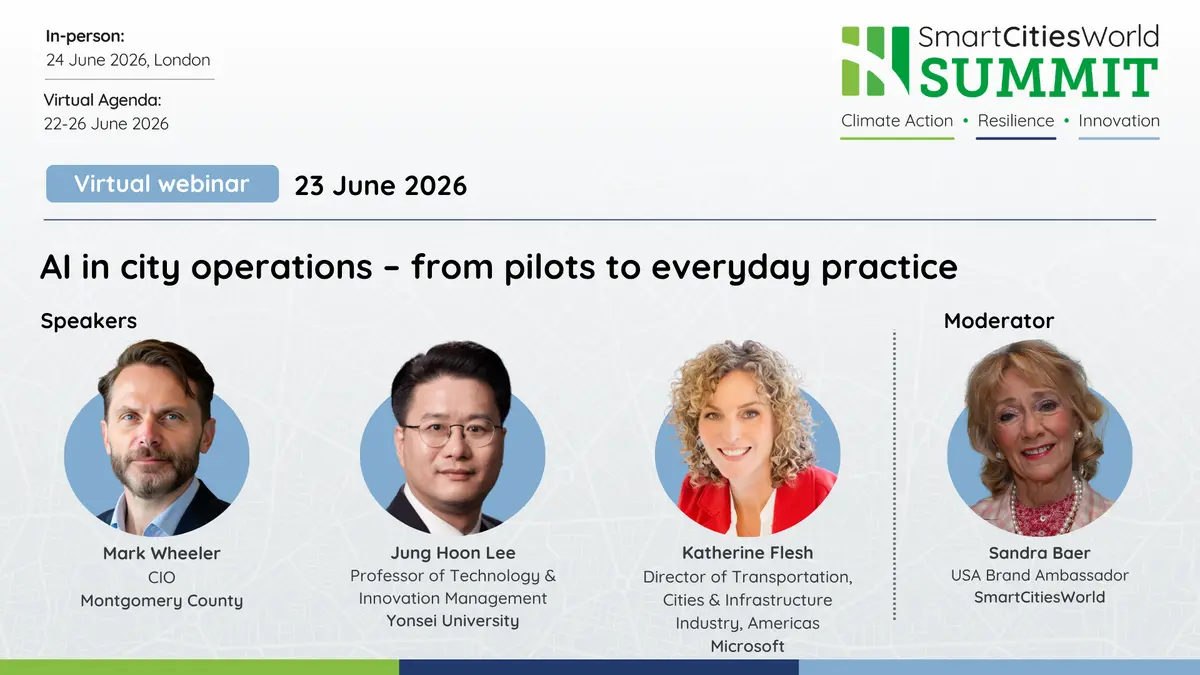
AI in City Operations: The Shift from Experiments to Daily Use
Artificial intelligence is no longer a novelty in urban management. Cities around the world have spent years testing algorithms for traffic signals, waste collection, public safety, and infrastructure maintenance. The next challenge is not proving that AI can work in a controlled pilot. The challenge is making it work every day, across departments, under budget pressure, and within strict rules for privacy, security, and accountability. A recent panel discussion on AI in city operations captured this transition, focusing on how edge computing, computer vision, unified data, and agentic AI can help local authorities turn growing volumes of urban data into smarter, faster decisions and more responsive services.
The context is urgent. Cities are confronting climate change, aging infrastructure, population growth, and the need to digitize services without losing public trust. The same technologies that promise efficiency can also create new risks if they are deployed without governance. The panel discussion therefore explored not only what AI can do, but also what foundations cities need before they can scale it. Those foundations include secure digital infrastructure, interoperable data platforms, and a workforce that understands how to use AI as a decision-support tool rather than a black box.
Why Pilots Stall and What Everyday Practice Requires
Many city AI projects remain in pilot purgatory. A traffic camera trial may show promising results, but it is never integrated into the traffic management center. A predictive maintenance model may identify failing water pipes, but work orders are still generated manually. A chatbot may answer common questions, but it is not connected to the case management system. These gaps are rarely about the AI model itself. They are about process, data, procurement, and organizational change.
To move from pilots to everyday practice, cities need to treat AI as part of the operating model. That means redesigning workflows around AI insights, training staff to interpret and challenge outputs, and establishing clear escalation paths when AI gets something wrong. It also means measuring outcomes that matter to residents: shorter commute times, cleaner streets, faster permits, lower energy bills, and more reliable public services. Without this operational discipline, AI remains a demonstration rather than a capability.
Another barrier is fragmentation. Data often sits in silos owned by different departments, each with its own format, refresh rate, and legal constraints. Computer vision and edge computing can generate rich data, but that data is only useful if it can be combined with other sources. A city might have real-time video of a busy intersection, but without transit schedules, weather data, and incident reports, it cannot optimize traffic flow effectively. Unified data is therefore not a technical luxury. It is a prerequisite for everyday AI.
Edge Computing and Computer Vision at the Curb
Edge computing brings processing power closer to where data is created. Instead of sending every video frame to a central cloud, cities can analyze data on devices or local servers. This reduces latency, lowers bandwidth costs, and can improve privacy because raw footage does not need to leave the camera. For city operations, edge computing enables faster responses. A computer vision model running at the edge can detect a blocked bus lane, a fallen tree, or a dangerous crowd buildup in seconds. The system can then alert the right team or adjust a signal automatically.
Computer vision is already being used for a wide range of urban tasks. It can identify potholes and cracks in roads, count pedestrians and cyclists, detect illegal dumping, monitor parking violations, and inspect infrastructure such as bridges and streetlights. In public safety, it can help identify anomalies, though cities must balance security benefits with civil liberties. The key is to define narrow, transparent use cases with strict data retention rules. When deployed responsibly, computer vision can give cities a continuous awareness of conditions on the ground, allowing them to shift from reactive repairs to preventive maintenance.
Edge computing also supports resilience. If a network connection goes down, local devices can continue to operate and store critical alerts. That matters for emergency response, where every second counts. However, edge devices must be managed securely. Each camera, sensor, and gateway is a potential entry point for cyberattacks. Cities need device identity, encryption, firmware updates, and monitoring as part of their AI strategy. Without these controls, scaling edge AI increases risk instead of reducing it.
Unified Data and Agentic AI for Workforce Decisions
Unified data platforms bring together information from sensors, cameras, permits, 311 systems, utilities, transit, and social services. When data is clean, documented, and accessible through APIs, AI can reason across domains. A city can see how a new bike lane affects traffic, parking demand, and air quality. It can predict which neighborhoods are most vulnerable to heatwaves and direct resources accordingly. It can also give frontline workers a single view of a problem rather than forcing them to check multiple systems.
Agentic AI takes this further. Unlike a simple chatbot, an agentic system can pursue a goal across multiple steps. It might receive a report of a water leak, check asset records, schedule an inspection, notify affected residents, and generate a work order. It could optimize waste collection routes based on traffic, weather, and bin fill levels. It could help a planner draft a climate resilience plan by pulling together data on flooding, heat, and vulnerable populations. The promise is not that AI replaces human judgment. The promise is that AI handles routine coordination so that people can focus on complex decisions.
But agentic AI requires guardrails. Cities must define what decisions AI can make autonomously and what requires human approval. They need audit trails, explainability, and the ability to override or shut down a system. They also need to address bias. If training data reflects historical inequities, AI may reinforce them. For example, if past enforcement focused on certain neighborhoods, predictive policing could perpetuate that pattern. Good governance means testing for disparate impact and involving community stakeholders in design and oversight.
Secure Digital Foundations and the AI Super Gap
Secure digital foundations are the bedrock of scaled urban AI. That includes zero-trust security, identity and access management, data encryption, privacy-enhancing technologies, and resilient cloud and edge infrastructure. It also includes procurement rules that require vendors to meet security and interoperability standards. Cities cannot afford a patchwork of proprietary systems that cannot talk to one another. Open standards and modular architectures help cities avoid lock-in and adapt as technology changes.
The Global Smart City Index has highlighted an emerging AI super gap between cities. Some cities have the data platforms, talent, and governance to move quickly. Others risk falling further behind. The gap is not only about wealth. It is also about political will, institutional capacity, and the ability to coordinate across agencies. Cities that invest in AI-ready infrastructure and digital skills can attract investment and improve services. Cities that do not may find themselves dependent on vendors and unable to control their own data.
Closing the gap requires deliberate action. Smaller cities can share platforms, pool procurement, and partner with universities and regional governments. National governments can set standards, fund foundational infrastructure, and support workforce training. International cooperation can help spread best practices. The goal should be a two-tier urban future where only a few cities benefit from AI. Instead, AI should help all cities deliver better services, reduce emissions, and become more resilient.
Global Examples: Malaysia, Singapore, and Sunderland
Several cities and regions are showing what this looks like in practice. Malaysia is positioning itself as a leader in AI-powered urban innovation, with Kuala Lumpur hosting the first Southeast Asian smart city expo. The event brought together policymakers, technology providers, and urban planners to explore how AI can improve mobility, energy, public safety, and service delivery. Malaysia's approach combines national digital strategy with local experimentation, reflecting a broader trend in Southeast Asia where rapid urbanization and digital adoption are happening at the same time.
Singapore continues to build its reputation as one of the smartest nations in the world. Its city profile highlights long-term investment in digital twins, sensor networks, open data, and smart nation initiatives. Singapore uses AI for traffic management, energy optimization, water management, and public health. It also invests heavily in cybersecurity and governance, recognizing that trust is essential for adoption. The city-state's experience shows that smart city success is not about technology alone. It is about sustained political commitment, strong institutions, and a culture of continuous improvement.
Sunderland offers a different but equally instructive example. The city is repositioning itself as a leading smart city by using digital infrastructure and low-carbon innovation to build a resilient, future-focused economy. Its efforts include smart mobility, digital skills, and sustainable energy projects. Sunderland demonstrates that industrial cities can reinvent themselves through technology and sustainability, provided they align investment with local economic strengths and community needs.
Energy Transition, Buildings, and Unlocking Value
The energy transition is another area where AI and data are changing city operations. Cities are moving from being passive consumers of energy to system leaders who coordinate generation, storage, and demand. AI can optimize building energy use, integrate rooftop solar and batteries, manage electric vehicle charging, and shift demand to times when renewable energy is abundant. This helps reduce costs and emissions while improving grid stability.
Buildings are central to this shift. They consume large amounts of energy and produce significant emissions. By combining building data with AI, cities and building owners can unlock value: predictive maintenance, occupancy-based heating and cooling, fault detection, and automated demand response. A panel discussion on unlocking value from buildings, data, and AI explored how real-time data can turn buildings into flexible assets that support the grid rather than strain it. The same data can improve comfort, health, and productivity for occupants.
Smart sensor networks extend these benefits indoors. Sensors can detect risks early, such as poor air quality, water leaks, fire hazards, or structural movement. They improve situational awareness for facility managers and emergency responders. They also support healthier, more secure, and sustainable buildings. During a pandemic or wildfire smoke event, sensor data can help adjust ventilation and filtration. In an emergency, it can guide evacuations. As cities face more extreme weather and health threats, indoor environmental monitoring becomes part of urban resilience.
How Urban AI Applications Will Evolve
Industry leaders expect urban AI applications to evolve quickly. According to an urban solutions executive, AI is already making a significant impact in projects ranging from traffic management to infrastructure inspection. The next phase will see AI become more embedded in daily operations, with less emphasis on dashboards and more emphasis on automated workflows. AI will increasingly work in the background, coordinating systems and surfacing only the exceptions that require human attention.
This evolution depends on data platforms, AI-ready infrastructure, and effective governance. Cities that master these elements will be able to scale successful pilots and avoid the trap of endless experimentation. They will also be better positioned to manage cybersecurity threats, protect privacy, and ensure that AI benefits all residents. The transition from pilots to everyday practice is not a single project. It is a continuous process of learning, adapting, and improving. As cities prepare for the next wave of AI adoption, the focus is shifting from experimentation to operational discipline, with procurement, governance, and workforce readiness increasingly determining which cities can deliver results at scale.
Source:Smart Cities World News