

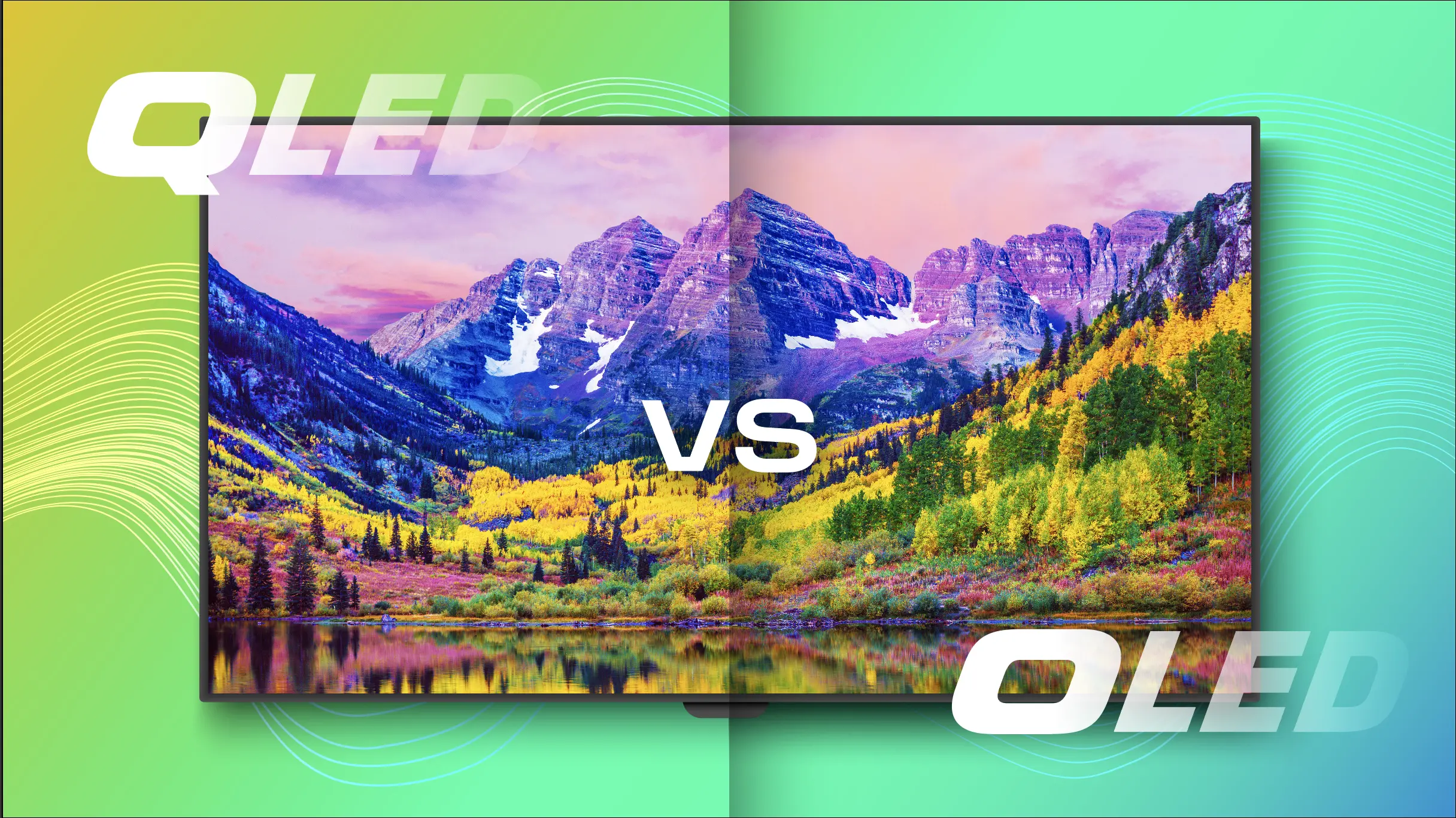
If you’re buying a new TV, the acronyms QLED and OLED are impossible to ignore. They describe two different display technologies with distinct strengths and weaknesses. Choosing between them depends on your budget, room lighting, and picture-quality priorities. This explainer covers the technical differences, performance trade-offs, and real-world factors to help you decide.
Both QLED and OLED TVs are widely available from major manufacturers. Samsung and TCL are the biggest promoters of QLED, while LG, Sony, and Panasonic sell OLED TVs. Samsung also sells both QLED and OLED models, which adds to the confusion. Understanding what each term actually means is the first step toward making an informed purchase.
QLED vs. OLED: Quick summary
- OLED stands for organic light-emitting diode.
- QLED stands for quantum dot LED TV.
- OLED is an emissive technology: every pixel produces its own light and turns off independently.
- QLED is a transmissive LCD technology: an LED backlight shines through a quantum dot layer and an LCD panel.
- QLED can be brighter and is available in more screen sizes, while OLED offers perfect black levels and better off-angle viewing.
What is QLED?
QLED is not a fundamentally new display type. It is a variation of LCD, also called LED TV, that uses quantum dots to improve color and brightness. Quantum dots are microscopic semiconductor particles that absorb light and re-emit it at different wavelengths. In most QLED panels, blue LEDs supply the light, which then passes through a quantum dot film that converts part of that light into red and green. The resulting white light is richer and wider in color than the light from a conventional LED backlight.
Samsung has used quantum dots in its high-end LCD TVs since 2015 and adopted the QLED brand in 2017. TCL, another major TV maker, also produces QLED models and was the first to deploy Super Quantum Dots. Other companies, including Vizio and Hisense, use quantum dots in some LCD TVs but do not always brand them as QLED. Regardless of the name, the underlying structure remains an LCD panel that relies on a backlight.
Because QLED is transmissive, the backlight must be controlled in zones to produce dark scenes. High-end QLED TVs use full-array local dimming or mini-LED backlights to reduce light bleed and improve contrast. These features have helped QLED models approach OLED performance, but the technology cannot completely turn off individual pixels. In dark rooms, the difference between QLED and OLED black levels is still visible.
What is OLED?
OLED is a completely different technology from LCD. Each pixel is made of organic compounds that emit light when electric current flows through them. That means OLED does not need a backlight at all. The emissive nature of OLED provides several advantages, including perfect black levels, infinite contrast, uniform screens, and extremely thin panels.
LG Display has been the leading producer of OLED TV panels, and most OLED TVs on the market use LG’s WOLED panels. Samsung entered the OLED TV panel market in 2022 with QD-OLED, which combines a blue OLED layer with a quantum dot color conversion layer to achieve wider color gamut and higher color brightness. Sony, Panasonic, Philips, and other brands sell OLED TVs built on these panels.
OLED panels have also become significantly brighter over time. Newer iterations use multiple stacked emissive layers to increase luminance without sacrificing the technology’s inherent contrast advantage. Despite these gains, OLED still cannot match the absolute peak brightness of the brightest QLED/LCD TVs, but its black-level advantage makes HDR content look exceptionally vivid and three-dimensional.
Quantum dots: the link between QLED and OLED
Quantum dots play a role in both technologies, but in different ways. In QLED, quantum dots are embedded in a film or an enhancement layer within an LCD panel. They transform the emission spectrum of the LED backlight to produce brighter, purer colors. In QD-OLED, quantum dots convert the blue light from an OLED pixel into red and green. This direct approach allows the display to produce color without a color filter, increasing efficiency and color purity.
Picture quality: QLED vs. OLED
The picture quality battle between QLED and OLED comes down to several key factors. No single metric determines the best display; room lighting, content type, and personal preference all matter.
Contrast and black levels
OLED is the undisputed winner in contrast. Since OLED pixels can switch off completely, black areas are truly black, resulting in infinite contrast. This makes dark scenes in movies and games look far more realistic. QLED relies on local dimming to suppress backlight output in dark regions. The best QLED TVs, such as TCL’s flagship QM8K with Halo Control technology, narrow the gap substantially, but they can still show halos or blooming around bright objects on black backgrounds.
Brightness
QLED has an edge in raw luminance. LED backlights can generate higher peak brightness than OLED, especially in small highlights. This makes QLED a strong choice for sunny living rooms and for HDR content that demands impactful highlights. However, the latest OLED models are much brighter than earlier generations, and in most rooms they deliver plenty of brightness while retaining superior contrast. In side-by-side tests, many viewers prefer the HDR image quality of OLED despite lower numeric brightness.
Viewing angles and uniformity
OLED panels maintain color and brightness at almost any viewing angle. QLED/LCD panels typically suffer from color shift and contrast loss when viewed from the side. High-end QLED models use wide-angle filters or advanced polarizers to reduce off-axis degradation, but they still cannot match OLED’s consistency across the screen. OLED also has better screen uniformity, with no backlight bleed, clouding, or vignetting.
Color and processing
Both QLED and OLED can produce accurate and vivid colors. QLED uses quantum dots to achieve high color volume, while QD-OLED and modern WOLED panels also offer excellent color performance. Video processing, motion handling, and upscaling vary more by brand than by panel type. Neither technology has a universal advantage in these areas, so it is worth reading reviews that measure input lag, motion resolution, and color accuracy for specific models.
Sizes and prices
QLED/LCD TVs are produced in a much larger range of sizes than OLED. Common QLED sizes include 32, 43, 50, 55, 58, 65, 75, 82, 85, 98, 100, and 115 inches. OLED sizes currently include 42, 48, 55, 65, 77, 83, 88, and 97 inches. If you want a particularly small set or a massive screen without spending a fortune, QLED is likely the better option.
Price is another important factor. OLED panels are more expensive to manufacture, so OLED TVs cost more than QLED TVs at the same size, especially above 65 inches. A 77-inch OLED typically costs more than a 75-inch QLED, and premium 83- and 97-inch OLEDs carry a significant premium. QLED prices, meanwhile, continue to fall as production scales. Large QLED TVs are among the best value options for home theaters.
Burn-in: a real but manageable concern
Burn-in occurs when static images, such as network logos, scoreboards, or video game heads-up displays, leave a permanent ghost on the screen. OLED displays are more vulnerable to burn-in than LCD/LED displays, including QLED, because each OLED pixel degrades at a different rate depending on how heavily it is used. Prolonged exposure to high-brightness static elements can create uneven wear that is visible in normal content.
Modern OLED TVs include features like pixel shifting, logo brightness limiting, and screen cleaning cycles to reduce burn-in risk. For most viewers who watch varied content, burn-in is not a practical problem. However, if you plan to use the TV primarily as a monitor for a computer desktop or watch a single news network for many hours a day, QLED is a safer choice.
The future of QLED and OLED
TV technology continues to evolve. Samsung is researching direct-view quantum dot displays, also called electroluminescent quantum dots, which would eliminate the LCD layer and allow quantum dots to emit light directly. This type of emissive QLED could match OLED’s black levels while delivering higher brightness and better color efficiency. It may be several years before such products reach stores.
MicroLED is another emissive technology that uses microscopic LEDs as individual pixels. It promises the infinite contrast of OLED, no burn-in risk, and extremely high brightness. However, MicroLED TVs are currently very expensive, with some large models costing more than $1 million. As manufacturing improves, MicroLED or electroluminescent QLED could eventually become the premium display of choice, but for now OLED remains the standard for picture quality.
Frequently asked questions
Is OLED or QLED better?
For picture quality in a dark or moderately lit room, OLED is generally better due to its perfect black levels, wide viewing angles, and uniform screen. QLED is better for bright rooms because it can get much brighter. Ultimately, the best choice depends on your usage and the specific model you are considering. Both technologies appear on lists of recommended TVs because each offers models with strong performance, and your personal priorities should guide your decision.
What is the lifespan of an OLED vs. QLED TV?
Manufacturers rarely specify an exact lifespan, but most modern TVs can last at least five years and many last much longer. OLED panels are more susceptible to burn-in over time, but they are not plagued with short lifetimes. QLED/LCD TVs are generally more durable in that regard. Overall, a TV’s lifespan depends on usage, room environment, and build quality. In any case, TV prices tend to fall steadily, so future replacements are likely to offer more features for less money.
Source:CNET News