

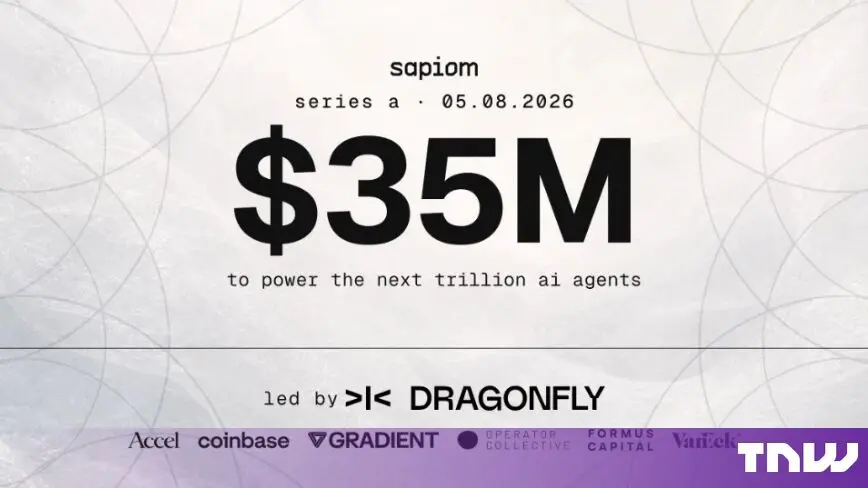
San Francisco-based Sapiom has raised $35 million in a Series A round to continue building the cost-saving layer between AI agents and the language models they depend on. Dragonfly led the round, with participation from Anthropic, Okta Ventures, Menlo Ventures, and Array Ventures. The fresh capital comes 11 months after the startup was founded, and six months after a $15 million seed round led by Accel. Sapiom has now raised $50 million in total.
The startup’s pitch is narrow and timely: make AI agents cheaper to run. When an agent performs a task, Sapiom sits in the middle and decides which model, tool, or service should handle the request. It enforces a budget before money is spent, and its Router sends each call to the cheapest capable model instead of defaulting to the most expensive frontier system. Since the platform launched six months ago, it has processed more than 270 million transactions.
The core problem Sapiom addresses is common across the AI industry. Agents are no longer single prompts. They chain together multiple steps, call external tools, retrieve data, and often run for hours or days. Each step can trigger a paid API call, and costs multiply quickly. For many companies, the gap between a successful proof-of-concept and a production deployment is not model quality but spend. Sapiom is one of a growing group of startups trying to close that gap with smart routing, governance, and infrastructure.
The bill that made the case
The most striking evidence for Sapiom’s approach comes from a customer called Polsia. Polsia is an AI startup that employs no people in the traditional sense. Instead, it runs swarms of agents that help operate other businesses. According to reporting around the company, Polsia’s projected revenue jumped from $100,000 to $10 million in a year. But its token bill climbed just as fast, eventually reaching $1.2 million per month on Anthropic’s models. Sapiom ran a series of evaluations, and the monthly bill fell roughly tenfold, to about $100,000.
“It’s just unsustainable,” Ilan Zerbib, Sapiom’s founder, said in an interview. He argued that startups cannot deploy at the prices frontier labs charge, even when product-market fit and demand are clearly there. The Polsia example illustrates an important dynamic: revenue growth can be real while unit economics remain broken. If an AI company spends a million dollars a month on tokens, it needs enormous margins to survive. Cutting that bill by 90% changes the entire business model.
An investor with a complicated interest
There is an awkward part to the funding story. Anthropic, one of the companies whose tokens Sapiom helps save, is also an investor in Sapiom, returning for the Series A alongside Dragonfly, Okta Ventures, Menlo Ventures, and Array Ventures. In other words, a model maker is helping to fund a startup whose product reduces how much companies spend on model makers.
Zerbib frames the relationship as aligned rather than adversarial. Cheaper inference allows companies to build more agents, and some of that additional work will still require the most powerful models. The hope is that reducing waste on simple requests frees budget for the hard tasks where frontier models genuinely matter. In that sense, the model lab is betting on the growth of the overall agent economy, not just on every individual token being expensive.
This kind of strategic investment is not unusual in infrastructure. Cloud providers sometimes invest in FinOps startups that help customers cut their cloud bills. The logic is that cost optimization eventually leads to more usage. If a company can double its agent deployment because unit costs fall, the strongest models still capture some of the upside.
Cost is the new constraint
Sapiom is riding a broader shift in how companies talk about AI. After an initial wave of enthusiasm, corporate buyers are now focused on returns. Gartner forecasts that companies will cancel more than 40% of agentic AI projects by the end of 2027. Escalating costs are among the leading reasons. Corporate AI budgets are getting their first hard audit, and some firms have already begun capping what staff can spend on AI tools.
Survey evidence supports this skepticism. In June, KPMG surveyed 2,100 executives and found that only 7% could name established returns from their AI investments. That kind of statistic makes CFOs nervous. When a technology is expected to drive productivity but the bills arrive faster than the profits, finance teams start looking for controls.
Zerbib believes the number of agents is about to explode. He told an interviewer that there are tens of millions of software developers and that “we’re talking about trillions of agents that will operate in the economy in the next three years.” His central argument is that most of that work does not need a frontier model. “In 95% of cases, it doesn’t make sense to go to a very expensive frontier model,” he said.
That claim is supported by the current behavior of many US firms. Companies are already swapping frontier models for cheaper alternatives to control spend. Small tasks like summarizing emails, classifying tickets, or extracting structured data can often be handled by smaller, open-weight models. The challenge is knowing when a cheap model is enough and when a more expensive model will save time or avoid errors.
Sapiom’s platform tries to answer that question automatically. It uses evaluations to test different models on a customer’s real workloads, then sets routing policies based on accuracy, latency, and cost. The budget controls act as a guardrail: even if an agent goes off script, it cannot spend more than the limit set by the organization.
A crowded toll booth
Sapiom’s Router puts it in direct competition with OpenRouter, the best-known name in model routing. But Sapiom argues that its real difference is the infrastructure underneath. Rather than serving as a pure middleman, Sapiom serves open-weight models from its own racks in a San Jose data centre. It charges for compute directly instead of adding a markup to someone else’s API. This vertical ownership gives it more control over cost, latency, and reliability.
Haseeb Qureshi, a Dragonfly partner who is joining Sapiom’s board, called the gap an infrastructure problem rather than a dashboard problem. “Agents are becoming employees with no manager and no budget,” he said, “and increasingly, the CTO is the one acting as CFO, allocating real money with no visibility into where it goes.” The point is that tools like Sapiom are not just about model selection. They are about giving engineering and finance teams a way to manage agents as a real cost center.
That edge may not last. Routing is starting to look like a commodity. Amazon and Microsoft now bundle model routing into Bedrock and Azure. Open-source routers are free, and OpenRouter alone moves around 25 trillion tokens a week. One market tracker counts 80 active routing competitors. The barrier to entry for a simple router is low, and many providers can claim to reduce costs with aggressive caching or model fallbacks.
What might separate the winners is the infrastructure Sapiom owns. Running open-weight models in its own data centre means the company can deliver margins that pure API resellers cannot. It also allows tighter integration between the router and the inference engine, enabling faster rerouting based on live performance.
Sapiom is one of a wave of startups selling agent infrastructure to investors this year. The market is still early, and customer needs are shifting quickly. Companies are moving from experimental chatbots to production agents that handle real workflows, and with that transition comes a need for controls, observability, and cost governance.
The opportunity is real: if the number of agents does grow to billions or trillions, the financial plumbing around them will be valuable. At the same time, the competition is intense and the technology is easily copied. Sapiom is betting that what it owns underneath—the inference, the evaluation engine, and the budget controls—will make the difference between a feature and a company. That, in the end, is the bet behind its $50 million in total funding.
Source:TNW | Investors-funding News