

AI Image Generators 2026: Google's Nano Banana Pro Dominates Test
Generative AI has come a long way since early 2023, when the first wave of tools amazed users with their ability to write coherent text and produce photorealistic images. Three years later, the landscape is crowded with specialized services, each promising studio-quality output. But which paid AI image generator is actually worth a subscription? A rigorous new test of six popular tools has produced a surprising but decisive answer.
The test evaluated Google's Nano Banana Pro (part of Gemini 3), ChatGPT's image generator, Midjourney, Adobe Firefly, Leonardo AI, and Canva's internal image generator. Each tool was given the same nine challenging prompts, covering photo recontextualization, restoration, colorization, logo design, fantasy art, social media graphics, and pop culture references. More than 50 images were generated, and each was scored across 30 individual criteria, producing an aggregate percentage. The results reveal a stark gap between the leader and the rest.
Key Facts
- Google's Nano Banana Pro earned a near-perfect score of 93%.
- ChatGPT ranked second with 74%.
- Midjourney scored 57%, Adobe Firefly 54%, Leonardo AI 52%, and Canva 43%.
- Nine tough prompts tested photo recontextualization, restoration, original images, text rendering, and pop culture.
- All six tools performed well on logo creation, but most struggled with text and faces.
- The winner costs $19.99 per month as part of Google AI Pro, while ChatGPT Plus is $20 per month.
The State of AI Image Generation in 2026
When generative AI first hit the scene, the ability to create images from text seemed almost magical. Early models produced surreal, often flawed results, with mangled hands, nonsensical text, and inconsistent lighting. By 2026, the technology has matured significantly. Some models can now generate photorealistic portraits, accurately render complex text, and even perform sophisticated photo editing tasks like recontextualization and colorization.
However, not all tools are created equal. The market has segmented into specialized niches: Midjourney excels at hyper-creative cinematic imagery, Adobe Firefly prioritizes commercial-safe content, Leonardo AI focuses on fantasy art, and Canva integrates AI directly into marketing design workflows. Google's Nano Banana Pro, by contrast, aims to be a general-purpose powerhouse. The test results suggest it has succeeded.
Testing Methodology
To ensure a fair comparison, the same nine prompts were fed to each of the six AI image generators. All images were generated in a 1:1 square ratio for easy side-by-side comparison. The prompts were designed to probe a wide range of capabilities:
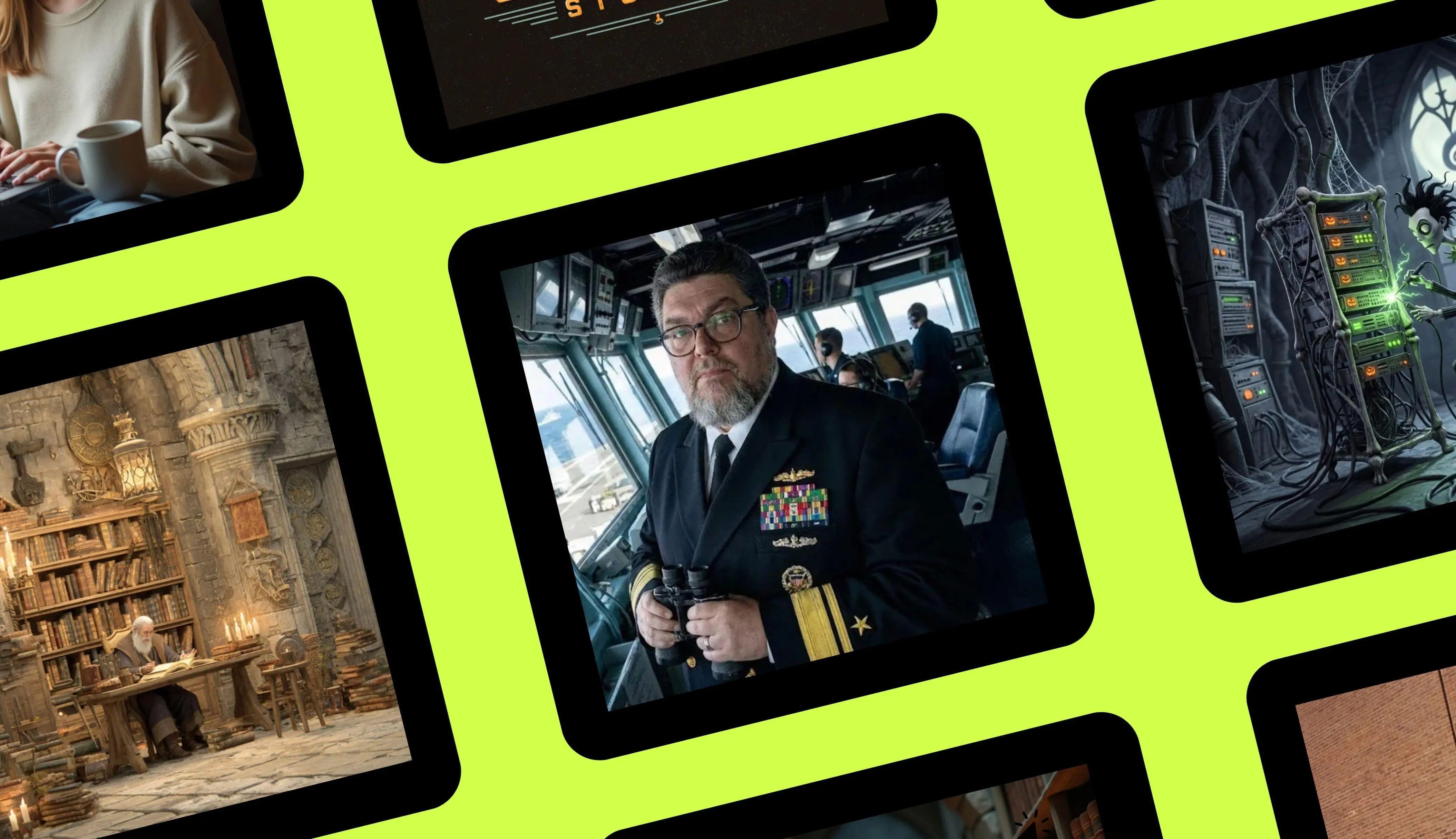
- Admiral photo recontextualization: Dress a man in a US Navy admiral's uniform on the bridge of an aircraft carrier without changing his face.
- Restore black and white image: Restore an old black and white photograph to look like a modern, high-quality studio image, repairing scratches and improving clarity.
- Restore and colorize black and white image: Restore an old truck photo, remove damage, and convert to realistic color while preserving original text.
- Create a logo: Design a retro-futuristic logo for a video studio named 'Space Coast Studios'.
- Fantasy librarian: Create a fantasy scene of a medieval librarian in a candlelit stone library.
- Studio portrait of a senior adult: Create a photorealistic portrait of a stylish senior wearing glasses, holding a flagship smartphone, with Facebook-style ad copy.
- Candid portrait of a student: Create a natural portrait of a student using a MacBook Pro next to a cup of coffee, with lifestyle copy.
- 'Back to the Future' poster: Create a poster for a fourth Back to the Future movie set in 1920s New York City.
- 'Nightmare Before Christmas'-style IT person: Generate an IT professional in a data center in the style of Tim Burton.
Points were awarded for accuracy, creativity, text rendering, facial preservation, and adherence to the prompt. Deductions were made for errors, refusals, or bizarre artifacts.
Google Gemini 3 Nano Banana Pro: The Clear Winner
Overall score: 93% | Cost: $19.99/mo as part of Google AI Pro
Nano Banana Pro did not just win; it dominated. It aced nearly every test, with only minor deductions for a watermark and one instance of misinterpretation. In the admiral recontextualization test, it kept the subject's face and glasses, changed the angle he was facing, placed him properly on the bridge of a ship, and even added binoculars to his hands. The result was convincing, though the model had to contend with the fact that real Navy personnel typically do not have beards.
Photo cleanup was equally impressive. Given a dark, old photo of a child standing on a submarine, Nano Banana Pro produced a dramatically clearer image while preserving facial features. For the truck colorization test, it initially confused the prompt with a previous image, but when given a fresh session, it delivered a mostly accurate restoration. The lettering on the truck was largely readable, though it rendered 'RADIOLOGICAL DEFENSE' as 'BADICLOGICAL DEFEKSE', costing a few points.
Creative generation was where Nano Banana Pro truly shone. The Space Coast Studios logo included a palm tree, a rocket, film elements, and clean text. The medieval librarian image featured abundant candles, candlelight, and stone walls. For social media, it generated a senior adult holding what was clearly an iPhone, with perfectly placed text, and a student in a cozy setting with a MacBook Pro and coffee. Text was error-free and integrated cleanly.
Pop culture prompts were handled with surprising sophistication. For a fictional fourth Back to the Future movie set in 1920s New York, Nano Banana Pro produced a poster with a DeLorean, a skateboard, period clothing for Marty, and text that evoked the original logo style. It placed 'New York City 1925' on a marquee and added the tagline 'The Roaring Twenties Got Heavy'. The Nightmare Before Christmas-style IT professional also captured the Tim Burton aesthetic. Aside from the watermark and one session issue, the model made no significant errors.
ChatGPT: Best for Natural-Language Iteration
Overall score: 74% | Cost: $20/mo as part of ChatGPT Plus
ChatGPT's image generator, now updated with the ChatGPT Images feature, placed second but trailed far behind. In the admiral test, it produced a good facial likeness but struggled with the uniform's rank insignia, which appeared to be a strange cross between a Lieutenant and an O-8 Admiral. The child photo restoration was good, preserving the original face. However, photo retouching is not a
Source:ZDNET News