

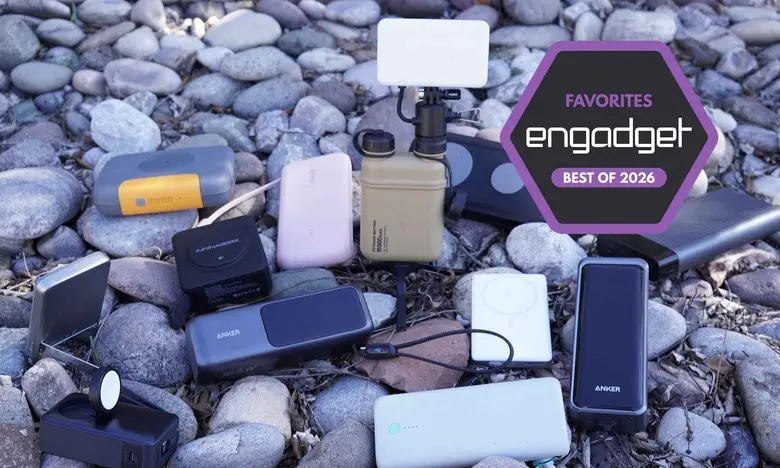
Finding yourself far from a wall socket when your phone hits five percent is positively nervewracking. If you stash a portable battery in your bag, you can avoid that feeling altogether. But there are thousands of power banks out there and it can be tough to pick the right one for what you need. We've spent years testing dozens of batteries and found the best power banks for different scenarios. Whether you need a quick reup for your phone or a huge brick to keep your laptop alive, you'll find something fitting here.
Best power banks for 2026
Our top recommendations cover a range of needs, including MagSafe-compatible wireless chargers, compact emergency batteries, and high-capacity units for laptops and multi-device charging. Each pick is based on hands-on testing with real devices, measuring charge times, capacity, and usability.
Best MagSafe power bank: Anker MagGo Power Bank (10K)
- Capacity: 10,000mAh
- Maximum Output: 15W (wireless)
- Ports: One USB-C in/out
- Included cable: USB-C to USB-C
- Number of charges iPhone 15: 1.64
- Charge time iPhone: 4 to 100% in 2h 26m, 0 to 70% in 1h 8m
- Weight: 8.82 oz
- Dimensions: 4.22 x 2.71 x 0.78 in
Anker's MagGo Power Bank was one of the first Qi2-certified products on the market, and the new standard makes this popular MagSafe/kickstand model much faster. It is the most well-rounded MagSafe battery we've tested. In our tests, it brought an iPhone 15 from near-dead to half-full in about 45 minutes, significantly faster than previous models. It also has a strong magnetic connection and a built-in kickstand, making it easy to use your phone while it charges or prop it up for video watching. An LED display shows the remaining battery percentage and estimated charge or discharge time.
The power bank also charges Android phones like the Galaxy S23 Ultra, though those without Qi2 won't get the faster wireless speeds. Newer Pixel 10 phones do support Qi2, so they benefit from magnetic alignment and faster charging. A USB-C port is also available for wired charging of non-Qi2 devices.
Pros
- Qi2 tech enables extra fast wireless charging
- Sturdy kickstand props up iPhones as it charges
- LED display for battery percentage
Cons
- More expensive than other MagSafe packs
Best portable charger for Android: Anker Nano Battery (Foldable USB-C)
- Capacity: 5,000 mAh
- Maximum Output: 22.5W
- Ports: One USB-C and one USB-C connector
- Cable: USB-C to USB-C
- Number of charges Galaxy S23 Ultra: 0.65
- Charge time: 0 to 65% in 1h 2m
- Weight: 3.5 oz
- Dimensions: 3.03 x 1.45 x 0.98 in
The Anker Nano power bank delivers impressive power for its size. It's shaped like a lipstick case and features a built-in USB-C connector that folds down when not in use, so you don't need to carry a separate cable. There's also a built-in USB-C port for refilling the battery or charging another device. Four indicator lights show the remaining charge.
In testing, the 5,000mAh battery got a depleted Galaxy S23 Ultra back to 65 percent in about an hour. It's small enough to use your phone while charging without feeling awkward, making it a great companion for earbuds or a quick phone boost. For a bit more capacity, the Anker 30W Nano Power Bank offers 10,000mAh and a built-in USB-C cable that doubles as a handle.
Pros
- Very portable
- Affordable
Cons
- Small enough to get misplaced
Best low-capacity power bank: Anker 10K Fusion
- Capacity: 10,000mAh
- Maximum Output: 30W
- Ports: One USB-C in/out port, one USB-C in/out cable, wall prongs
- Cable: Built-in USB-C
- Number of charges iPhone 15: 1.86
- Charge time iPhone: 5 to 100% in 1h 53m, 5 to 91% in 1h 5m
- Number of charges Galaxy S23 Ultra: 1.45
- Charge time Galaxy: 5 to 100% in 1h 2m, 5 to 50% in 23m
- Weight: 8.8 oz
- Dimensions: 4.25 x 2.0 x 1.22 in
The Anker 10K Fusion solves two common problems: remembering a cable and a wall adapter. It has an attached USB-C cable for your gadget and foldable wall prongs for recharging the battery itself. Despite the extra attachments, it remains compact, slightly wider than a stick of butter. The 30W output enables fast charging on many Android phones, getting a Galaxy S23 from five percent to full in just over an hour. It also gave an iPhone 15 a significant boost in just 20 minutes.
There's an additional USB-C port for devices that need a separate cable, and both that port and the built-in cable can be used to refill the bank. The onboard display shows the remaining charge percentage accurately, and the corduroy texture adds a nice grip. The previous pick in this category, the BioLite Charge 40 PD, remains durable and quick, but the Anker 10K Fusion offers faster charging and more features at a lower price.
Pros
- Has a built-in USB-C cable
- Also has built-in wall prongs
- Display is fairly accurate
- Affordable
Cons
- iPhone charging is slower than other banks in its range
Best medium capacity power bank: Belkin BoostCharge 20K with Integrated Cable
- Capacity: 20,000mAh
- Maximum output: 30W
- Ports: One built-in USB-C in/out cable, one USB-A port, one USB-C port
- Cable: USB-C
- Number of charges iPhone 15: 3 – 3.5
- Charge time iPhone: 5 to 100% in 2h 6m
- Number of charges Galaxy S23 Ultra: 2.5 – 3
- Charge time S23 Ultra: 1h 15m
- Weight: 14 oz
- Dimensions: 6.06 x 3.0 x 0.99 in
Integrated cables are becoming a popular feature in portable chargers, and the Belkin BoostCharge 20K is one of the most affordable options. It can output 30W, which is not the fastest but still solid. It charged a Galaxy S24 Ultra from near-dead to full in 75 minutes and brought an iPhone 15 from five to 87 percent in just over an hour. The 20,000mAh capacity means you can get those results about three times over.
The built-in USB-C cable is magnetized for easy storage, and there are two additional ports: a USB-A and a USB-C. You can charge three devices simultaneously, though speeds will drop. There's no digital display, just four LED indicators, which are accurate. The BoostCharge 20K comes in blue, pink, white, and black, with a matte finish that resists smudges.
Pros
- Built-in USB-C cable is handy
- Comes in four color options
- Affordable
- Great capacity for the price
Cons
- Charge isn't as fast as other banks
Best medium-high capacity power bank: Nimble Champ Pro
- Capacity: 20,000mAh
- Maximum Output: 65W
- Ports: Two USB-C in/out
- Cable: USB-C to USB-C
- Number of charges iPhone 11: 2.95
- Charge time iPhone: 5 to 100% in 1h 39m average
- Number of charges Galaxy S22 Ultra: 2.99
- Charge time Galaxy: 5 to 100% in 59m average
- Number of charges iPad Air: 1.83
- Charge time iPad: 5 to 100% in 1h 55m
- Weight: 12.9 oz
- Dimensions: 5.92 x 2.48 x 1.00 in
The Nimble Champ Pro delivers a screaming fast charge, getting a Galaxy S23 Ultra from five percent to full in under an hour. That's faster than all but the most premium power banks. It provided nearly three full charges to an iPhone and a Galaxy device, and can refill an iPad more than once. The battery itself also recharges quickly from the wall.
Nimble is a certified B-Corp, using 90 percent post-consumer plastic and recyclable packaging. The unit feels sturdy and compact, with a marbled aesthetic from the recycled materials. Both USB-C ports are in/out, allowing simultaneous charging of two devices. The only minor complaint is that the four indicator lights sometimes underestimated the remaining charge, but they improved after a few charge cycles.
Pros
- Super fast charging
- Made from recycled materials
- Sturdy and compact design
Cons
- Indicator lights underestimate charge
Best multi-device power bank: BioLite Charge 100 Max
- Capacity: 25,000mAh
- Maximum total output: 120W
- Ports: Wireless pad (15W), two USB-C (100W), one USB-A (15W), one USB-C (15W)
- Cable: USB-C to USB-C (100W)
- Number of charges iPhone 15: 5
- Charge time iPhone: 5 to 100% in 1h 52m (wired), 2h 38m (wireless)
- Number of charges Galaxy S23 Ultra: 4
- Charge time S23 Ultra: 1h 4m
- Number of charges iPad Air: 2.2
- Charge time iPad: 5 to 100% in 2h 20m
- Number of charges MacBook Pro: 0.75
- Charge time MacBook Pro: 57 minutes
- Weight: 1.28 lbs
- Dimensions: 5.5 x 4.4 x 1.38 in
The BioLite Charge 100 Max is a compact, rounded power bank that's great for travel. It has four USB ports (three Type-C and one Type-A) plus a MagSafe-compatible wireless charging pad with 15W output. The magnetic hold is sufficient for keeping it in place on a desk, but not for carrying around. The 10 LED pips accurately indicate remaining charge, though the last pip doesn't flash before dying.
The rubberized texture and yellow accents make it pleasant to hold. BioLite is a climate-neutral certified B-Corp that helps bring energy to underserved areas. While it's $50 more than similar-capacity competitors, its blend of portability, speed, and design makes it a strong contender for multi-device users.
Pros
- Compact and colorful design
- Delivers a quick charge to phones, tablets and laptops
- Company is climate neutral-certified
Cons
- More expensive than similar-capacity batteries
Best laptop power bank: Anker Laptop Power Bank with Built-in Cable
- Capacity: 25,000mAh
- Maximum output: 165W
- Ports: Two built-in USB-C in/out cables, one USB-A port, one USB-C port
- Cable: USB-C to USB-C
- Number of charges iPhone 15: 4 – 5
- Charge time iPhone: 5 to 100% in 1h 54m
- Number of charges Galaxy S23 Ultra: 3.75 – 4
- Charge time S23 Ultra: 52m
- Number of charges iPad Air: 1.75 – 2
- Charge time iPad: 5 to 100% in 1h 58m
- Number of charges MacBook Pro: 0.68
- Charge time MacBook Pro: 53 minutes
- Weight: 1.31 lbs
- Dimensions: 6.18 x 2.12 x 1.93 in
This Anker laptop power bank ensures you're never left without a way to charge your devices. It has two attached USB-C cables: one acts as a carrying handle, and the other is retractable up to two feet. Both support input and output, so you can charge a device or refill the battery itself. The display shows remaining charge, output wattage per port, and estimated time to full when recharging.
The unit has a matte silver exterior and feels durable. It's only $15 more than Anker's popular PowerCore bank, but includes built-in cables, making it a great value. It delivered fast charge times to all tested devices, including a MacBook Pro.
Pros
- Two built-in USB-C cables so you're never without a cord
- Durable build
- Display shows detailed charging information
- Delivers a fast charge
Cons
- Screen picks up smudges easily
Best premium power bank: Anker Prime Power Bank 26K 300W
- Capacity: 26,250mAh
- Maximum combined output: 300W
- Ports: Two USB-C (140W), one USB-A (22.5W)
- Cable: USB-C to USB-C (240W)
- Number of charges iPhone 15: 5 – 5.5
- Charge time iPhone: 5 to 100% in 1h 41m
- Number of charges Galaxy S23 Ultra: 4.3
- Charge time S23 Ultra: 1h 9m
- Number of charges iPad Air: 2.5
- Charge time iPad: 5 to 100% in 1h 50m
- Number of charges MacBook Pro: 0.83
- Charge time MacBook Pro: 1h 12m
- Weight: 1.32 lbs
- Dimensions: 6.3 x 1.5 x 2.5 in
The Anker Prime Power Bank stands out not because of its app connectivity, but due to its exceptional speeds, large capacity, and convenient optional charging base. The two USB-C ports can deliver up to 140W each, allowing simultaneous fast charging of two high-powered laptops. In testing, it got a near-dead iPhone 15 to 60 percent in 30 minutes and delivered more charge to a MacBook Pro than any other battery we tested.
The display shows remaining charge and battery temperature, which is useful for monitoring lithium-ion health. The design is sleek, with a shiny black front and matte silver body, and it's more compact than most 27,000mAh batteries. The optional charging base costs extra, but it makes recharging effortless—just set the battery down and walk away.
Pros
- Delivers a super fast charge
- Sleek and premium design
- Display shows remaining charge and battery temperature
Cons
- Pricey, especially with the optional base
Best power bank for outdoors: Nestout 15000mAh Outdoor Battery Power Bank
- Capacity: 15,000mAh
- Maximum Output: 32W
- Ports: One USB-C in/out, one USB-C in, one USB-A
- Cable: USB-A to USB-C
- Number of charges iPhone 11: 2.99
- Charge time iPhone 11: 0 to 100% in 2h average
- Number of charges iPad Air: 1.17
- Charge time iPad: 0 to 100% in 2h 23m
- Weight: 12.8 oz
- Dimensions: 5.0 x 1.25 x 3.0 in
Few power banks are waterproof, but the Nestout Portable Charger has an IP67 rating, meaning it can survive submersion in a meter of water for 30 minutes. We tested this by dropping it in a five-gallon bucket for five minutes, and it worked perfectly after drying. The water resistance comes from screw-on caps with silicone gaskets. The battery also meets military-standard shock and drop specifications, surviving repeated drops from chest height.
Charging speeds are not the fastest, but adequate. The supplied cable is short, so you'll likely want your own. Nestout offers clever accessories, including a dimmable LED worklight, a small tripod, and a portable solar panel that refilled the bank to 40 percent in under three hours—impressive for its compact size.
Pros
- Waterproof with the caps secured
- Clever accessories (sold separately)
- Survived drop tests
Cons
- Not the fastest charge times
- Included cable is short
What to look for in a portable battery pack
Battery type
Nearly every rechargeable power bank you can buy (and most portable devices) contain a lithium-ion battery. These beat other battery types in terms of size-to-charge capacity, and have even increased in energy density by eightfold in the past 14 years. They also don't suffer from a memory effect, where a battery's lifespan deteriorates due to partial charges.
Flying with portable batteries
Lithium-ion batteries can overheat and catch fire, which is why airlines have restrictions. The TSA allows external batteries rated at 100Wh or less (all of our recommendations are under this) to fly with you, but only in your carry-on luggage, not checked bags. Some airlines, like Southwest, now require power banks to be in clear view when in use during a flight. If not in use, they can stay in your carry-on bag in the overhead bin.
Capacity
Power bank manufacturers usually list capacity in milliamp hours (mAh). Smaller batteries with 5,000mAh capacity make good phone chargers, filling a smartphone to between 50 and 75 percent. Larger batteries that can recharge laptops and tablets, or give phones multiple charges, can exceed 25,000mAh. Prices, size, and weight increase with capacity. Keep in mind that a 10,000mAh power bank won't charge a 5,000mAh phone twice due to energy loss through heat and voltage conversion. In our tests, 10,000mAh translated to roughly 5,800mAh of device charge, 20,000mAh to about 11,250mAh, and 25,000mAh to about 16,200mAh—an average efficiency of around 60 percent.
Wireless
Wireless charging is less efficient than wired, but convenient. Qi2-certified power banks, which support speeds up to 15W and magnetic attachment, have markedly improved performance. MagSafe technology was once exclusive to iPhones, but Google's Pixel Snap brings similar features to Pixel 10 phones. The latest wireless standard, Qi2 25W, is supported by new iPhone 17 and Pixel 10 Pro XL models, and compatible power banks are already appearing on the market.
Ports
USB-C ports deliver faster charges than USB-A, but Type-A jacks are still handy for specialized cables. Larger banks may have ports with different wattage ratings, and at least one in/out port for recharging the bank itself. The port's wattage determines what you can charge: a phone can use a 100W port, but a 15W port won't do much for a laptop. Also ensure your cable matches the maximum wattage—a 60W cable won't deliver 100W speeds. Built-in USB-C cables are a convenient feature, eliminating the need to remember a separate cord.
Design
Power banks now come in various colors, shapes, and finishes. Some have extra features like MagSafe compatibility, a built-in wall plug, kickstands, or digital displays. Nearly all have indicator lights or LED displays to show remaining charge. The choice comes down to personal preference and how you plan to use the battery.
How we test best power banks
We considered brands our staff and reviewers have tried over the years, checked customer ratings on retail sites, and then acquired the most promising candidates for hands-on testing. We used each battery to charge an iPhone and an Android phone, as well as an iPad and a MacBook Pro for larger portable chargers. Devices were drained to between zero and five percent, then charged until full or until the power bank died.
Reference battery capacities of our test devices include the iPhone 11 (3,110 mAh), iPhone 14 Plus (4,325 mAh), iPhone 15 (3,349 mAh), iPhone 16 (3,561 mAh), Galaxy S22 Ultra (4,855 mAh), iPad Air (7,729 mAh), and 16-inch M1 Pro MacBook Pro (27,027 mAh). We continuously update this guide as companies release new products.
Other power banks we tested
Belkin Stage PowerGrip
The Belkin Stage PowerGrip is a 9,300mAh power bank with a wireless charging pad, built-in cable, Bluetooth shutter, and a quarter-inch tripod thread. It resembles a digital camera and provides a sturdy grip. It's slow, taking about two hours to charge an iPhone 16 from three to 98 percent, but it has enough juice for a full refill and is useful for photography.
Anker MagGo for Apple Watch Power Bank
The Anker MagGo for Apple Watch combines a 10K battery with a built-in USB-C cable and a pop-up Apple Watch charger. It's niche but handy for Apple Watch users, saving the day with a quick watch refill before a hike or during travel.
HyperJuice 245W
The HyperJuice 245W is a sleek power bank with a 27,000mAh capacity, four USB-C ports, and 245W total output. It's fast, filling a Galaxy S24 Ultra in just over an hour, but lacks a USB-A port. It's priced the same as competitors with better port variety.
EcoFlow Rapid Magnetic Power Bank
EcoFlow's first power bank is a Qi2-enabled magnetic charger with 5,000mAh capacity, a pull-out leg, and an attached USB-C cable. It looks nice and works well, but didn't outperform our top MagSafe pick in speed or capacity.
Mophie Snap+ Powerstation Mini
The Mophie Snap+ Powerstation Mini is well-built with a rubberized contact point and sturdy stand, but its 5,000mAh capacity only provides a partial charge to newer phones. Our top MagSafe pick has double the capacity, a stand, and a display for just $20 more.
Power bank FAQs
What's the difference between a portable power bank and a portable charger?
There's little difference. Portable batteries, portable chargers, external battery packs, and USB chargers all refer to a lithium-ion battery that stores a charge to refill other devices. The key specs are capacity (mAh), size, and weight. Power stations, on the other hand, are much larger units, often around the size of a car battery, and cannot be taken on airplanes.
Does fast charging actually ruin your battery?
Not exactly. Heat is the real enemy of battery longevity. Fast charging generates more heat, but modern phones use heat shields, heat sinks, and software to manage temperatures. Studies on EV batteries, which use similar lithium-ion chemistry, show only a slight decrease in capacity with fast charging, with ambient temperature making a larger difference. In short, fast charging is slightly harder, but smartphone safeguards make it negligible.
Can you use a power bank for all your devices?
It depends on the bank's size and your device's battery. A 5,000mAh battery won't charge a laptop, but a 20,000mAh capacity can provide partial refills. Port compatibility matters too—if your device has a USB port, you're fine. Devices with DC or AC power requirements may need specialized power banks or power stations.
Source:Engadget News