

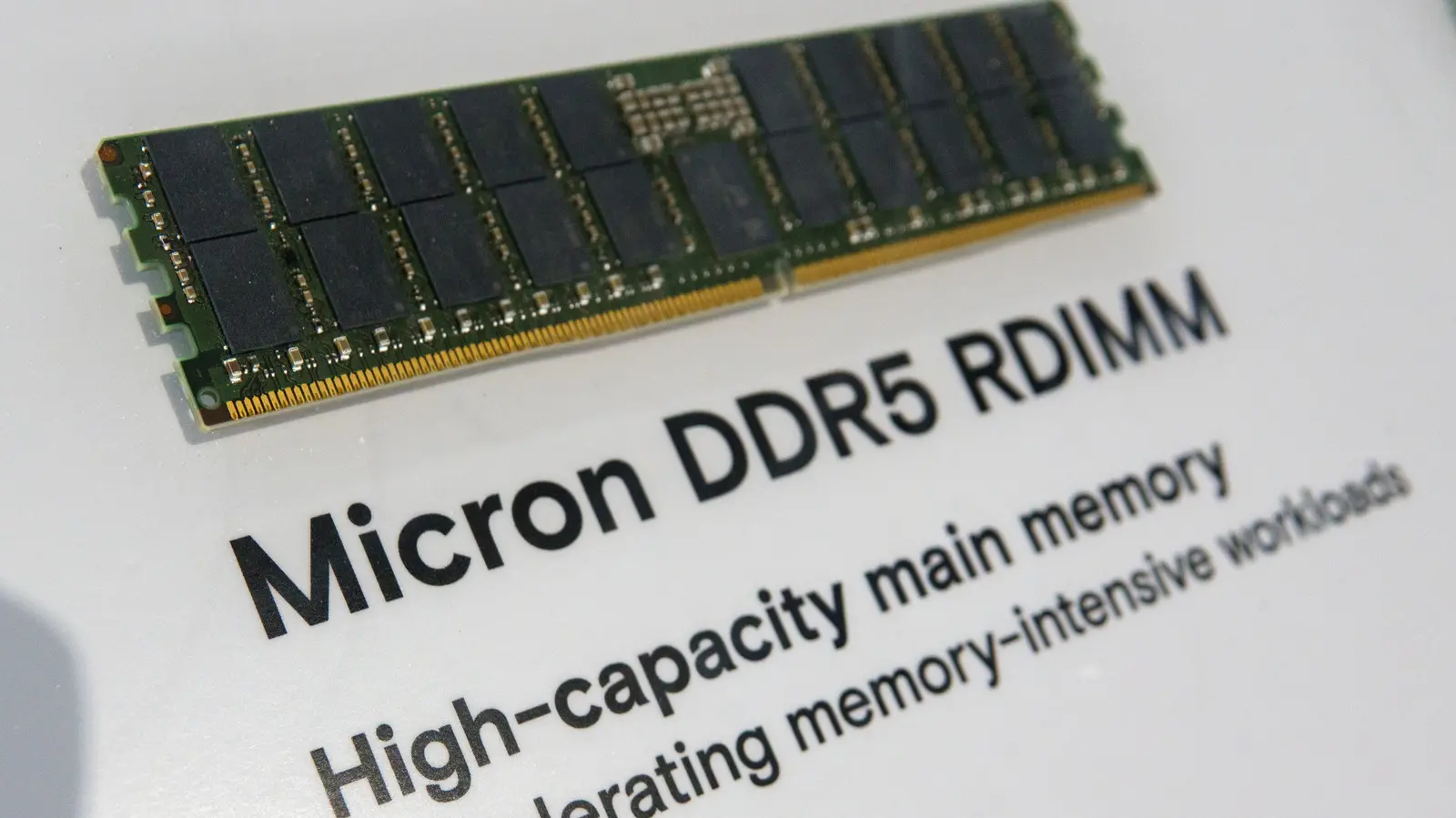
Micron has introduced a new class of ultra-dense server memory: a 512GB DDR5 RDIMM that puts half a terabyte of RAM onto a single module. The module runs at speeds up to 9,200 MT/s and operates at roughly 16 watts, a combination that could reshape how data centers balance memory capacity, bandwidth, and power efficiency as artificial intelligence workloads continue to strain conventional server designs.
The announcement addresses a long-standing challenge in memory design. For years, increasing capacity meant adding more DIMMs, more slots, and more power. That approach works in consumer desktops, where 32GB or 64GB is often more than enough for gaming and everyday productivity. But in servers running large language models, in-memory databases, real-time analytics, and simulation-heavy workloads, memory capacity is a hard constraint. More memory allows larger datasets to remain in main memory, improving caching and reducing the need to fetch data from slower SATA SSDs or hard drives.
Key facts at a glance
- Micron's new module is a 512GB DDR5 RDIMM for servers.
- It delivers data rates up to 9,200 MT/s.
- It consumes about 16 watts per module.
- Micron says it uses more than 60 percent less power than four 128GB RDIMMs, which would draw about 44 watts.
- The design uses 3D through-silicon vias to stack 32GB DRAM dies vertically.
- The memory is based on Micron's 1γ node, built around EUV lithography.
- A dual-socket server can hold up to 12TB of DDR5 using these modules.
- Micron is validating the memory with AMD and Intel for next-generation server platforms.
- Volume production is expected in the second half of 2027.
- Pricing is negotiated directly with customers and is not publicly disclosed.
- Micron has secured at least 16 strategic customer agreements in AI, data center, and automotive markets, totaling $22 billion in upfront commitments.
- Micron expects supply to remain constrained through 2028.
- Micron exited the consumer memory business after closing its Crucial brand in 2025.
The headline density figure is impressive, but the speed and power numbers may matter just as much. A 512GB module at 9,200 MT/s is not simply a capacity play. It is a bandwidth play. Modern AI accelerators and high-core-count server CPUs need to be fed constantly. If memory bandwidth stalls, expensive compute sits idle. By pushing DDR5 speeds higher while keeping power low, Micron is targeting the part of the server where performance per watt can determine whether a data center expansion is economically viable.
Not the first 512GB module, but a different milestone
Micron is not the first company to bring a 512GB DDR5 module to market. Samsung introduced its own 512GB DDR5 module in 2021 and can claim the earlier launch. Micron's distinction is that its 512GB DDR5 RDIMM reaches 9,200 MT/s while operating at about 16 watts per module. That combination of density and data rate is what Micron is presenting as a new class of ultra-dense server memory.
The distinction matters because memory specifications are rarely about a single number. Capacity, speed, latency, power, thermal design, and manufacturing yield all interact. A module that offers high capacity but runs at a modest data rate may be useful for capacity-bound workloads, but it can bottleneck bandwidth-hungry AI training and inference. A module that offers high speed but low capacity forces servers to use more slots, which increases power draw and can create thermal and board-space challenges. Micron's pitch is that the new RDIMM improves both dimensions at once.
How 3D TSV stacking and the 1γ node enable density
To fit 512GB onto a single RDIMM, Micron stacks 32GB DRAM dies and interconnects them vertically using three-dimensional through-silicon vias. In traditional memory packaging, electrical signals often travel through wire bonds and PCB traces. With TSVs, tiny vertical connections run directly through the stacked dies. This shortens the power pathways, lowers resistance, improves signal integrity, and raises power efficiency. Vertical stacking is also what allows extreme density within the same RDIMM form factor.
Micron also credits its latest DDR5 manufacturing process, the 1γ node, which is built around EUV lithography. The same node has helped Micron DDR5 reach 9,200 MT/s, and the company confirmed that the new 512GB DDR5 RDIMMs are based on it. Advanced process nodes can improve speed and power efficiency, but they can also create yield challenges, especially for very dense modules. That helps explain why ultra-dense RDIMMs have remained a niche product even after Samsung's earlier entry.
Why power efficiency is now a boardroom issue
Micron says its 512GB module consumes more than 60 percent less power than four 128GB modules, which would use about 44 watts. That comparison is central to the product's value proposition. Data centers are under growing pressure from local communities, regulators, and utilities over energy and water use. Every watt saved at the memory level can reduce cooling demand, power delivery requirements, and total cost of ownership. In a facility with thousands of servers, a 28-watt difference per memory configuration can scale into megawatts of avoided power draw.
Power efficiency also affects how densely servers can be packed. If memory modules generate less heat, racks can be designed with fewer thermal constraints. That can allow more compute and memory in the same physical footprint. For hyperscalers building AI clusters, floor space, power, and cooling are often as scarce as capital. A memory module that reduces power per gigabyte therefore has strategic value beyond its raw capacity.
AI workloads are changing the memory market
Micron is positioning the 512GB DDR5 RDIMM for large, demanding AI, analytics, and in-memory database workloads. The company also lists Spark Support Vector Machines and claims that its 512GB RDIMMs can deliver 1.4 times higher performance compared to 256GB configurations. The logic is straightforward: denser DRAM means more data can live in main memory, which improves caching and reduces data pulls from slower storage tiers. In AI systems, data starvation is a common bottleneck. Keeping more of the working set in memory can raise utilization of GPUs and CPUs that would otherwise wait on storage.
Beyond AI training, the modules are aimed at analytics, virtualization, simulation-heavy workloads, and in-memory databases. These applications share a common trait: they are memory-capacity sensitive. Virtualization hosts benefit from more memory because they can run more virtual machines per server. In-memory databases benefit because they can hold larger datasets without sharding or offloading to disk. Analytics engines benefit because they can scan and join larger tables in memory. Simulation workloads benefit because complex models can be held closer to the processor.
Ultra-dense DDR5 has been niche, but the economics are shifting
512GB RDIMMs have not taken off quickly, despite Samsung's modules being available for several years. The astronomical cost is one reason. Advanced process nodes and complex stacking also tend to produce lower yields than mature processes, which raises effective cost per module. For much of the past decade, most server buyers could meet their capacity needs with lower-density modules and more DIMM slots.
The AI infrastructure buildout has changed that calculus. Hyperscalers and large cloud providers have demonstrated that price is less of an obstacle when the goal is to secure compute and memory capacity quickly. Memory shortages have made supply access a competitive advantage. Data centers have been projected to consume about 70 percent of global memory supply in 2026, a figure that underscores how aggressively AI infrastructure is absorbing available DRAM. At the same time, server CPUs are approaching 200 cores. AMD's 192-core Epyc 9965 is one example. More cores require more memory bandwidth and capacity to stay fed. In that environment, Micron's timing may be well suited to demand.
Validation, production timelines, and supply constraints
Micron said it is working with AMD and Intel to validate the new DDR5. Platform validation involves testing the memory to JEDEC specifications and stress-testing compatibility with specific CPUs, including Xeon and Epyc processors, as well as server platforms. Following validation, Micron expects its 512GB DDR5 RDIMMs to enter volume production in the second half of 2027.
Pricing will be negotiated directly with customers, so Micron is not publicly disclosing figures. Publicly available pricing for adjacent products gives some sense of the range. A single 256GB DDR5-6400 RDIMM, which has half the density and a much lower data rate, retails between $11,000 and $16,000. Micron's 512GB modules are expected to cost far more.
Micron has also announced at least 16 strategic customer agreements across the AI, data center, and automotive markets. Those agreements total $22 billion in upfront commitments to secure supply. The company expects supply to remain constrained through 2028, and it says customers currently want roughly 50 percent more memory than it can ship. That supply-demand imbalance explains why ultra-dense server memory is suddenly a strategic product rather than a niche curiosity.
For consumer PC builders, there is a catch. This kind of advancement might normally suggest that denser consumer memory is on the way. But Micron closed its Crucial brand and exited the consumer memory business altogether in 2025. The company's focus is now squarely on high-value markets such as AI, data centers, and automotive, where demand is strong and customers are willing to commit capital years in advance.
Micron's 512GB DDR5 RDIMM therefore lands at the intersection of several trends: the need for more memory capacity per server, the demand for higher bandwidth, the pressure to reduce power consumption, and the AI-driven scarcity of advanced memory. Its success will depend on validation, yield, pricing, and the pace at which hyperscalers deploy next-generation platforms. But as server CPUs add cores and AI models grow larger, the case for packing more memory into every DIMM slot is becoming harder to ignore.
Source:SlashGear News