

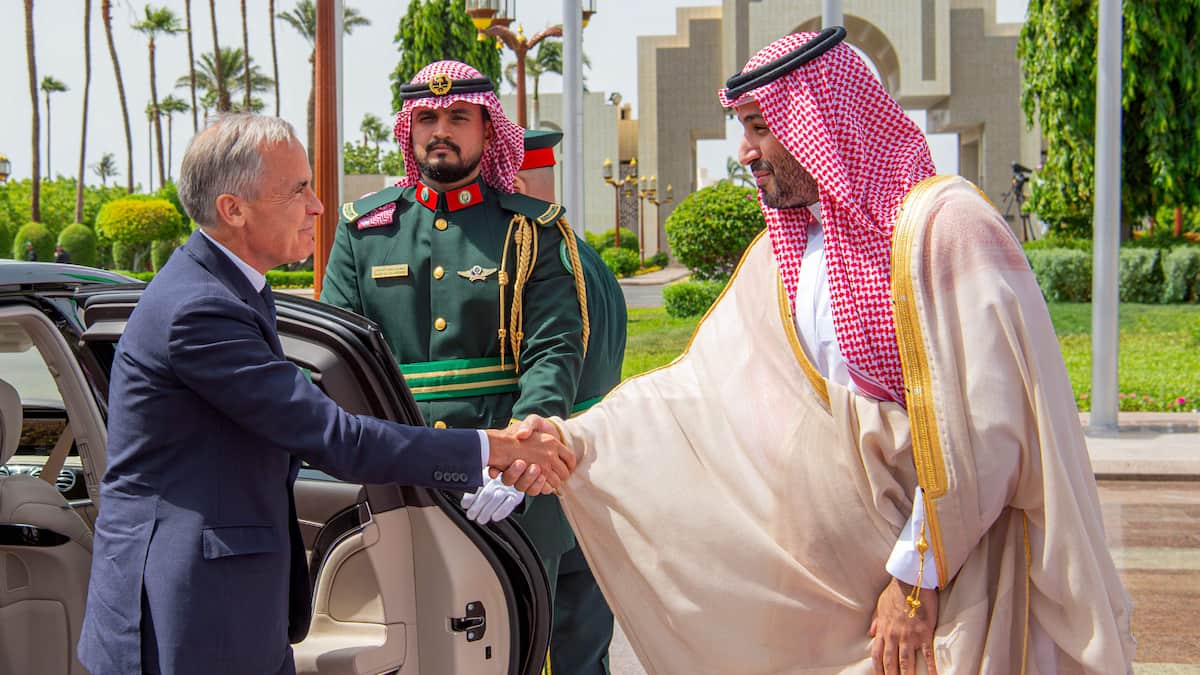
Canadian Prime Minister Mark Carney’s trip to Saudi Arabia on July 9, 2026, has drawn fierce criticism, with commentators describing his behavior as fawning and obsequious. A widely circulated opinion column in the French-language press likened Carney to a waiter catering to the every whim of Crown Prince Mohammed bin Salman (MBS). The column, dripping with sarcasm, imagined Carney fetching water, couscous, and even a bread knife—the latter reserved for journalists critical of the regime. While purely satirical, the piece captures a sentiment that Carney’s deference compromises Canada’s moral standing.
The visit comes two years after Carney’s Liberal Party won the 2025 federal election on a platform that promised climate action, social justice, and a renewed focus on human rights. Yet his meeting with MBS, whose government has been implicated in the 2018 murder of journalist Jamal Khashoggi, the ongoing war in Yemen, and a brutal crackdown on dissidents, has left many progressives feeling disillusioned. Critics accuse Carney of prioritizing economic deals—notably a potential expansion of oil exports and pipeline projects—over ethical foreign policy.
Mark Carney, a former governor of the Bank of Canada and the Bank of England, has long been known as a globalist technocrat. His career includes stints at Goldman Sachs and as UN Special Envoy for Climate Action. Supporters once hailed him as the leader who would bridge the gap between growth and sustainability. But his Saudi outreach suggests a pivot toward realpolitik. The Trudeau-era promise of an “ethical” foreign policy appears to have given way to transactional diplomacy.
During the visit, Carney and MBS signed several memoranda of understanding, including a framework for joint investment in energy infrastructure and technology. The Canadian government also agreed to boost military cooperation, aligning with NATO demands for increased defense spending—a move that pleases Washington but alarms progressives. Carney’s critics note that he has reversed course on banning new oil sands projects and now champions pipelines like the aborted Energy East. For left-wing voters who supported him, this is a bitter pill.
The satirical column, titled “Carney, garçon de table” (Carney, Table Waiter), imagines a series of demeaning exchanges. “Mark, water!” says MBS. “Yes, Your Bellyness, coming right away!” In another, “Mark, the couscous! … Mark, the finger bowl!” The author, Richard Martineau, a prominent Quebec columnist, uses hyperbole to underscore what he sees as a lack of backbone. He contrasts Carney’s bowing with his predecessor Justin Trudeau’s “sunny ways,” but notes that Trudeau likewise sought Saudi arms deals despite human rights concerns.
The column ends with a broader indictment: “Canada presents itself as a moral authority. But it’s been a long time since our country impressed anyone on the international stage. We are like all other countries. We close our eyes and hold out our hand.” This sums up the disconnect between Canada’s public image and its real-world actions.
Background on Saudi Arabia’s human rights record is essential context. The kingdom executes dozens of people annually, bans female drivers (though the ban was lifted in 2018, women still face discrimination), and criminalizes homosexuality with the death penalty. In 2020, Saudi courts sentenced five activists to decades in prison. Under MBS, the country has modernized in some ways—entertainment, tourism—but political repression has intensified. The Crown Prince’s consolidation of power includes imprisoning rivals, monitoring dissidents abroad, and waging a war in Yemen that has caused a humanitarian catastrophe.
Carney’s supporters defend the visit as pragmatic. A senior government aide, speaking on condition of anonymity, argued that engagement is better than isolation. “We can’t change Saudi Arabia by ignoring it. We have to be at the table, even if that means uncomfortable moments.” The phrase recalls Carney’s own earlier remark: “If you’re not at the table, you’re on the menu.” That quote, originally about climate negotiations, now seems to apply to geopolitics. But critics say the table in Riyadh is set by the Saudi host, and Canada is the supplicant, not a partner.
The timing of the visit also raises eyebrows. It comes amid a global energy crisis and rising tensions between the West and China. Saudi Arabia, as the world’s largest oil exporter, holds sway over energy prices. Canada, with the third-largest proven oil reserves, sees an opportunity to export more crude. The Trans Mountain Pipeline expansion, completed in 2024, was supposed to reduce reliance on the U.S. But tanker access to Asian markets remains limited. Saudi investment could help, but at what cost?
Human rights organizations have condemned the visit. Amnesty International Canada issued a statement calling on Carney to raise specific cases, including that of imprisoned women’s rights activist Loujain al-Hathloul. “Instead of bowing, the Prime Minister should be demanding accountability,” said Amnesty’s secretary-general. There is no public evidence that Carney raised human rights issues in private meetings. The official readout from his office stressed discussions on “regional security, clean energy cooperation, and economic diversification.”
Meanwhile, within Canada, the backlash from progressive circles is palpable. Grassroots Liberal Party members, many of whom were energized by Carney’s climate rhetoric, are organizing petitions and letters. Social media is rife with comparisons to former Prime Minister Jean Chrétien, who famously scolded protesters while still championing social programs. But Chrétien also kowtowed to the U.S. on Iraq—a reminder that Canadian leaders have long balanced values with interests.
The opposition Conservatives, unsurprisingly, have been quiet. They support any expansion of energy trade. The NDP and Green Party, however, have seized on the controversy. NDP leader Jagmeet Singh said, “This is what happens when a former banker runs the country—everyone becomes a client.” The Green Party called for a parliamentary inquiry into the deals signed in Riyadh.
Economists point out that the real stakes are about diversifying Canada’s energy markets. The U.S. remains the primary customer, but with the Biden administration’s green policies and potential trade disputes, Saudi Arabia offers an alternative. Yet the returns may be modest: Saudi crude is cheaper to produce, and the kingdom already has customers in Asia. The deals signed are likely to involve joint ventures, not guaranteed purchases of Canadian oil.
Culturally, the article’s French-Canadian source highlights a distinct Quebec perspective. In Quebec, there is a tradition of sharp political satire, and Martineau’s column resonated with readers who feel that Canada’s federal government is overly deferential to foreign powers—whether the U.S., China, or now Saudi Arabia. The image of a Quebec-born prime minister bowing to an Arab prince carries extra resonance in a province that values its own dignity.
In response to the column, Carney’s office dismissed it as “satire that doesn’t reflect reality.” But the damage to his brand may be lasting. For a leader who promised to restore Canada’s moral authority, the optics of laughing alongside MBS are damaging. The photograph released by the Saudi press shows both men smiling, Carney’s hands clasped almost submissively. In the background, ornate gold decorations and a massive portrait of King Salman underscore the power imbalance.
As the story evolves, further details may emerge. For now, the “Carney as waiter” metaphor has become a rallying cry for critics on the left and right. It underscores the challenge of maintaining principles in a complex world. Whether Carney can recover the trust of his base depends on what he does next. Will he address human rights? Will he redirect investment to green energy? Or will he double down on oil and military spending? The answer, for now, remains unspoken.
This incident also reflects broader trends in global leadership. The era of moral posturing may be giving way to a more cynical approach, where even self-styled progressive leaders prioritize commercial and strategic interests. Canada is not alone; Germany, France, and the UK all have similar contradictions. Yet for a candidate who campaigned on climate and social justice, Carney’s Saudi embrace feels particularly hypocritical.
The long-term effect on Canada-Saudi relations remains to be seen. Both countries have economic reasons to stay close. But if the Canadian public pushes back hard enough, Carney might be forced to recalibrate. The next election is scheduled for 2029, but with a minority government, a confidence vote could come sooner. For now, the image of the “table waiter” will linger, a cautionary tale about the perils of power and the seduction of the global elite.
Source:Le Journal de Québec News