

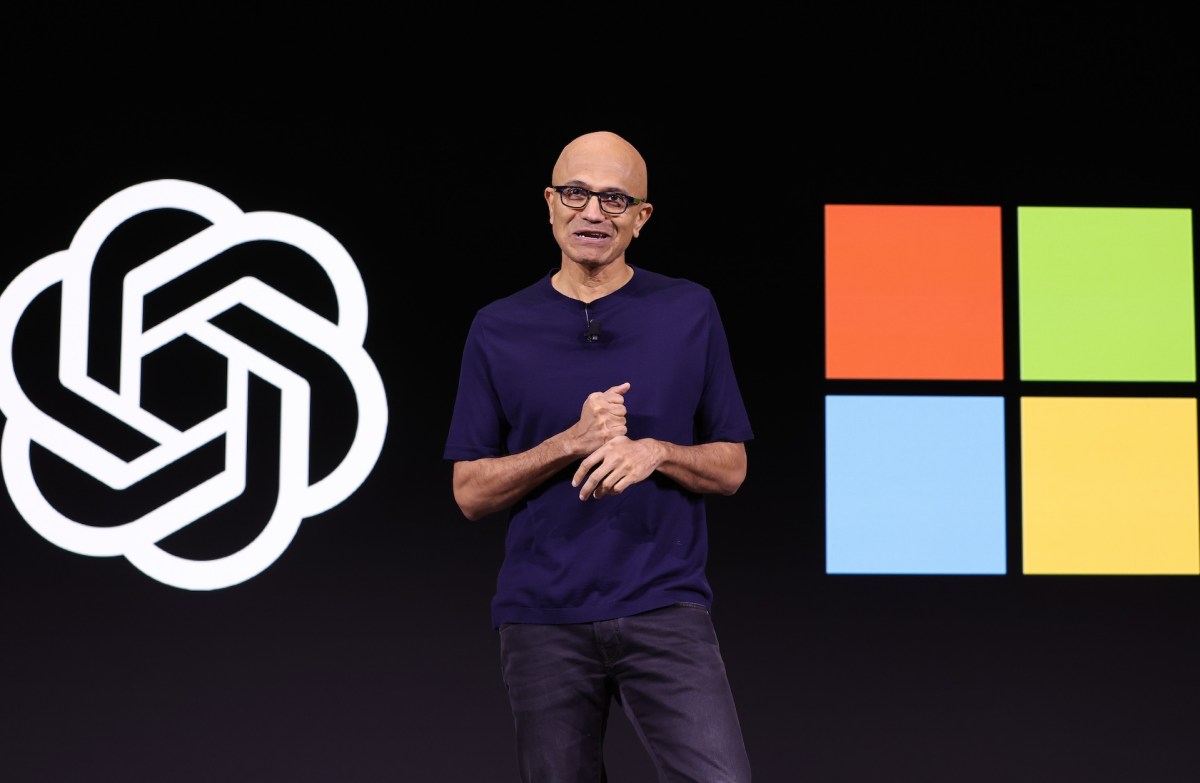
Satya Nadella, the CEO of Microsoft, has stirred the tech world with an unexpected warning directed at any organization using artificial intelligence from major labs like OpenAI and Anthropic. In a blog post published Sunday, Nadella argues that companies are paying twice for AI — once with money for token usage, and again with something far more valuable: the proprietary business data they must reveal to make those models useful.
“You essentially pay for intelligence twice, once with money, and again with something even more valuable: the proprietary knowledge you must reveal to make that intelligence useful. The better you want the model to perform, the more of that knowledge you have to feed it!” Nadella wrote.
The concern is not new. Venture capitalists like Jason Calacanis and Palantir CEO Alex Karp have previously voiced fears that the giant AI labs collecting training data and user feedback could end up competing with their own customers. But coming from the head of Microsoft — a company that has invested billions in both OpenAI and Anthropic — the warning carries extra weight.
The hidden cost of AI: Your data becomes the model’s intelligence
Nadella’s central thesis is that when enterprises use proprietary models, they are effectively training their future competitors. As users interact with an AI — writing prompts, using tools, and especially correcting outputs — they generate “exhaust” data that the model makers can capture. Every correction is a lesson in the nuances of the business. Over time, the model absorbs institutional knowledge that no competitor could buy.
“Models learn from ‘exhaust,’ the prompts people write, the tools agents use, and especially the corrections people make when the model is wrong. Every correction is distilled into institutional know-how,” Nadella wrote. He warns that AI companies reserve the right to learn from customer usage and interaction data, meaning that sensitive business processes become part of the training set.
This situation is particularly dangerous for startups and medium-sized enterprises that rely heavily on proprietary AI to gain a competitive edge. If the model maker can see every strategic query, every product idea, and every customer complaint, it can build a profile of the company’s capabilities and weaknesses.
Distillation: The fair-use debate Nadella reignites
Nadella’s proposed solution touches on the controversial practice of model distillation. Distillation is a technique where one model’s outputs are used to train another, often smaller and cheaper, model. In February 2026, Anthropic accused Chinese open-source models of sending millions of prompts to Claude to improve their own AI, and called for stricter export controls.
Nadella argues that if AI labs are allowed to freely scrape the internet for training data, then enterprises should have the reciprocal right to study and distill those proprietary models. He calls it hypocritical for model makers to claim fair use over public data while imposing restrictive terms on distillation.
“While the great innovation that comes from model providers having fair use rights to train models on public data is needed, I find it ironic that the status quo is to then turn around and impose restrictive terms on distillation,” Nadella wrote.
By advocating for distillation rights, Nadella is essentially empowering companies to take what they have learned from a proprietary model and use that knowledge to build their own AI systems — without having to reveal their internal secrets to the original model maker.
The cloud provider’s play: Build your own learning environment
Nadella’s prescription for enterprises is to “retain ownership” of their data, including prompts, feedback, and corrections. To do that, he suggests companies build their own “proprietary learning environments” on the cloud. This is a convenient recommendation for the CEO of Microsoft, whose Azure cloud platform would be a natural home for such environments.
He also urges companies to adopt “orchestration layers” — tools that allow them to switch easily between different AI models rather than being locked into one provider. The market for AI gateways, which route requests to the best model based on cost, latency, or quality, has been growing rapidly. Startups like Vercel and OpenRouter, as well as larger players, now offer such functionality.
The subtext of Nadella’s post is a quiet endorsement of open-source AI. Although he never explicitly says “open source,” the move toward retaining ownership and controlling the model training pipeline inevitably points to open-source models that can be run on-premise or in a private cloud.
Evidence of a shift: Enterprises moving to on-prem open-source models
Idit Levine, founder and CEO of Solo.io, a company that provides networking and security software for enterprise AI management, says she is already seeing a wave of organizations moving away from proprietary models. After experimenting with closed-source models, her customers start asking: “Can I take an open source model and run it on-prem? It will do almost 90% of what the big one’s doing. It will cost way less. And they understand that, and they can control it.”
Solo.io’s technology was selected by the Linux Foundation to power the Agentgateway project. Its customers include T-Mobile, ADP, and SAP. Levine sees the shift to on-premise open-source models as the next major wave in enterprise AI.
Data from third parties supports this trend. Vercel, which besides website hosting now offers AI model-switching tools, reported that open models accounted for 29% of all traffic routed through its gateway last month. OpenRouter, a company that helps developers route requests among different AI models, has also seen a surge in open-source model usage.
Nadella’s own blog post could accelerate this trend. When the CEO of a company that has invested heavily in proprietary AI is telling customers to be wary, it sends a strong signal. “In consuming intelligence, you are creating intelligence. And what you create should belong to you,” Nadella wrote.
The broader implication is that the era of blindly using the biggest proprietary models may be giving way to a more hybrid, controlled approach. Enterprises are realizing that the convenience of a GPT or Claude comes with a hidden cost: their competitive secrets. As more companies install open-source models on their own servers, they gain not only cost savings but also data sovereignty and the ability to fine-tune the model without exposing their core knowledge.
While the debate over AI safety and job displacement continues, the issue of data ownership and model control is emerging as a key strategic concern for businesses. Nadella’s warning may prove to be a watershed moment, prompting many executives to rethink their AI procurement strategies.
Source:TechCrunch News