

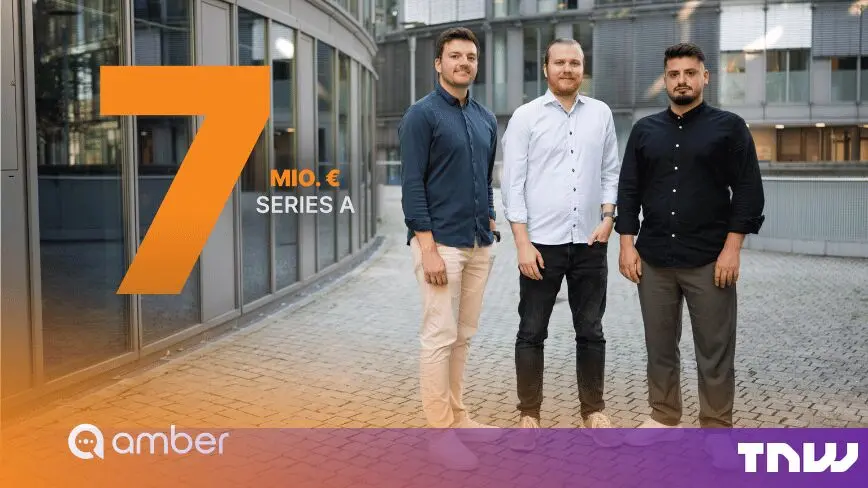
Aachen-based amber has closed a €7mn Series A round. Ventech co-led the round with NRW.Venture, the venture arm of NRW.BANK, the development bank owned by the German state of North Rhine-Westphalia. By the standards of this year’s AI funding rounds, €7mn is small. The argument behind it is not.
Key facts at a glance
- Startup: amber, based in Aachen, Germany
- Round: €7mn Series A
- Investors: Ventech and NRW.Venture (co-leads)
- Product: AI Data Layer that structures internal company information before it is fed to a large language model
- Customers: More than 400 active customers, including Ritter Sport, Zentis, Hailo, Scheidt & Bachmann, Schüßler-Plan, and Dalli
- Team: Roughly 60 staff across Aachen, Cologne, and Tirana
- Founded: 2021 by Philipp Reißel, Bastian Maiworm, and Igli Manaj, all connected to RWTH Aachen University
The technology behind the bet
The underlying idea is simple: before an LLM can answer a question about a company, the company’s own data has to be findable, readable, and connected. amber does that work. It connects and structures internal information from emails, documents, cloud apps, and business systems. The company calls this its AI Data Layer, and its announcement makes clear that is where the money goes.
Enterprises have spent the past two years discovering that generic LLMs are not enough. A model may know the world, but it does not know a specific company’s products, customers, or internal vocabulary. The solution is usually some form of retrieval-augmented generation: a layer that retrieves relevant pieces of context and inserts them into the prompt. amber argues that the quality of that context is now the decisive factor.
“The competition for models is more or less over. The quality of responses depends on the context you ingest,” co-founder and chief executive Philipp Reißel said in a recent interview.
That is a large claim, and amber attaches a number to it. Structuring data before it reaches a model cuts token costs by as much as 60%, the company says, depending on the use case. Token costs are the fees paid to process chunks of text in and out of an LLM. For a large organisation, those costs can quickly become substantial. Treat the figure as the company’s own. Nobody has audited it, and amber hedges it explicitly.
Others have noticed the same direction of travel. Uber’s technology chief said this month that the “tokenmaxxing” era is ending. Microsoft has told its own staff to stop burning tokens. If frontier models converge, the competitive pressure moves to whoever prepares the input. That is exactly the space amber wants to occupy.
A bet against the Cloud Act
The second part of the pitch is sovereignty. amber runs on German cloud infrastructure and has no American shareholders. The company says that puts it outside the US Cloud Act, which allows American authorities to compel US companies to produce data wherever they store it. For a European manufacturer, this is not an abstract legal worry. If an American-owned cloud provider hosts internal data, the US government may be able to demand access to it, even if the data is stored in Frankfurt or Munich.
“What’s happening at amber is decided by European minds,” co-founder Bastian Maiworm said in a recent interview.
The statement targets two rivals in particular. Glean, the Palo Alto company doing broadly the same job, hit a $7.2bn valuation last year. Microsoft is merging its Copilots into one enterprise product. Both are American companies, and both are likely to process or store data on infrastructure that falls under the Cloud Act.
Europe has spent months arguing about this. Airbus shifted its most critical applications to a French cloud. The EU’s own Made in EU procurement rules do not mention software. amber sells into that gap rather than waiting for the rules to close it. The compliance argument runs alongside it. amber pitches GDPR-compliant access to internal knowledge, which matters more to a German manufacturer than a benchmark score does.
Who is actually paying
The customer list reads as a roll call of German mid-sized industry. Ritter Sport makes chocolate. Zentis makes jam. Hailo makes ladders. Scheidt & Bachmann builds fare collection and fuelling systems. Schüßler-Plan does engineering consultancy. Dalli makes detergents. These are Mittelstand firms, the family-owned medium-sized companies that form the backbone of the German economy.
They share a problem that is demographic rather than technological. The people who run production lines, maintain machines, and deal with customers have been doing so for decades. When they retire, they take unrepeatable knowledge with them. Much of it was never written down.
“It’s quite difficult with large IT infrastructures to ensure that, once people retire, their knowledge remains accessible,” Maiworm said.
That is the pitch in a sentence. A generation of German engineers and plant managers is leaving the workforce and taking decades of undocumented practice with it. amber promises to catch that knowledge on the way out. Instead of relying on an employee to explain how a particular machine behaves under certain conditions, a company can search its own records, communications, and reports to reconstruct the answer.
The company reports more than 400 active customers and roughly 60 staff, across Aachen, Cologne, and Tirana. The team is deliberately smaller than other AI startups, but it has a clear focus on the German-speaking market.
Founded before the wave
Reißel, Maiworm, and Igli Manaj started the company in 2021, all three connected to RWTH Aachen University. Reißel and Manaj had worked on the underlying technology before transformer models went mainstream. Maiworm brought the operator’s view from a family business. That founding story explains why the company is not chasing benchmarks. It is trying to solve a practical problem that existed long before ChatGPT.
The product line now runs as amberSearch, amberAI, and amberAgents, which traces the company’s own path from search to assistant to agent. The next step is the hardest one. Today’s AI tools still require a human to ask the right question. amber wants software that spots what needs doing and does it, whether that means preparing a contract, answering a regulatory request, or flagging an unusual pattern in operational data.
“Today’s AI tools are still waiting for users to ask the right questions,” Maiworm said in the funding announcement. This is the industry-wide shift from chatbots to agents. Agents need to be connected to company data in a way that is reliable, secure, and auditable. amber’s argument is that its data layer gives it a head start.
A state bank on the cap table
NRW.Venture is not an ordinary venture investor, and it does not pretend otherwise. It is the venture arm of a state-owned development bank. Its mandate is not only to generate financial returns, but to strengthen the regional economy.
“Through our investment, we are supporting a start-up from North Rhine-Westphalia that is addressing a large European market and helping to strengthen the long-term competitiveness of SMEs,” said Johanna Antonie Tjaden-Schulte of NRW.BANK’s managing board.
Public money keeps turning up on European cap tables. When Lovable raised at $13.3bn this month, the EU became a shareholder. The scale differs by three orders of magnitude. The instinct does not. Governments across Europe are trying to build domestic AI champions, or at least ensure that strategically important technology is not entirely in American hands.
Ventech first backed amber in March 2025 with €2.1mn and has now doubled down. Partner Nicolas Barthalon named a third problem the firm thinks amber solves: helping organisations discover and govern the right agents and workflows amid what he called accelerating AI sprawl. That is a real complaint inside large companies now. Every department buys its own tool, nobody can see the whole estate, and the person who has to govern it has no map.
The limits of the round
The amber Series A does not buy a fight with Glean. A $7.2bn company and a €7mn round do not compete in any meaningful commercial sense, whatever the product overlap. amber contests a segment, German-speaking mid-market industry, rather than a market. It is a spatial strategy: win one region and one vertical before expanding.
Refusing American shareholders also costs something. It helps when selling to a Mittelstand board worried about the Cloud Act. It narrows the capital pool at the exact moment rivals raise hundreds of millions. VCs from the US may not be willing to invest in a company that explicitly markets itself against their legal system. That leaves a smaller group of European investors, and European funds are often smaller than their American counterparts.
The founding claim stays contested, too. Frontier labs keep shipping capability gaps that show up in benchmarks, which is not what a finished contest looks like. OpenAI, Google, and others keep spending on model training. If model quality continues to improve, part of amber’s premise weakens, even if the data layer remains valuable.
amber plans Benelux first, then the Nordics. The test is whether a manufacturer in Antwerp or Helsinki cares about the jurisdiction of its data as much as one in Düsseldorf does. If sovereignty travels, €7mn bought a cheap entry. If it does not, amber has built an excellent German business.