

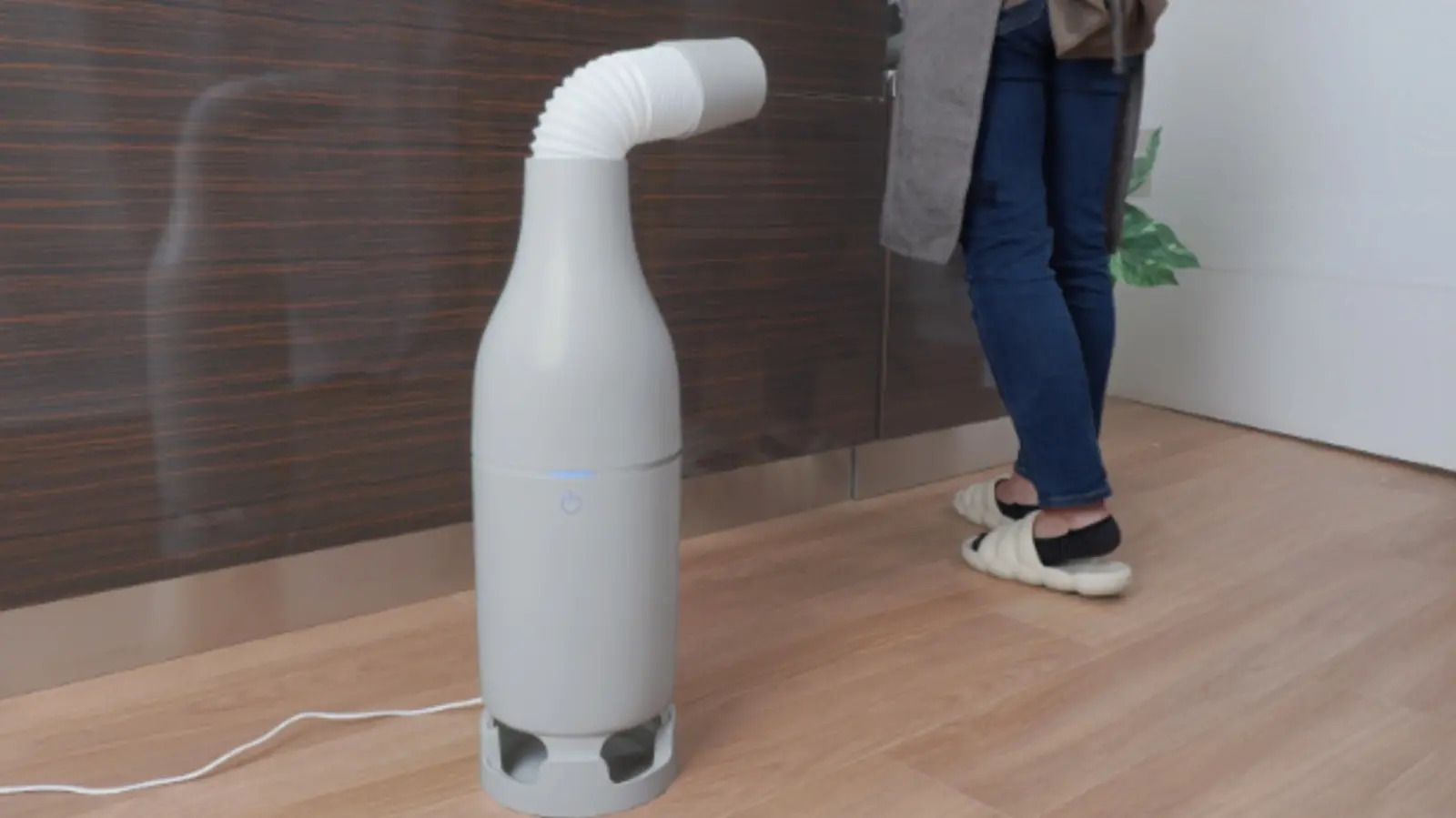
As heatwaves become more frequent and electricity bills remain a concern, many households are looking for cooling solutions that do not require installing a full air-conditioning system. A compact Japanese gadget offers one answer: a USB-powered spot cooler that uses a chilled bottle to take the edge off hot rooms. Priced at 7,980 yen, or roughly $50, the USB Spot Ice Fan is designed as a low-commitment alternative for people who cannot install centralized air conditioning or simply want targeted cooling without cooling an entire home.
The device is small enough to move from room to room and light enough to carry without much effort. It weighs 1.8 kg and measures 175 mm by 175 mm by 694 mm. It runs on USB-C power, so it can be connected to a wall adapter or a power bank. That flexibility makes it suitable for desks, bedrooms, kitchens, and other spaces where a permanent cooling system is impractical.
Key facts at a glance
- What it is: A compact USB spot cooler that uses a chilled bottle to provide localized cooling.
- Price: 7,980 yen, or around $50.
- Claimed cooling: It can lower ambient temperature by about 3 degrees.
- Maximum cooling time: Up to four hours per chilled bottle.
- Weight and size: 1.8 kg; 175 mm by 175 mm by 694 mm.
- Power: USB-C, compatible with wall plugs and power banks.
- Best use: Personal or spot cooling in homes, rentals, historic buildings, and dry climates.
- Main limitation: It is not a replacement for a full air conditioner and cannot cool a whole home to the same level.
How the bottle-based spot cooler works
The USB Spot Ice Fan is part of a broader category of air coolers that rely on cold surfaces, water, or ice to create a cooler airflow. In this case, a chilled bottle is used as the cooling element. The fan circulates air past the cold bottle, and the user places the unit close to where cooling is needed. The approach is simple, but it is important to understand that it is spot cooling rather than central cooling. A user may feel relief while sitting near the device, but the effect on the temperature of an entire room will be limited.
The claimed three-degree reduction is most likely to be noticed in a small, enclosed space and when the bottle is properly chilled. The unit can run for up to four hours on a single bottle, which means users should plan refreezing or swapping bottles for longer sessions. Because it is powered by USB-C, it can run from a standard charger or a power bank, making it useful during short outages or in spaces without convenient outlets. Still, the device should not be confused with an air conditioner, which uses refrigeration to remove heat and humidity from a room.
Air coolers versus air conditioners
Air conditioners are effective at lowering room temperature and reducing humidity, but they come with higher upfront costs, installation requirements, and maintenance demands. In many homes, installing a centralized system is not possible without major construction work. Even window units or portable air conditioners may require venting, special brackets, or permission from a landlord or local authority. Refrigerant handling is also regulated in many places, which is one reason HVAC installation and repair are often left to licensed professionals.
Air coolers take a different approach. They are generally cheaper to buy and run, need less setup, and do not require external ventilation in the same way. They can be moved from room to room, and they do not use refrigerants that require specialist handling. Many models use water, ice packs, or both to produce a cooler breeze. This makes them attractive to renters, people in older buildings, and households that want a lower-cost cooling option. The trade-off is performance. Air coolers are less precise, they cannot reach the same low temperatures as air conditioners, and their effectiveness depends heavily on climate and room conditions.
Who benefits most from air coolers?
The right choice depends on the home, the climate, and local rules. In some historic districts, visible air-conditioning units are restricted because they can alter the appearance of protected buildings. In parts of Lithuania, for example, air conditioners are allowed only when they are out of sight, such as in inner courtyards. Reports from Spain have noted that fines for visible units in historic areas can reach thousands of euros. For residents of such areas, an air cooler may be one of the few practical cooling options.
Air coolers can also be a step up from running a plain fan. Unlike air conditioners, they can be used with a window open, allowing fresh air to circulate while the unit provides localized cooling. In dry climates, adding water or ice can make the air feel more comfortable and can even add some humidity. That can be helpful in arid regions where the air is very dry. However, in places with consistent intense heat or high humidity, an air conditioner is usually more effective. High humidity makes evaporative cooling less efficient, and a room that is already damp may feel worse rather than better. For people who need stronger cooling but cannot install a full system, portable air conditioners that vent through a window can be an alternative.
Climate is not the only factor. Room size, insulation, shade, and airflow all affect how well an air cooler performs. A small bedroom with a closed door may cool more noticeably than a large open-plan living area. A unit placed near a window with cross ventilation may provide better comfort than one tucked into a corner. Users should also consider noise levels, water tank capacity, and how often they are willing to refill or clean the device.
What to consider before buying
Buyers should start with the size of the space they want to cool. Air coolers are usually best for personal cooling or small rooms, not for cooling an entire house. A model with a larger water tank can run longer between refills, but it may also be heavier and harder to move. Ice packs can boost cooling for a short period, but they need freezer space and must be rotated. Noise is another practical concern. Some models advertise low noise levels, but fan speed, water flow, and placement can change how quiet the unit feels in a bedroom or office.
Maintenance matters as well. Water tanks should be cleaned regularly to prevent mold, mineral buildup, and unpleasant odors. Cooling pads and filters need to be checked and replaced according to the manufacturer's instructions. Users should also think about drainage and spill risks, especially if the unit will be placed near electronics or on wooden floors. Finally, shoppers should treat cooling claims carefully. A manufacturer's test conditions may not match a real home, and a spot cooler's effect will depend on room temperature, humidity, and distance from the user.
Portable cooler options and features
For buyers who cannot travel to Japan to purchase the USB Spot Ice Fan, online marketplaces offer a range of air coolers that use similar technology. One popular portable evaporative cooler has earned an average rating of 4.2 stars from more than 530 reviewers. It has a 3-gallon water capacity, a window for checking the water level, and space for up to six ice packs. The unit is designed to run for up to 12 hours of non-stop use, with six fan speeds and three modes: normal, sleep, and cool. Its noise rating can go as low as 36 dB, which is quieter than a person snoring, making it suitable for overnight use in a bedroom.
Another option is a 4-liter evaporative cooler priced at about $110.79, with a 4.2-star average from more than 600 reviewers. It has a movable water tank and cooling pad, and its fan can move air at 22 feet per second. The unit is rated to cover up to 300 square feet, with three modes and four fan speeds. Its 40-inch fan can oscillate up to 80 degrees, helping to distribute airflow across a wider area. These features show how varied the market has become: some models prioritize long runtimes and large tanks, while others focus on oscillation, airflow speed, or quiet operation.
Air coolers are not the only localized cooling products worth considering. Wearable cooling gadgets have become more common, including waist fans, handheld fans, neck fans, and cooling vests. These products are designed for personal use rather than room cooling, and they can be useful for commuters, outdoor workers, and people who move between spaces without air conditioning. For households weighing a full air-conditioning installation against smaller cooling devices, the most practical approach is to match the product to the space, the climate, and the user's tolerance for heat and humidity.
Source:SlashGear News