

Key Facts
- Apple Vision Pro is Apple's mixed-reality spatial computer. The first model launched in February 2024, and the M5 update arrived in October 2025.
- The M5 Vision Pro starts at $3,699 for 256GB of storage. Apple raised the price from $3,499, citing the global memory crisis.
- The headset uses an M5 chip and an R1 chip, has 16GB of RAM, and is sold with 256GB, 512GB, or 1TB of storage.
- It has two micro-OLED displays with more than 4K resolution per eye and 23 million total pixels. The M5 model supports refresh rates up to 120Hz and renders 10 percent more pixels than the M2 version.
- Comfort has improved with the Dual Knit Band, but the headset weighs more than 1.3 pounds and uses an external battery pack.
- Battery life is up to 2.5 hours for general use and up to three hours for video playback on the M5 model.
- Navigation uses eye tracking, hand gestures, and voice commands. There are no bundled controllers. Optic ID iris authentication handles unlocking and purchases.
- The Vision Pro is strongest for watching movies, viewing 3D content, and serving as a Mac display. It has a limited app and game library.
- Apple does not accept older Vision Pro models for trade-in. Zeiss optical inserts cost $99 for readers and $149 for custom prescriptions.
- No new Vision Pro is expected for at least two years. Development on a next-generation headset is paused while Apple focuses on smart glasses.
What the Vision Pro Is and Why Apple Calls It a Spatial Computer
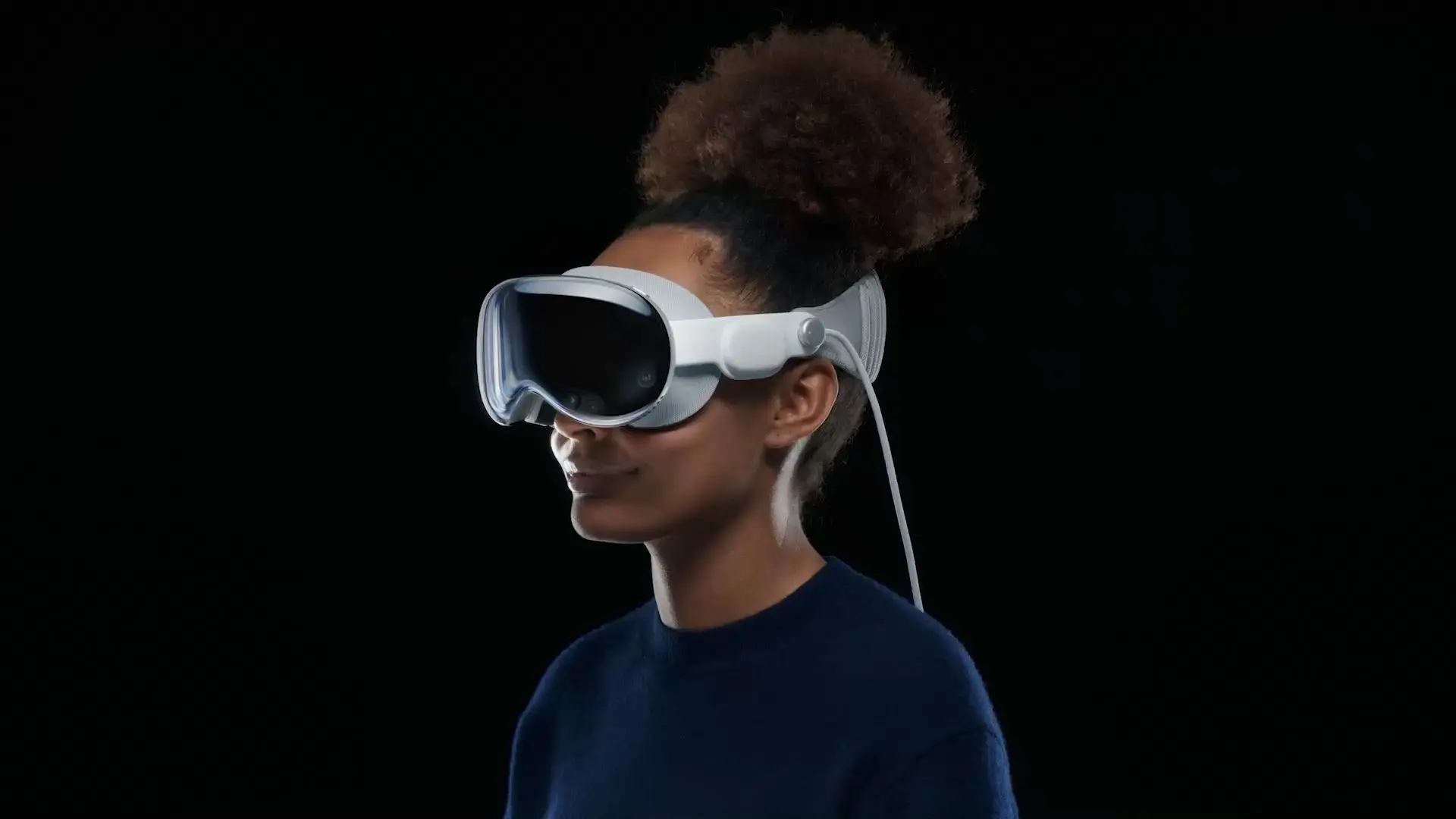
Apple Vision Pro is a wearable mixed-reality device that blends digital content with the physical world. Apple avoids the word headset and describes the product as a spatial computer because it places apps, windows, and media into the space around the wearer. The device can show augmented reality content over a digital view of the room, or it can shut out the surroundings and present a fully virtual experience. The switch between the two modes is controlled with the Digital Crown.
The headset is not see-through. Everything the wearer sees is displayed on internal screens. Cameras map the environment and pass a digital image of the real world back to the displays. That design allows virtual objects to appear in a room while keeping the surrounding space visible. When the wearer wants full immersion, the cameras can be turned off and the view can be replaced by a virtual Environment.
Apple positions the Vision Pro for work, entertainment, gaming, communication, and content capture. The pitch is that a user can place multiple windows in mid-air, resize them, and arrange an infinite canvas. Apps can stay present in the real world, or they can sit against a virtual background. The device runs visionOS, has a dedicated App Store, and can also run many iPhone and iPad apps.
Price, Positioning, and Buying Considerations
The $3,699 starting price makes the Vision Pro a difficult purchase for many consumers. It is far more expensive than mainstream VR headsets and costs more than many high-end laptops. The price is not the only barrier. Reviews and user reports have shown that the device does not easily fit into an existing workflow for most people. Some buyers have regretted the purchase after discovering that the headset is best suited to a narrow set of tasks.
The Vision Pro is excellent for watching movies, viewing 3D videos, and using as a display for a Mac. It can create a personal theater with spatial audio, and it supports 3D titles and immersive video. It can also serve as a large virtual monitor for a Mac, which appeals to some remote workers and media consumers. Outside those uses, the value proposition is less clear. The app and game library is limited compared with more established platforms.
Prospective buyers should try the Vision Pro at an Apple Store and research what it can do before spending the money. Fit is critical. The Light Seal must block out light and sit comfortably on the face, and the wrong size can make the display blurry or allow light to leak in. The ordering process includes a Face ID scan to help determine the correct Light Seal and headband fit. Customers who wear glasses can order Zeiss optical inserts, but those add to the cost.
Design, Comfort, and Fit
The Vision Pro looks like a high-end pair of ski goggles. It has a single piece of laminated glass on the front, attached to a curved aluminum alloy frame. The frame connects magnetically to a soft Light Seal that conforms to the face. The headset is sold in silver with matching gray Light Seals and bands. A tight but comfortable fit is essential for blocking light and keeping the image sharp.
Two Audio Straps with built-in speakers sit at the sides of the headset. They connect to a 3D knitted headband that holds the device in place. The original model shipped with a Solo Knit Band, while the M5 model includes the Dual Knit Band. The Dual Knit Band adds a second strap over the top of the head and uses counterweights in the back strap to distribute weight more evenly. Apple designed it to be breathable, cushiony, and stretchy. A Fit Dial tightens the headset against the head.
Comfort is improved, but weight remains a concern. At more than 1.3 pounds, the Vision Pro can cause fatigue quickly. Reviewers have found the Dual Knit Band more comfortable for sessions lasting more than an hour or two, and it reduces pressure on the face and neck strain. Even so, the weight is still noticeable. The external battery pack adds another item to manage, and the headset is not easy to travel with, especially with a dedicated travel case. Owners can swap battery packs for additional power, but the device ships with only one battery.
Display, Cameras, Sensors, and Controls
The Vision Pro has two custom micro-OLED displays that deliver more than 4K resolution to each eye, for a total of 23 million pixels. The M5 model can render 10 percent more pixels than the earlier version, which makes text and details sharper. It also supports refresh rates up to 120Hz, up from 90Hz, for smoother visuals and reduced motion blur. An external EyeSight display shows a digital representation of the wearer's eyes so people nearby can tell whether the user is in an immersive mode or can see the room.
More than a dozen cameras and sensors map the world and track the wearer. The system includes 12 cameras and five sensors. Two cameras send more than a billion pixels per second to the displays to show the real world. Others handle head tracking, hand tracking, and real-time 3D mapping. Infrared flood illuminators improve hand tracking in low light, and LiDAR depth sensors determine the size and location of objects. Four infrared cameras and LED lights inside the headset track eye movement.
There are no physical controllers. Users highlight an app or element by looking at it and select it with a tap of the fingers. Scrolling is done with a flick of the fingers. Voice commands are also supported. Bluetooth keyboards, mice, trackpads, and game controllers can be connected, mainly for Mac use and Apple Arcade games. The headset can detect hand movements even when the hands rest in the lap.
Optic ID uses iris scanning for authentication. Each person has a unique iris pattern, and the headset uses infrared cameras and lights to verify it. Optic ID can unlock the device, authenticate purchases, and replace passwords. The Vision Pro also has a 3D camera that captures spatial photos and videos. A recording indicator appears on the external display so the headset cannot be used to record secretly.
Audio, Connectivity, and Performance
The Audio Straps contain dual-driver speakers positioned next to each ear. The speakers analyze the acoustic properties of a room and adapt the sound to the space. They support spatial audio for surround sound, and six microphones handle calls, video calls, and voice commands. The Vision Pro can pair with AirPods for a more private audio experience. USB-C AirPods Pro 2 and AirPods Pro 3 support 20-bit, 48 kHz lossless audio with ultra-low latency when connected to the headset.
Connectivity includes Wi-Fi 6 on the 2.4GHz and 5GHz bands. The Vision Pro does not support Wi-Fi 6E or the 6GHz band. The device is powered by an M5 chip built on third-generation 3-nanometer technology. The M5 has a 10-core CPU and a 10-core GPU. Its 16-core Neural Engine improves AI features, and unified memory bandwidth reaches 153GB/s. The Vision Pro has 16GB of RAM. The M5 works with the R1 chip, which processes input from cameras, sensors, and microphones. Apple says the R1 can stream images to the displays within 12 milliseconds for a nearly lag-free view of the world.
The M5 improves performance compared with the M2 model. Apps and widgets load faster, web browsing is more responsive, and AI-powered features such as spatial scene creation and Persona generation run more efficiently. The GPU includes Neural Accelerators and supports third-generation ray tracing for better lighting, shadows, and reflections. A thermal system quietly moves air through the headset to control heat and maintain performance.
Battery Life and Storage
Apple did not put a battery inside the Vision Pro because of weight constraints. The headset is powered by a braided cable connected to an external battery pack worn at the hip, or by a power adapter. The M5 model offers up to 2.5 hours of general use and up to three hours of video playback. That is a half hour longer than the M2 model for general use. When plugged into a power adapter, the Vision Pro can run all day. The entry-level model has 256GB of storage, and Apple also sells 512GB and 1TB versions.
visionOS, Apps, and Mac Integration
visionOS is the operating system that runs on the Vision Pro. It provides a three-dimensional interface with a Home View, apps, and windows that react to light and shadow in the room. Apps can be placed anywhere in virtual space, resized, stacked, and arranged around the room. A virtual keyboard supports air typing, and Bluetooth accessories can be used for text input and control. The level of immersion is adjustable, and a Guest Mode lets other people try the headset. Travel Mode is designed for use on a plane, car, or train.
visionOS 26 added persistent widgets that stay in place around the user, more lifelike Personas, shared experiences for people in the same room, and the ability to view an iPhone while wearing the headset. It also added Spatial Scenes that add depth to 2D images, a spatial browsing feature in Safari, and a Jupiter Environment. The current software is visionOS 26.6.1.
visionOS 27 is set to arrive in the fall. It adds a major Siri overhaul with generative AI, conversational abilities, personal data access, and the ability to take action in apps. Siri appears as a floating 3D bubble that can be placed anywhere in the user's space. The update also includes Visual Intelligence, a Siri app for
Source:MacRumors News