

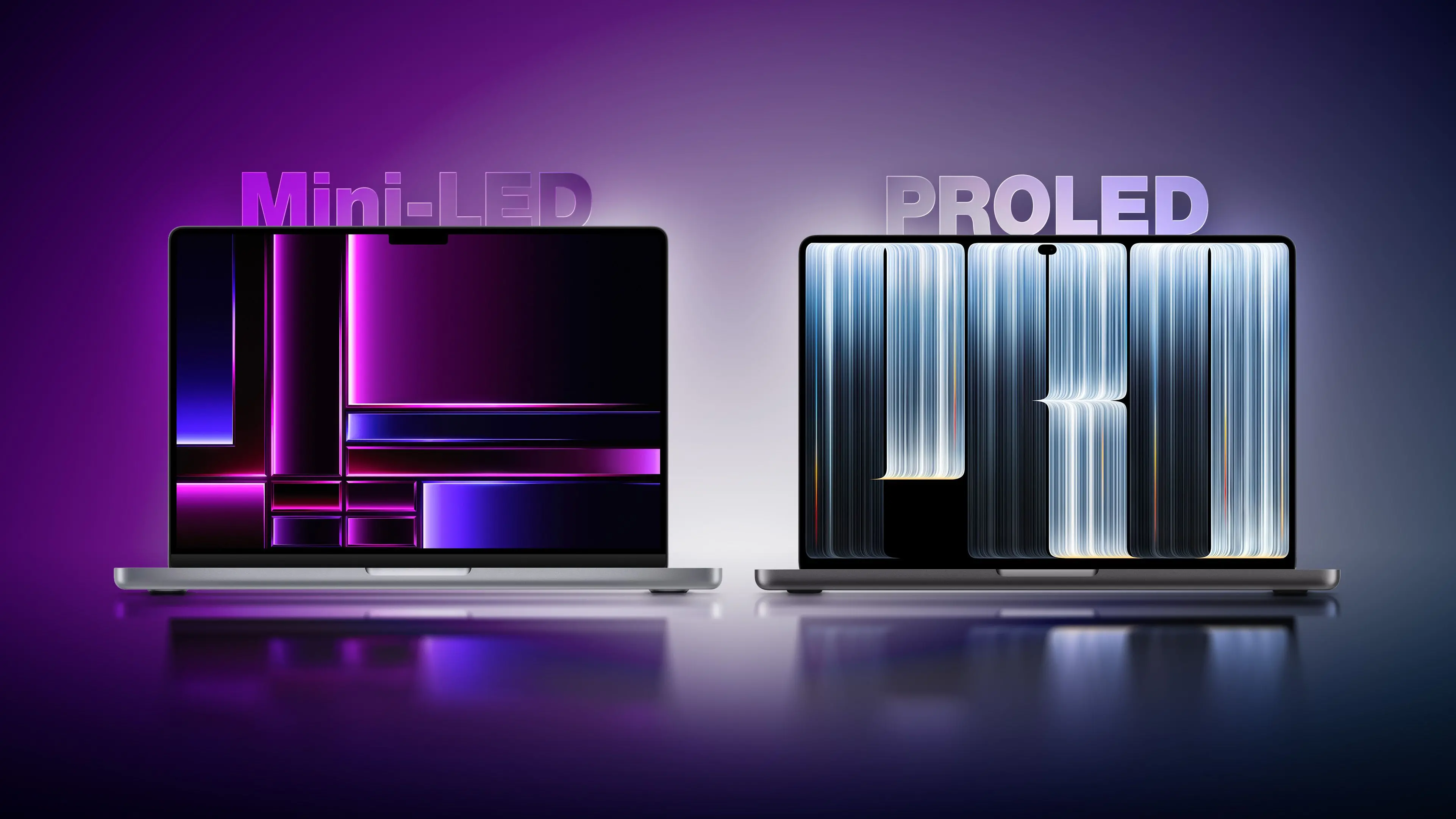
Apple is now selling two MacBook Pro families side by side, and the split comes down almost entirely to the screen. The new PROLED XDR model, announced in late October 2026, pairs a tandem OLED panel with touchscreen input, the Dynamic Island and a thinner, lighter chassis. It sits alongside the Liquid Retina XDR models that debuted in March 2026, and both lines use the same M5 Pro and M5 Max chips.
That shared silicon is the key to understanding the purchase decision. Because chip options, memory ceilings and battery life are unchanged, buyers are effectively being asked whether a better display, onscreen touch and slightly better portability are worth a $400 starting premium. For some workflows the answer is an easy yes. For others, the older design remains the smarter buy.
Key Facts at a Glance
- Two display technologies: Mini-LED-backlit LCD with local dimming (Liquid Retina XDR) versus tandem OLED with two self-illuminating pixel layers (PROLED XDR).
- Price gap: $400 at every equivalent size and chip tier. The 14-inch M5 Pro starts at $2,499 or $2,899; the 16-inch M5 Pro starts at $2,999 or $3,399.
- Same compute: M5 Pro and M5 Max chips, identical memory configurations and identical battery endurance across both lines.
- Contrast: 1,000,000:1 on the Mini-LED model versus 10,000,000:1 on the OLED model.
- Brightness: Peak HDR rises from 1,600 nits to 2,000 nits, while both panels sustain up to 1,000 nits full-screen.
- Touch: Only the PROLED model supports direct onscreen Multi-Touch, with the sensor built into the panel rather than layered on top.
- Weight: The 16-inch body drops from 2.14 kg to 1.82 kg with the M5 Pro, a 15 percent reduction.
- Storage ceiling: The PROLED 16-inch M5 Max offers a 16TB option that the Mini-LED model does not.
- Availability: Liquid Retina XDR launched March 11, 2026; PROLED XDR arrives November 6, 2026.
Display: Zone Lighting Versus Per-Pixel Illumination
The fundamental difference is how light is produced. The Liquid Retina XDR relies on a Mini-LED backlight divided into local dimming zones, so bright objects and dark objects in the same region of the screen share a single pool of light. The PROLED XDR uses tandem OLED, stacking two self-illuminating pixel layers, which means each pixel switches on and off independently. The practical result is that contrast jumps by an order of magnitude, from 1,000,000:1 to 10,000,000:1, and bright highlights no longer halo into adjacent dark areas.
Apple also adds a dedicated display engine on the OLED model that compensates for content, temperature, the surrounding environment and individual pixel usage over time, a safeguard against uneven aging in an emissive panel. Peak HDR brightness climbs from 1,600 nits to 1,000 nits sustained in full-screen SDR use and 2,000 nits peak outdoors. Both panels keep a 1-nit minimum brightness, True Tone, one-billion-color support and a 254-pixel-per-inch density.
Resolution and physical size shift slightly as well. The 14-inch OLED panel measures 14.2 inches at 3024 by 1986, compared with 3024 by 1964 on the Mini-LED version. The 16-inch model grows from 16.2 inches at 3456 by 2234 to 16.3 inches at 3472 by 2266. The OLED variant also trims its borders, shrinks the camera cutout into a Dynamic Island, rounds all four display corners instead of only the top two, and adds fingerprint-resistant oleophobic coating to its antireflective layer. Both offer an optional nano-texture finish.
Reference Modes and Color Workflows
The PROLED panel adds Adobe RGB coverage alongside P3, and that extra gamut propagates through the reference modes. Where the Mini-LED model offers Apple XDR Display at P3-1600 nits, Design and Print at P3-D50 and Photography at P3-D65, the OLED model offers Apple XDR Display at P3 plus Adobe RGB-2000 nits, Design and Print in both P3-D50 and Adobe RGB-D50, and Photography in both P3-D65 and Adobe RGB-D65. It also adds a DICOM-600 nits medical imaging preset, doubling the 350-nit version on the older panel, and an Apple Color Matching Function for visual consistency with the iPhone 18 Pro and Studio Display XDR. Both retain HDR video, broadcast television, digital cinema and sRGB modes, and both work with Pro Display Calibrator.
Design, Dimensions and Thermals
The OLED machine is meaningfully lighter even though it is only marginally thinner. The 14-inch M5 Pro falls from 1.60 kg to 1.38 kg, a 13.8 percent cut, while the 16-inch M5 Pro drops from 2.14 kg to 1.82 kg, a 15 percent reduction. Thickness falls 3.2 percent on the 14-inch and 4.8 percent on the 16-inch, with depth reduced 2.2 percent and 1.6 percent respectively. Width barely moves.
Underneath, Apple redesigned the hinge to stay stable during touchscreen use, reworked the thermal architecture to redirect warm air away from the display while maintaining sustained M5 Pro and M5 Max performance, and brought back an illuminated rear Apple logo that the Mini-LED model lacks.
Audio, Camera and Input
Redesigned woofers deliver 50 percent deeper bass and reshaped tweeters improve dispersion clarity. The OLED model also adds dedicated audio tuning for closed-lid use with an external display and advanced video stabilization to reduce camera shake during touchscreen use. The 12MP Center Stage camera, Desk View, 1080p recording, six-speaker array, Spatial Audio and three-microphone setup carry over unchanged.
Touch is the headline addition. The PROLED model accepts direct onscreen swipes, pinch-to-zoom and drag-and-drop, and macOS translates existing app touches into clicks while updated gesture APIs enable new interactions such as double-tapping a window to fill the screen or flicking to tile it. Spotlight relocates into the Dynamic Island when Siri AI is enabled, and additional AssistiveTouch and Touch Accommodations options expand accessibility.
Storage, Displays and Power
The M5 Max in the PROLED model can be configured with 2TB, 4TB, 8TB or 16TB, while the Mini-LED version stops at 8TB. M5 Pro storage remains capped at 1TB, 2TB or 4TB on both. External display support rises from 144Hz to 165Hz for three 4K screens on M5 Pro and four on M5 Max, limited to those specific arrangements. Genlock, which synchronizes display refresh with camera capture, is exclusive to the OLED model. The 14-inch battery grows from 72.4Wh to 72.6Wh without adding endurance, and the 16-inch M5 Max raises its minimum recommended charger from 70W to 94W.
Environmental Differences
The PROLED model uses 55 percent recycled content against 45 percent, though its renewable manufacturing electricity share dips from 50 percent to 45 percent. It also introduces 100 percent recycled tantalum in multiple capacitors, a first for the company.
Pricing and the Upgrade Question
The premium is uniform: $2,499 versus $2,899 for the 14-inch M5 Pro, $2,999 versus $3,399 for the 16-inch M5 Pro, $4,099 versus $4,499 for the 14-inch M5 Max and $4,399 versus $4,799 for the 16-inch M5 Max. Because the Mini-LED models have seen price increases since March, comparing original launch prices overstates the real-world gap.
For existing M5 Pro and M5 Max owners, there is little reason to move, since processing performance, maximum memory and battery life are effectively identical. The exceptions are professionals who need Adobe RGB coverage, extra reference modes, genlock or more than 8TB of internal storage. The touchscreen alone is unlikely to justify a replacement, and the weight savings matter most to frequent travelers carrying a 16-inch machine daily. The case is stronger for anyone coming from an M1, M2 or M3 generation, particularly if that machine is struggling with current workloads or short on memory and storage. Owners of capable machines may prefer to wait, with M7 Pro and M7 Max models reportedly planned for late 2027 alongside this new display and design.
For buyers who need a MacBook Pro now, the PROLED model is the stronger choice when the $400 premium is affordable and the built-in display gets heavy use, since the OLED panel is the main justification for the extra spend. The Liquid Retina XDR model remains sensible when discounts produce a substantial saving, especially for anyone working primarily from an external monitor, but it is worth remembering that it carries a five-year-old design. It is still the better purchase when the saving funds the memory or chip configuration a workflow actually requires.
Source:MacRumors News