

Argentina Embarks on Ultraliberal Experiment
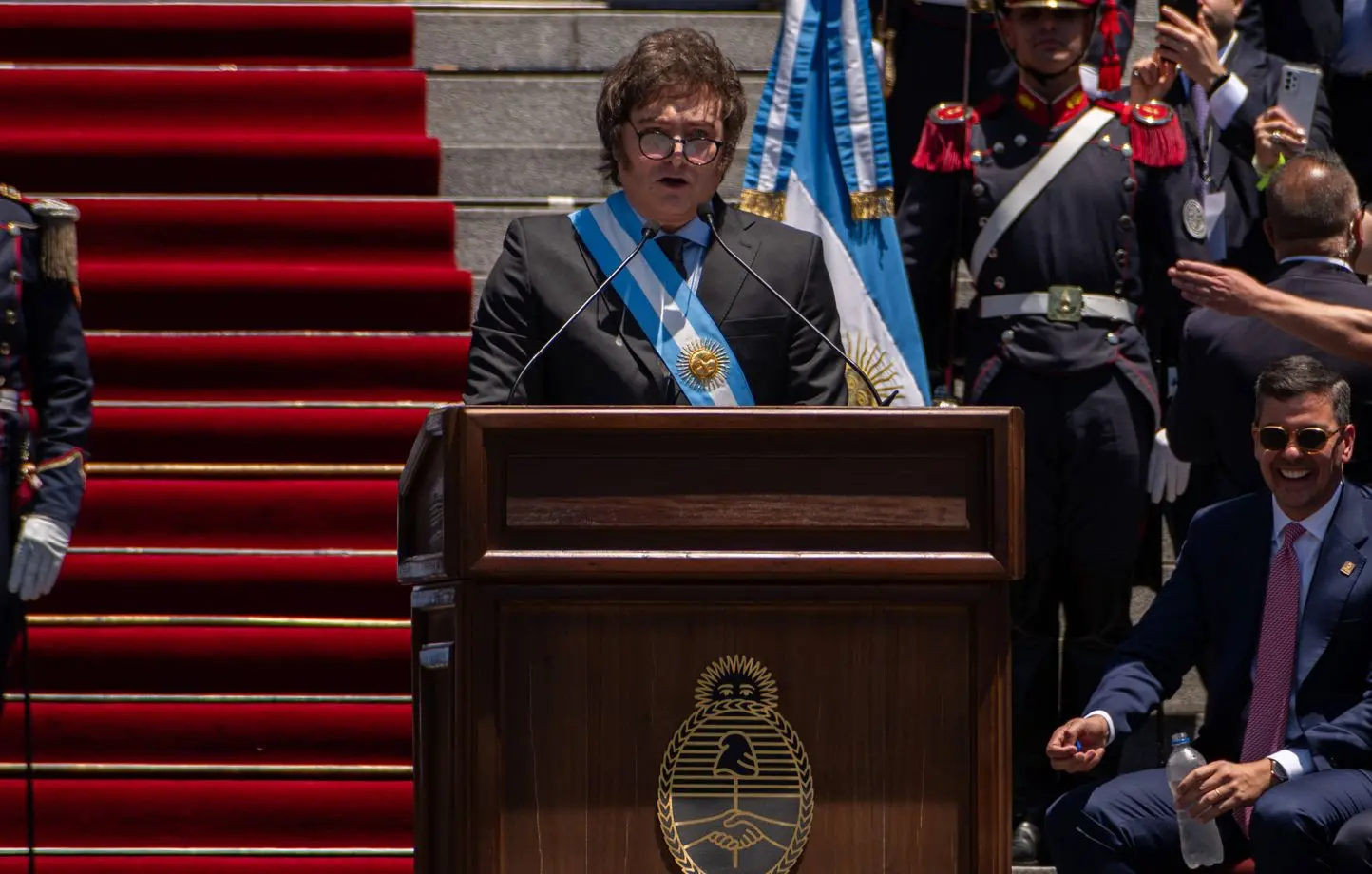
Argentina has officially taken a turn toward ultraliberalism. Javier Milei, elected on November 19, became president on Sunday, announcing an inevitable "shock" of austerity. "There is no alternative to an adjustment, there is no alternative to a shock" in the budget, because "there is no money!" he declared to thousands of supporters outside the Parliament, where he had just been sworn in. "We know that the situation will worsen in the short term. But after that we will see the fruits of our efforts," he added, promising "all necessary decisions to fix the problem caused by 100 years of waste by the political class."
Milei Sees the State as an "Enemy"
In front of him, a sea of sky-blue and white Argentine flags cheered his speeches, with cries of "Libertad, Libertad," and even "Motosierra!" (chainsaw!), a reference to the tool he brandished during the campaign to symbolize the cuts to come in the "enemy state." At midday, Javier Gerardo Milei, 53, became the twelfth president of Argentina since the return of democracy forty years ago, swearing before parliamentarians to honor "with loyalty and patriotism" this charge, and then donning the presidential sash. He also received the traditional sceptre made to measure for each president, bearing in his case engravings on the pommel of the faces of his five English mastiff dogs—"his children," as he calls them.
Milei was inaugurated under the benevolent gaze of nationalist or conservative leaders and politicians who had enthusiastically welcomed his victory: Brazil's Jair Bolsonaro, Hungary's Viktor Orban, the leader of Spain's far-right Vox party, Santiago Abascal. Also present was Ukraine's Volodymyr Zelensky, with whom Javier Milei shared a long embrace. The King of Spain and the presidents of neighboring Uruguay, Chile, and Paraguay were also in Buenos Aires. Brazil's Lula, who had been sharply criticized by Milei in the past, delegated his foreign minister.
Inflation at 143% Annually
Latin America's third-largest economy, but mired in chronic inflation at 143% annually, structural debt, and 40% poverty, Argentina is bracing for painful adjustments. Uncertainty remains about the very first measures: devaluation of the peso? Initial budget cuts? Restriction or even prohibition of monetary issuance? On Sunday, Javier Milei reaffirmed that a first concrete objective will be a 5% reduction in the budget deficit as a share of GDP, which "will fall on the state, not the private sector."
But until then, "people will have for the first time in a long time 'free' prices: the end of 'controlled prices,'" estimates Viktor Beker, an economist at the University of Belgrano, predicting high inflation in December and January. Milei himself warned that inflation will not be brought under control before "18 to 24 months."
The Rise of a Libertarian Outsider
Milei's ascent has been nothing short of meteoric. A former economics professor and television pundit, he burst onto the political scene with a fiery anti-establishment message that resonated with Argentines fed up with decades of economic mismanagement. His campaign was characterized by theatrical stunts, including waving a chainsaw at rallies to symbolize his promise to slash government spending. He has called the state an "enemy" and pledged to shrink it dramatically, eliminate the central bank, and dollarize the economy.
His victory marks a profound shift in Argentine politics, which has been dominated by the Peronist movement for much of the past century. Milei's brand of libertarianism, inspired by US politicians like Donald Trump and Brazil's Jair Bolsonaro, has attracted international attention. His inauguration was attended by a who's who of the global right, underscoring his alignment with like-minded leaders.
Milei's personal life has also drawn attention. The 53-year-old is unmarried and has no children, instead showering affection on his five English mastiffs, whom he calls his "children." He has said he communicates with them through a medium and has had them cloned. His eccentricities have fascinated the public and added to his unconventional image.
Economic Crisis and the Road Ahead
Argentina's economic crisis is the worst in decades. Inflation is running at 143% annually, the highest since the early 1990s. The country has defaulted on its debt multiple times, most recently in 2020. Foreign reserves are depleted, and the peso is under severe pressure. The poverty rate has soared to 40%, and the middle class is struggling to make ends meet.
Milei has promised a radical shock therapy to stabilize the economy. His plan includes cutting the budget deficit by 5% of GDP, which he insists will be achieved by reducing state spending rather than raising taxes. He has also vowed to eliminate the central bank and adopt the US dollar, though he has recently softened his stance on dollarization, saying it will be a gradual process.
However, Milei faces significant obstacles. His party, La Libertad Avanza, has only a small presence in Congress, meaning he will need to negotiate with other parties to pass his reforms. He also faces opposition from powerful unions and social movements that are likely to resist austerity measures. The country is also grappling with a severe drought that has hit agricultural exports, a key source of foreign currency.
Economists warn that Milei's shock therapy could lead to a sharp recession and social unrest in the short term. But his supporters argue that there is no alternative after years of failed policies. "The situation will worsen before it gets better," Milei has repeatedly warned. His promise to end "100 years of waste by the political class" has struck a chord with many Argentines who are desperate for change.
International Reactions and Implications
The international community is watching closely. Argentina is a major agricultural exporter and a member of the G20. Its economic stability is important for the region. Milei's election has been welcomed by investors who hope his reforms will open up the economy. Argentine bonds and stocks rallied after his victory. However, some neighboring countries are wary of his ideological stance. Brazil's Lula, a leftist, has had a strained relationship with Milei, though both have signaled a willingness to work together.
Milei's first days in office will be closely scrutinized. He has promised to announce a package of emergency measures soon after taking office. These could include a devaluation of the peso, spending cuts, and deregulation. The markets are expecting bold action, but the social and political costs could be high. As Argentina embarks on this uncertain path, the world watches to see whether Milei's gamble will pay off or plunge the country into further turmoil.
One of the key challenges will be managing the social impact of austerity. Argentina has a strong tradition of social protest, and unions have already vowed to resist any cuts to public services. Milei has promised to maintain social spending while cutting other areas, but many are skeptical. The country's powerful social movements, known as piqueteros, have blocked roads and staged massive demonstrations in the past. They are likely to mobilize again if Milei's policies lead to job losses and higher prices.
Another challenge is the political opposition. Although Milei won the presidency, his coalition lacks a majority in Congress. He will need to build alliances with more moderate parties, including former President Mauricio Macri's PRO, which has supported some of his proposals. However, Macri has indicated that his support is conditional on Milei's willingness to govern pragmatically.
On the economic front, Milei's plan to dollarize the economy is fraught with risks. Argentina lacks sufficient dollar reserves to convert all pesos into dollars. A hasty dollarization could trigger a banking crisis and hyperinflation. Milei has acknowledged these risks and has said that dollarization will be a gradual process, starting with the elimination of the central bank's ability to finance the government.
The International Monetary Fund (IMF) is also a key player. Argentina has a $44 billion loan program with the IMF, which Milei has criticized. He has promised to renegotiate the terms of the program, but the IMF has said it is willing to work with the new government. The outcome of these negotiations will be crucial for Argentina's access to international credit markets.
As Milei takes office, the eyes of the world are on Argentina. The country's experiment with ultraliberalism will be watched closely by other nations grappling with similar economic challenges. Whether Milei's shock therapy succeeds or fails, it will have profound implications for Argentina and beyond.
Source:20 Minutes News