

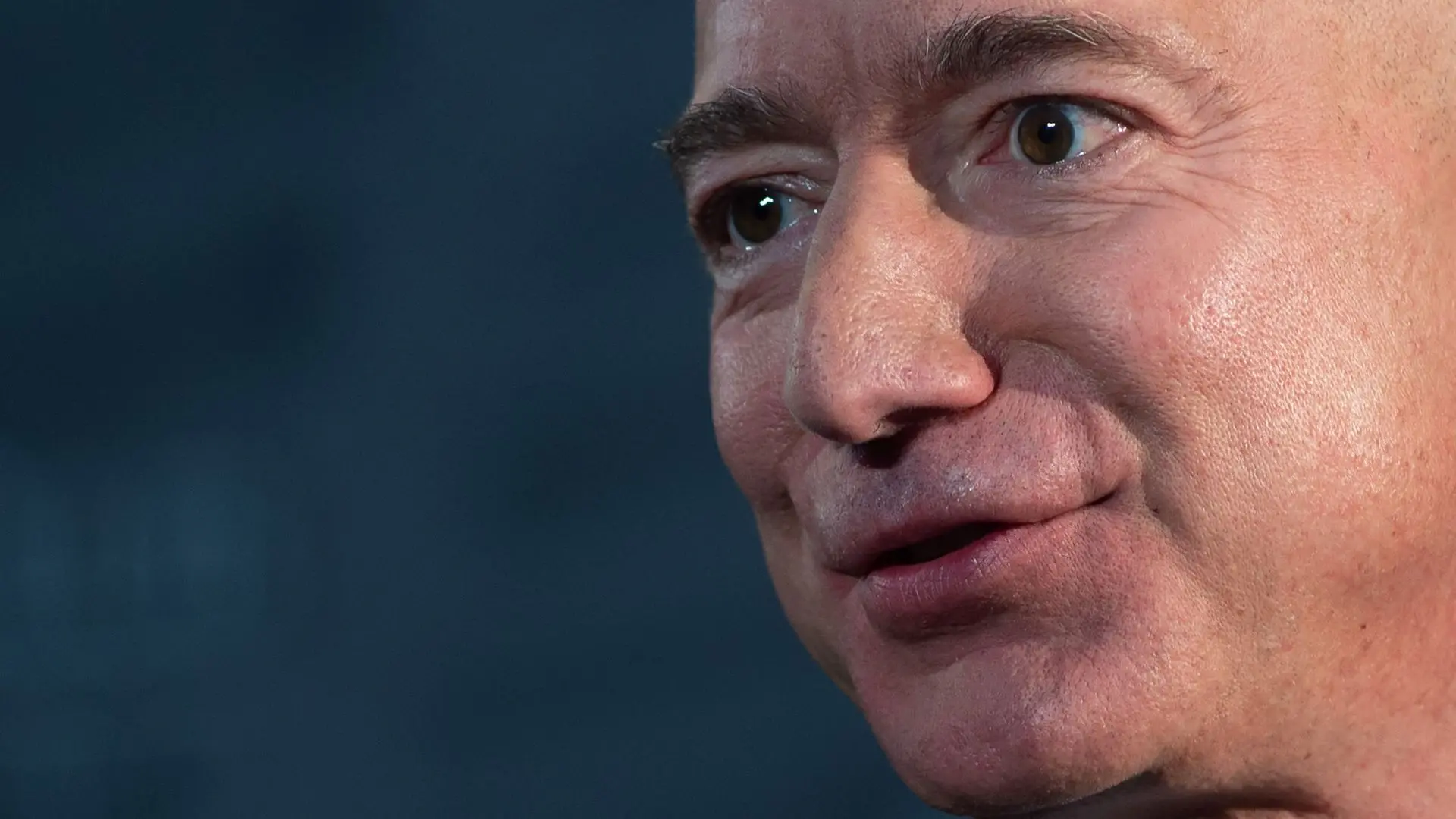
Jeff Bezos, the founder and chief executive of Amazon, announced on Tuesday that he will step down from his role as CEO in the third quarter of 2021, handing the reins to Andy Jassy, the longtime head of Amazon Web Services. The 57-year-old billionaire, who started the company in his garage in 1994, will become executive chairman and said he will remain 'engaged' in major decisions. The move marks the end of an era for the e-commerce giant that Bezos built into one of the world's most valuable companies.
Bezos, known for his relentless determination and willingness to fight back when attacked, has become one of the richest and most powerful individuals on the planet. His journey from a modest childhood to the pinnacle of global business is a story of risk-taking, long-term vision, and an unwavering focus on customer obsession. As he prepares to leave the day-to-day management of Amazon, he leaves behind a sprawling empire that dominates online retail, cloud computing, and voice-activated assistants, while facing increasing scrutiny over its market power and labor practices.
Early Life and the Birth of Amazon
Born Jeffrey Preston Jorgensen in Albuquerque, New Mexico, in 1964, Bezos was adopted as a young child by his Cuban immigrant stepfather, Miguel Bezos, whose surname he took. His mother was a high school student when she gave birth to him, and his biological father was an immigrant from Cuba. Bezos has spoken publicly about his modest upbringing, recalling how his family moved frequently and how he developed an early fascination with science and technology.
After graduating from Princeton University in 1986 with degrees in electrical engineering and computer science, Bezos worked on Wall Street for several years, including at the hedge fund D.E. Shaw. It was there that he conceived the idea for an online bookstore, driven by his fascination with the internet's potential for explosive growth. In 1994, he quit his job, drove across the country to Seattle, and founded Amazon in the garage of his rented home. The company initially operated as an online bookstore, but Bezos's vision was far larger: he wanted Amazon to become the 'everything store.'
The early years were marked by financial losses and skepticism from investors, but Bezos persisted. His strategy was to prioritize growth over short-term profits, investing heavily in infrastructure, technology, and customer experience. Amazon went public in 1997, and despite the dot-com crash of the early 2000s, Bezos's company survived and thrived. The introduction of Amazon Prime in 2005, with its fast shipping and streaming services, revolutionized e-commerce. The launch of Amazon Web Services (AWS) in 2006 created a new industry—cloud computing—that now powers much of the internet.
Amazon's rise was not without setbacks. In the late 1990s, the company burned through cash and faced skepticism from Wall Street. But Bezos's 'regret minimization framework'—a mental model for making decisions by imagining himself at 80 looking back—guided him through the turmoil. He famously told investors that Amazon would not prioritize short-term profits, and he stuck to that promise for years. The strategy worked: as Amazon's revenue grew, its stock price soared, creating enormous wealth for Bezos and early investors.
Building an Empire and Becoming the Richest Man
Under Bezos's leadership, Amazon expanded far beyond books. It moved into clothing, furniture, groceries, streaming, and even pharmaceuticals, launching an online pharmacy in late 2020. The company's market capitalization soared past $1 trillion, and Bezos's personal wealth grew accordingly. In 2018, he became the richest person in modern history, and he has since traded the top spot with Tesla CEO Elon Musk. Forbes estimated his net worth at $196 billion in early 2021.
Bezos's management philosophy is often described as 'Day 1' thinking—a commitment to staying innovative and avoiding complacency. He is famous for his 'two-pizza rule' for meetings (keeping teams small enough to be fed by two pizzas) and his insistence on written memos over PowerPoint presentations. His approach has made Amazon a disruptive force across multiple industries, earning him the nickname 'chief disruptor.' However, the company's aggressive tactics have also drawn criticism from competitors, regulators, and labor unions, who accuse Amazon of crushing competition and mistreating workers.
The launch of AWS in 2006 was a turning point. What began as an internal project to manage Amazon's own computing needs became a lucrative business that now generates the majority of the company's operating income. AWS powers everything from Netflix to NASA, and it has spawned a generation of cloud-based startups. Jassy, who led AWS from its inception, is widely credited with building it into a market leader.
Other Ventures and Philanthropy
Beyond Amazon, Bezos owns The Washington Post, which he purchased in 2013 for $250 million. He has consistently promised to uphold the newspaper's editorial independence, though his ownership has drawn the ire of former President Donald Trump, who frequently attacked both Bezos and the Post. Bezos also founded Blue Origin, a private spaceflight company, in 2000. The company aims to make space travel accessible and is developing a lunar lander as part of NASA's Artemis program. In 2021, Bezos announced he would fly on Blue Origin's first crewed spaceflight.
Blue Origin, founded in 2000, has been slower to achieve milestones than SpaceX, but Bezos has invested billions of dollars into the company. Blue Origin's New Shepard rocket has completed multiple suborbital test flights, and the company is developing the New Glenn orbital rocket. In 2019, Bezos unveiled a mockup of a lunar lander called Blue Moon, which he hopes will ferry cargo and astronauts to the Moon. He has said that his ultimate goal is to enable millions of people to live and work in space.
In addition to his business interests, Bezos has created several philanthropic organizations. The Day 1 Fund, launched in 2018, supports homeless families and early childhood education. The Bezos Earth Fund, announced in 2020 with a $10 billion commitment, funds climate change research and conservation efforts. Despite these initiatives, Bezos has faced criticism for not signing the Giving Pledge and for his relatively modest philanthropic giving compared to his vast wealth. Some critics argue that his giving is a fraction of what he could afford, while supporters note that his philanthropic work is still in its early stages.
Personal Life and Public Scandal
Bezos's personal life has often made headlines. In 2019, he announced his divorce from MacKenzie Scott after 25 years of marriage. The couple had four children together. The divorce settlement made MacKenzie one of the wealthiest women in the world, and she has since become a prominent philanthropist. That same year, Bezos became embroiled in a scandal when the National Enquirer, a tabloid owned by American Media Inc., threatened to publish nude photos of him and expose his extramarital affair. Bezos accused the publication of extortion and blackmail, and he publicly released emails detailing the threats. The episode was widely seen as an example of his willingness to fight back against adversaries, including those with ties to Trump.
Bezos is also known for his eccentric interests. A lifelong science fiction fan, he has funded the construction of a 10,000-year clock in Texas, designed to symbolize long-term thinking. The clock, which stands 500 feet tall, is meant to run for ten millennia. He has also invested heavily in Blue Origin, which competes with Elon Musk's SpaceX in the commercial space race.
Bezos is known for his distinctive, booming laugh, which he often uses to defuse tension or express amusement. Despite his immense wealth, he has cultivated an image of a simple, curious, and driven entrepreneur. He frequently wears jeans and a button-down shirt, and he has been photographed driving a Honda Accord in the early years of Amazon's success. His public persona has evolved from a nerdy tech founder to a muscular, bald billionaire who is comfortable in the spotlight—whether testifying before Congress or flying to space.
Criticism and Challenges
Despite his success, Bezos and Amazon have faced growing scrutiny. The company has been criticized for its treatment of warehouse workers, who report grueling conditions and inadequate safety measures. Amazon has also been accused of using its market dominance to stifle competition, leading to antitrust investigations in the United States and Europe. Bezos himself has been criticized for his reluctance to testify before Congress, though he eventually appeared in 2020. In response to criticism, Amazon has raised its minimum wage to $15 an hour and invested in worker safety, but concerns remain.
Bezos's departure comes at a time when Amazon is more powerful than ever, buoyed by the pandemic-driven surge in online shopping. Andy Jassy, who built AWS into a profit engine, is expected to maintain Amazon's aggressive expansion while perhaps softening its rough edges. Bezos, as executive chairman, will still wield significant influence, particularly over major strategic decisions.
What's Next for Bezos?
In a letter to employees announcing his departure, Bezos urged them to 'keep inventing' and 'don't despair when the idea seems crazy at first.' He emphasized that Amazon's success has always been driven by a willingness to take risks and learn from failure. As he transitions to executive chairman, Bezos plans to focus on Blue Origin, The Washington Post, and his philanthropic efforts. He has also said he will remain engaged in Amazon's big bets, such as its push into physical stores, healthcare, and artificial intelligence. In his letter, he wrote: 'Keep inventing, and don't despair when the idea seems crazy at first. Remember to wander. Let curiosity be your compass. It remains Day 1.'
Source:RTBF News