

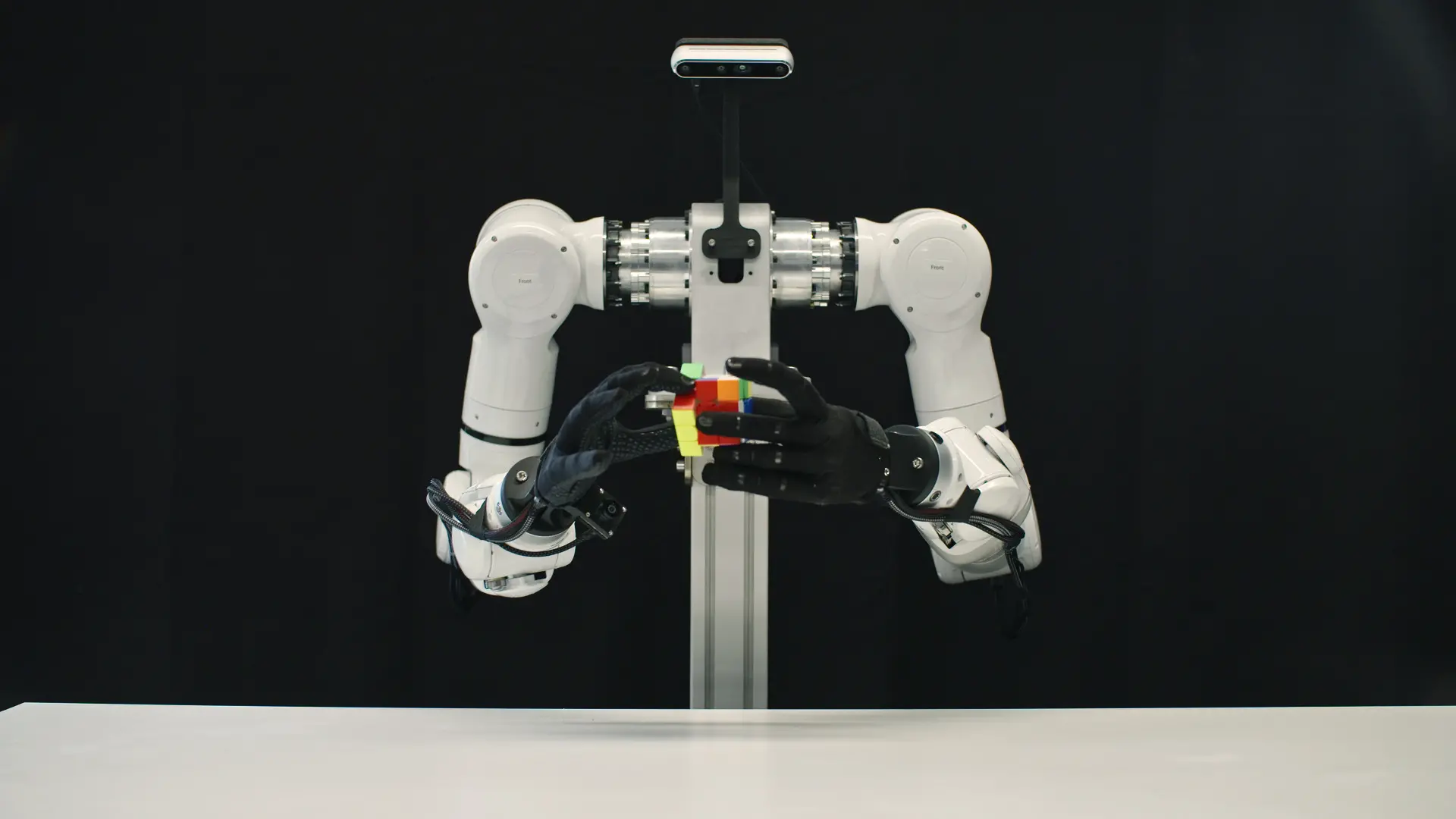
French robotics-focused startup Genesis AI has officially entered the foundational model arena with the release of its first model, GENE-26.5, alongside a human-like hand built entirely in-house. The company says the appendage can perform complex tasks ranging from cooking dishes to solving a Rubik's Cube, marking a significant step in the pursuit of general-purpose robotic dexterity.
The announcement comes less than a year after Genesis AI completed a substantial $105 million (approximately £77.2 million) seed funding round in July of last year. That round, one of the largest of its kind for a European AI robotics company, provided the financial firepower needed to accelerate development of both the foundational AI model and the physical hardware. According to co-founder and chief executive Zhou Xian, the company initially set out with a singular focus: building a model capable of powering real-world robotics. However, the team quickly realized that to achieve precise, end-to-end control it would need to design its own robotic hand rather than rely on third-party hardware.
A Leap in Robotic Dexterity
The human-like hand developed by Genesis AI is notably different from the robotic grippers used by dozens of other companies in the field. Most existing robotic hands feature only two or three fingers, optimized for simple grasping tasks. In contrast, Genesis AI's unit closely resembles a human appendage, with five articulated digits and a form factor that allows data gathered from human demonstrations to be transferred directly to the machine. This design choice is critical for training AI models that can operate in environments built around human ergonomics.
In a demonstration video released by the company, a pair of Genesis AI hands are shown carrying out intricate and delicate processes. The hands prepare a smoothie by picking up fruits, opening a lid, and operating a blender. They also play a piano melody with individual finger movements, showcasing fine motor control that is rare in robotic systems. Perhaps most strikingly, the hands can manipulate a Rubik's Cube, solving it through a sequence of coordinated rotations—a task that requires not only dexterity but also real-time perception and planning.
Overcoming the Data Bottleneck
One of the biggest challenges in robotic learning is the scarcity of high-quality training data. While AI models for language and vision can be trained on vast datasets scraped from the internet, robots need physical interaction data that is far more difficult to capture. Genesis AI has addressed this problem by developing lightweight sensor gloves that workers in fields such as pharmaceuticals or manufacturing can wear during their daily routines. These gloves capture fine-grained hand movements, pressures, and dexterous manipulations, and the data is then passed along to the AI model for training.
This approach acknowledges a practical reality: human workers already perform the tasks that robots are expected to master. By capturing their expertise, the company can quickly build a library of demonstrations without the need for expensive motion-capture setups or scripted robot teleoperation. Genesis AI also says that data from the gloves can be combined with information gleaned from ordinary videos of workers carrying out tasks. This multi-modal data collection strategy allows the model to learn from both structured sensor data and unstructured visual observations, significantly expanding the training distribution.
The Human-Like Design Advantage
The decision to mimic the human hand so closely is not purely aesthetic. Zhou Xian and his team believe that the more faithfully a robotic hand replicates human anatomy, the more directly human data can be transferred to the robot. If a hand has a different number of fingers or an unusual joint arrangement, the mapping between human actions and robot actions becomes noisy and lossy. A five-fingered hand with similar proportions to a human hand enables a much cleaner teleoperation and learning pipeline.
Another advantage is the ability to operate in human-centric environments. Tools, appliances, and workspaces are designed for human hands. A robotic hand with human-like form can use a knife, turn a knob, grip a hammer, or type on a keyboard without requiring custom modifications. This could make robots far more useful in domestic, industrial, and laboratory settings. Genesis AI is betting that this design will unlock a new wave of real-world automation where traditional, purpose-built grippers fall short.
Building the Full-Stack Approach
Genesis AI's strategy is notably vertical. Rather than supplying the model and leaving hardware development to third parties, the company builds its own hand and plans to integrate it into a full-body, general-purpose robot. This full-stack approach gives the company total control over the entire robot learning pipeline—from raw sensor data to actuation commands. It also allows for tighter integration between the perception system and the motor control system, which is essential for complex manipulation tasks.
According to the company, work is already underway to supplement the mechanical hand with a complete humanoid body. While the hand is an impressive feat in itself, the ultimate goal is to create a robot capable of navigating and acting in the world as fluidly as a human worker. The seed funding will likely be used to hire more engineers, expand data collection efforts, and advance the development of the full-body platform. However, the company has not provided a timeline for when the full-body robot will be ready for commercial deployment.
Backing and Talent
Genesis AI has attracted significant attention from prominent investors and technologists. The seed funding round was co-led by Eclipse and Khosla Ventures, with additional backing from Bpifrance, HSG, former Google chief Eric Schmidt, telecoms entrepreneur Xavier Niel, MIT Computer Science and Artificial Intelligence Laboratory director Daniela Rus, and Apple distinguished scientist Vladlen Koltun. This diverse group of investors brings both financial resources and deep technical expertise in AI, robotics, and manufacturing.
The company's co-founder and president, Theophile Gervet, previously worked at France's Mistral AI, one of Europe's most prominent AI startups. That experience has likely shaped Genesis AI's approach to building large-scale models for physical interaction. The company also retains a substantial presence in Europe, which it attributes to the continent's large talent base and potential market of industrial customers. Europe has long been a hub for advanced manufacturing, pharmaceutical production, and precision engineering, making it a natural market for robots that can handle delicate tasks.
Currently, Genesis AI's team of 60 people is split roughly evenly between the United States and Europe, with a slightly larger group based in San Carlos, California. The company also maintains offices in Paris and London. This transatlantic footprint allows it to tap into the AI research ecosystems of both regions while staying close to potential customers in the US tech industry and European industrial sectors.
Broader Implications for Industry
The introduction of a human-like robotic hand combined with a foundational model has broader implications for the future of work. In sectors such as pharmaceuticals and electronics manufacturing, there is a growing demand for automation that can handle tasks requiring fine motor skills and adaptability. Traditional industrial robots are excellent at repetitive tasks but struggle with variability. A robot powered by GENE-26.5, trained on human demonstration data, could potentially handle a much wider range of tasks with minimal reprogramming.
At the same time, the use of sensor gloves to collect data from workers raises important questions about the relationship between humans and robots. Will workers be enthusiastic about helping to train a potential robotic replacement? That remains to be seen. However, Genesis AI's approach may also create new opportunities for human-robot collaboration, where robots learn from and assist human workers rather than simply replacing them. In the near term, the gloves are likely to be positioned as a tool for improving workplace safety and efficiency, rather than as a threat to employment.
The development of foundation models for robotics is still in its early stages, but companies like Genesis AI are pushing the boundaries of what is possible. By combining sophisticated AI with hardware designed to mimic human capabilities, they are inching closer to the long-held vision of general-purpose robots that can operate seamlessly in the human world. The eventual success of these efforts will depend not only on technical breakthroughs but also on how well these systems can be integrated into existing industries and workflows.
In the meantime, Genesis AI's hand has already demonstrated a level of dexterity that could have immediate applications in labs, production lines, and even homes. As the company continues to expand its data collection efforts and refine its models, the gap between robotic and human manual dexterity is likely to narrow further. The path from a single hand to a full-body robot is long, but Genesis AI appears determined to walk it.
Source:Silicon UK News