

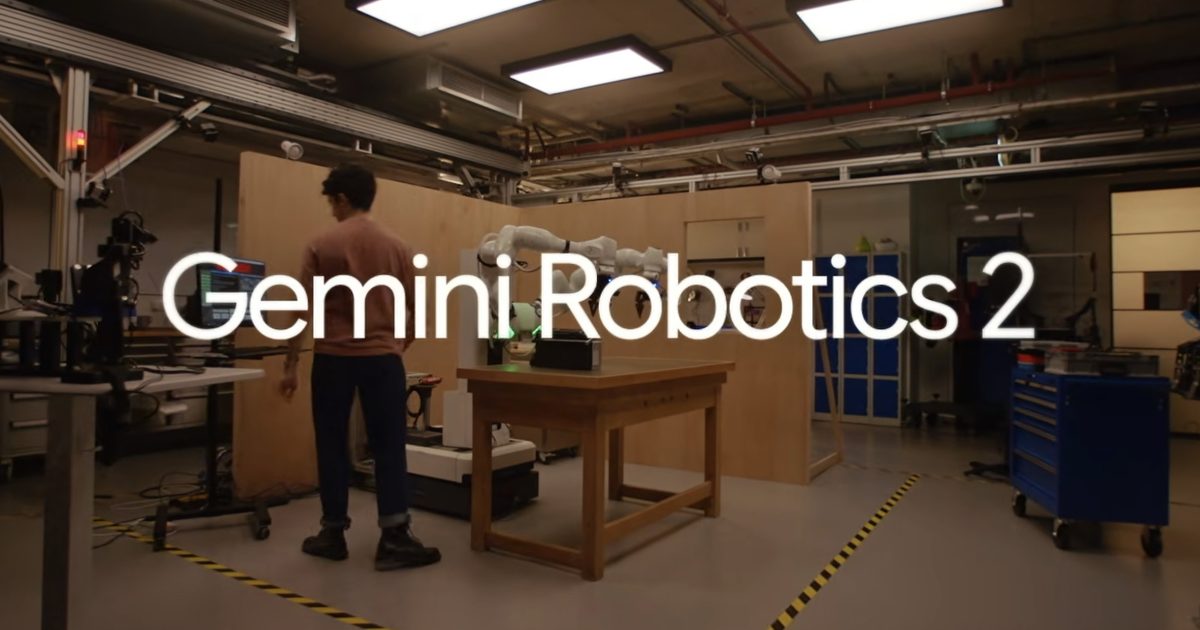
Google DeepMind has taken another major step toward making humanoid robots useful in real-world environments. The company introduced Gemini Robotics 2, an AI system designed to give robots the ability to think, move, and cooperate in ways that were previously limited to science fiction. Building on the original Gemini Robotics model, this new version moves beyond pre-programmed routines and remote control. Instead, it helps robots reason about their surroundings and adapt when things do not go as planned.
Key facts at a glance
- Gemini Robotics 2 is an AI system for whole-body control of humanoid robots.
- It can control five-fingered hands for tasks like tying knots or sealing zip-lock bags.
- Gemini Robotics ER 2 handles long-horizon planning and multi-robot coordination.
- An on-device version adapts to a new robot body in hours using as few as 200 examples.
- The new ASIMOV-Agentic benchmark tests whether robots know when to refuse risky actions or ask for help.
- ER 2 is available on Google AI Studio; other models are rolling out to early access partners.
From tabletop tasks to whole-body control
Most robotic AI systems in recent years have focused on tabletop manipulation. A robot arm with a gripper can pick up, place, stack, or sort objects within a confined workspace. Those systems are useful in factories and laboratories, but they do not capture the complexity of the real world. A robot that cleans a home, restocks a warehouse, or assists in a hospital needs to move its whole body. It has to walk, bend, reach, and carry objects while maintaining balance and avoiding obstacles.
Gemini Robotics 2 is designed to address that challenge. Instead of only controlling a robot's upper body, it controls the entire humanoid, from the feet to the fingertips. This allows for tasks that require locomotion and manipulation at the same time. In one demonstration, Apptronik's Apollo 2 robot was given a simple instruction: place a watering can into a bin on a bottom shelf. The robot walked across the room, picked up the can, navigated to the bin, and placed it in the correct location. The full sequence involved walking, grasping, object transport, and precise placement, all without human intervention.
This kind of task is deceptively difficult for robots. Every step changes the robot's center of mass. The position of the object relative to the target changes as the robot moves. The bin may be partially hidden, and the robot needs to adjust its reach and posture. By controlling the whole body, Gemini Robotics 2 can handle these complexities in a unified way.
Hands that can tie knots and seal bags
The new model also brings a noticeable leap in dexterity. It can control a five-fingered robotic hand well enough to perform delicate manipulation tasks. In tests, the system was able to tie a knot, seal a zip-lock bag, and unscrew a light bulb. These tasks require fine finger coordination, the ability to apply the right amount of force, and continuous feedback from touch sensors.
Dexterity is one of the biggest bottlenecks in robotics. Many robots can move an object from point A to point B, but fewer can handle objects that are flexible, soft, or irregularly shaped. A knot, for example, has no rigid structure. Sealing a zip-lock bag requires pinching and pulling with just the right tension. Unscrewing a bulb requires a stable grip and controlled wrist rotation. Gemini Robotics 2 performs these tasks with a five-fingered hand, showing that the AI model can work with complex end effectors.
At the same time, the model works smoothly with simpler two-fingered grippers. For industrial and warehouse applications, parallel-jaw grippers are still common because they are reliable and cost-effective. Gemini Robotics 2 can handle both types of hardware, which means it can be deployed across many different robots without requiring a complete redesign.
Gemini Robotics ER 2: the project manager inside the robot
Alongside the main model, Google is introducing Gemini Robotics ER 2, a reasoning model that acts as the robot's project manager. While Gemini Robotics 2 handles motion and manipulation, ER 2 is responsible for higher-level planning. It breaks down instructions into a sequence of steps, keeps track of progress over multi-minute tasks, and can coordinate multiple robots working on the same job.
This separation of concerns is useful. A robot needs both fast, reactive control and slow, deliberate reasoning. The reasoning model can decide what to do, while the control model figures out how to do it. ER 2 also helps robots handle interruptions. If a can falls over or a shelf is moved, the system can revise its plan without starting over.
There is also an on-device version of ER 2 designed for robots that operate without an internet connection. This is important for real-world deployments where connectivity is unreliable or where privacy concerns require local processing. The on-device model can adapt to a brand-new robot body in just a few hours using as few as 200 examples. That is a significant reduction in the data requirement. In the past, adapting a robot to a new platform often required collecting thousands of demonstrations over weeks.
Safety: knowing when to stop or ask for help
Safety is a major concern as robots move out of controlled labs and into human environments. Google gave this aspect special attention this time around. The company introduced a new benchmark called ASIMOV-Agentic, which is designed to test whether robots know when to refuse a risky action or ask a human for help instead.
The benchmark is named after Isaac Asimov, the science-fiction author who formulated the Three Laws of Robotics. ASIMOV-Agentic goes beyond simple notions of causing physical harm. It evaluates whether a robot can recognize situations where it lacks enough information, where an instruction is ambiguous, or where acting could have unintended consequences. A safe robot should not blindly follow an order if doing so would damage property or endanger someone.
Gemini Robotics ER 2 also includes a physical safety mechanism. It can sense when a person gets too close to the robot and bring the robot to a safe stop. This is similar to the emergency-stop functions found on industrial robots, but it is based on perception rather than a physical button. The robot can detect distance, estimate speed, and decide when a person is at risk.
Potential applications and industry impact
The combination of whole-body control, dexterity, and reasoning makes Gemini Robotics 2 relevant for several industries. In logistics, robots could unload trailers, sort parcels, and pack boxes in environments that are not fully structured. In home robotics, a humanoid robot with these abilities could perform chores like tidying up, loading a dishwasher, or folding laundry.
The ability to coordinate multiple robots is also significant. Many real-world jobs require more than one person working together. For example, moving a heavy object might require two robots to lift and carry it. ER 2 can assign roles, share progress, and synchronize actions among several robots. This brings concepts like multi-robot warehouse automation and collaborative construction closer to reality.
The on-device adaptation capability could lower the cost of deploying robots in new settings. Instead of sending every robot to a lab for retraining, an operator could let the robot learn from a small number of on-site demonstrations. This is critical for small and medium-sized businesses that need flexible automation but do not have extensive AI teams.
Availability and early access
Gemini Robotics ER 2 is already live on Google AI Studio, allowing developers to experiment with the reasoning model. The rest of the models are rolling out to early access partners. This staged rollout is common in AI, but it indicates that Google wants to gather feedback from real-world testing before a broader release.
The announcement comes at a time when the robotics industry is moving toward general-purpose humanoids. Several companies, including Apptronik, are building robots designed to work alongside humans. Pairing those platforms with a robust AI model is the missing piece. Gemini Robotics 2, combined with the ER 2 reasoning layer, could become the common brain for many different robot bodies.
Source:Digital Trends News