

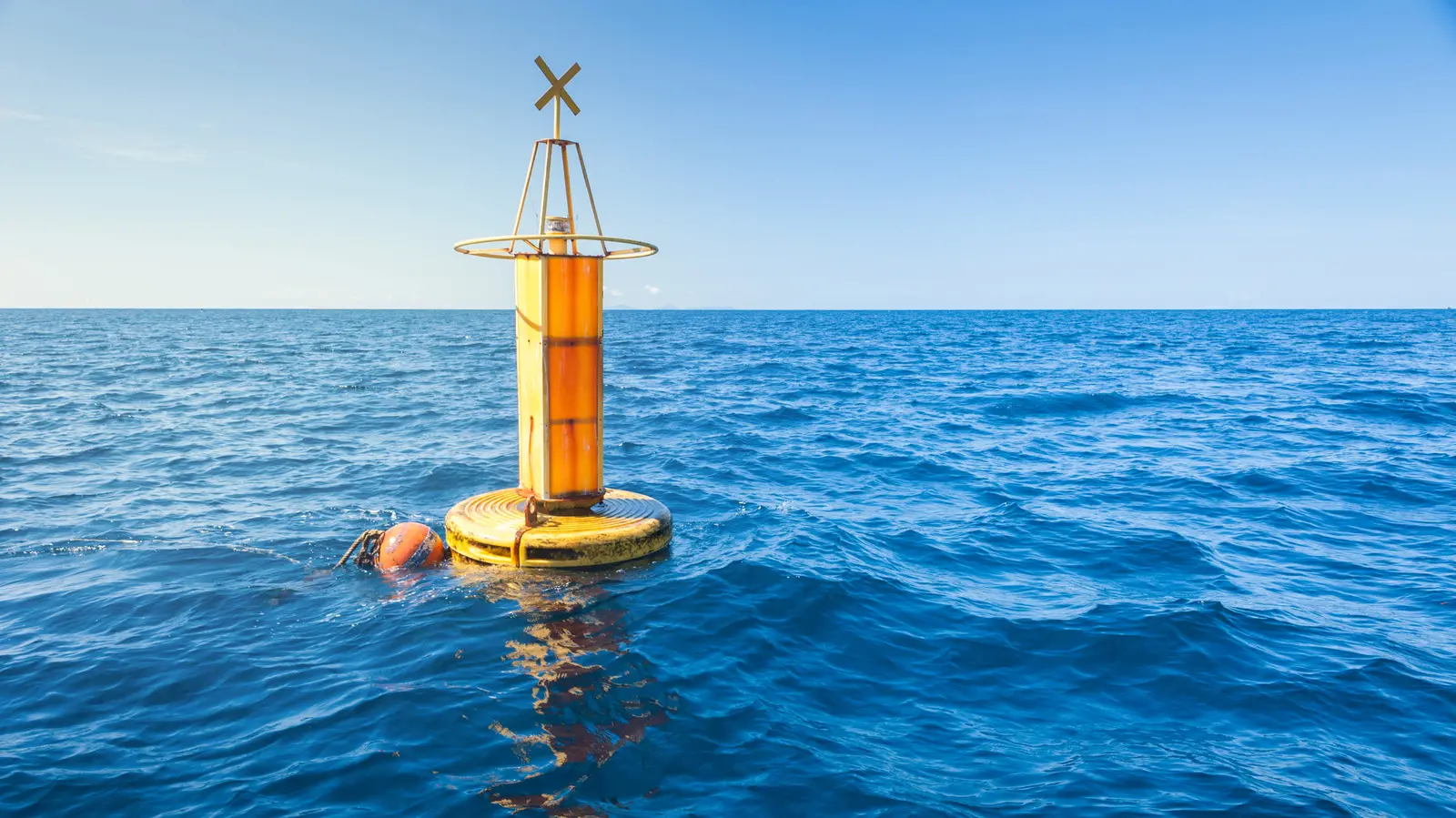
What Keeps a Buoy From Drifting Away?
Ocean buoys come in many shapes, colors, and sizes. Some are designed to drift with currents, while others are built to stay in one exact spot. Stationary buoys mark navigation channels, warn vessels of hazards, protect sensitive marine areas, and carry scientific instruments that monitor weather, waves, and ocean chemistry. A buoy that must remain fixed cannot simply float freely. It needs an anchoring or mooring system that connects it to the seafloor or holds it against wind, waves, and currents.
In shallow water, the solution can be surprisingly hands-on. Saturation divers can descend to nearly 400 feet to drill or jackhammer steel pins, U-bolts, and shovel-shaped anchors into rock or sediment. These mechanical attachments secure a buoy or mooring block directly to the bottom. The work is dangerous and expensive, but it is effective for many coastal navigation buoys, mooring fields, and monitoring stations.
Deep water is a different challenge. When the ocean floor lies thousands of feet below the surface, divers cannot reach it. Instead, deep-sea buoys use extremely heavy weights as anchors that sit on the ocean floor. These anchors are connected to the surface buoy by lengthy runs of cabling, chain, or synthetic line. The concept sounds simple, but engineers must account for powerful forces that can break a mooring, drag an anchor, or cause a buoy to drift away.
Shallow Anchoring Versus Deep-Water Mooring
A mooring system describes all the parts required to secure a floating vessel, device, or structure in the water. That includes anchors, weights, lines, connectors, swivels, and sometimes floats. In shallow water, a heavy concrete block or a screw anchor may be enough. A chain runs from the block to the buoy, and the chain's own weight helps keep the buoy from wandering. In deep water, the scale changes
Source:SlashGear News