

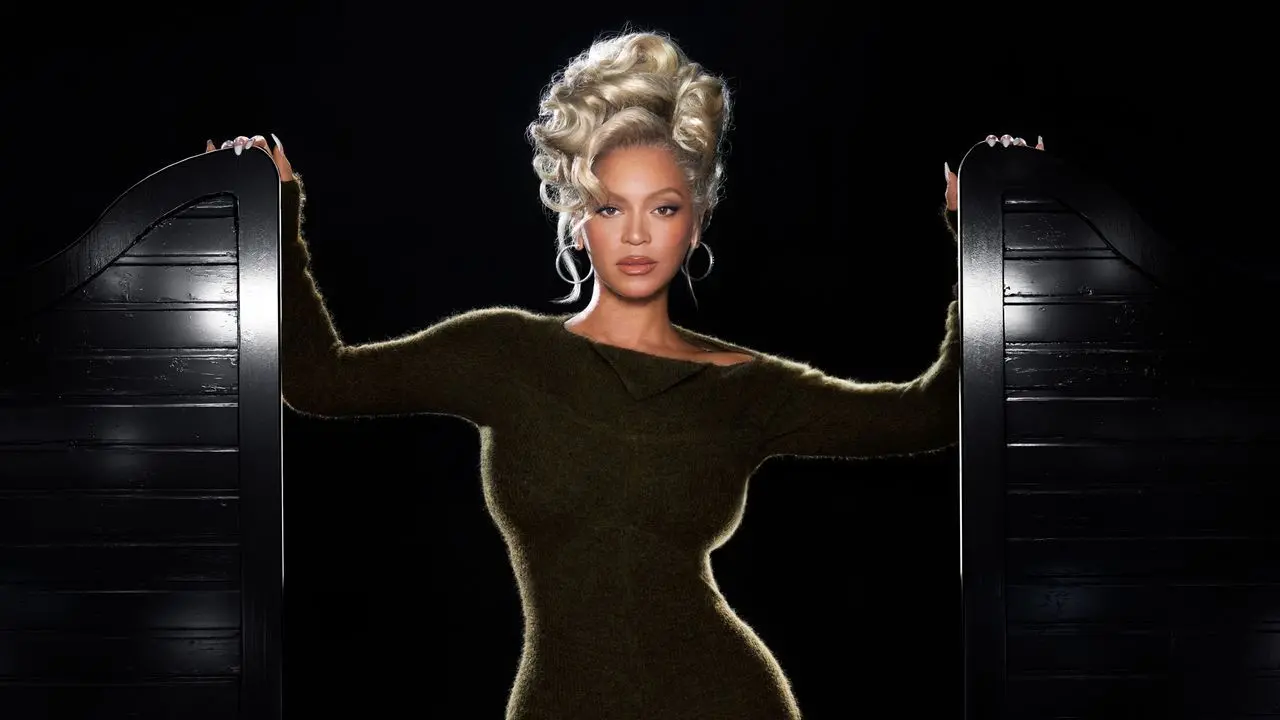
Beyoncé Knowles-Carter is using her eighth studio album, Cowboy Carter, to challenge the genre boundaries that have defined her career and to reclaim a wider American history. The album arrived in spring and is the second chapter in a trilogy that began with Renaissance. Across the project, she argues that categories are traps and that Black artists have long moved across country, R&B, dance, rap, zydeco, blues, opera, and gospel.
Key facts
- Cowboy Carter is Beyoncé’s eighth studio album and the second part of a trilogy that started with Renaissance.
- The title is deliberately Cowboy Carter, not Cowgirl Carter. Beyoncé says the word cowboy has a buried history: up to a quarter of American cowboys were Black, and the term was often used for enslaved men who tended cattle.
- The album samples Joseph Bologne, known as Chevalier de Saint-Georges, on the song Daughter. Beyoncé cites his 18th-century violin concerto as evidence of Black innovation in classical music.
- Texas Hold ’Em became a global hit and helped push country music, fashion, art, and culture back into a wider conversation. Beyoncé also highlighted artists including Shaboozey, Tanner Adell, Willie Jones, Brittney Spencer, Tiera Kennedy, and Reyna Roberts.
- Beyoncé launched the hair-care line Cécred early in the year and chose not to appear in its launch advertising so the products would be judged on their own merits.
- In July, Vice President Kamala Harris used Beyoncé’s song Freedom in the opening spot of her first presidential campaign. The moment felt both historic and inevitable.
- Beyoncé is 43 and has spent nearly three decades in the music industry. She has built rare control over her image, her music, and her business ventures.
- She says her business decisions are driven by love, legacy, and longevity. She prefers quality and integrity over shortcuts and does not work on projects that do not deeply interest her.
- Her daughter Blue Ivy, 12, has moved from watching the creative process to performing in it. Beyoncé says Blue chose the stage herself and earned her place.
- Beyoncé has deliberately released Renaissance and Cowboy Carter without music videos, arguing that the music needed space to breathe in an image-saturated world.
A title that corrects the record
The decision to call the album Cowboy Carter is central to its mission. Beyoncé wants listeners to research the word cowboy and confront the way American history has often been rewritten by the victors. She notes that Black men made up a significant part of the cattle industry and were essential to its development, even as they were denied basic respect. The word cowboy itself, she says, came from the terms used for enslaved men who worked with cows. No one called a Black cattle worker mister. The album turns that history into a statement about dignity, aspiration, and ownership.
That historical correction runs through the music. Cowboy Carter is not simply a country album; it is a lesson in lineage. Beyoncé uses the record to honor forgotten pioneers and to explore real musical inheritances. Linda Martell, the Black country pioneer whose career met resistance similar to Beyoncé’s own, appears on the album. The project insists that Black creativity has always been present in spaces where it was later minimized or erased.
Beyoncé describes the album as part of a longer mission to recenter Black communities in spaces where their influence has been overlooked. That mission has shaped her recent work across country music, the American West, and ballroom culture. Each step forward, she suggests, is also a look backward, a journey through roots that connect individual family trees to a much larger forest.
Cowboy Carter and the trilogy
Beyoncé began work on Cowboy Carter almost five years ago. She points listeners to the lyric about her age in 16 Carriages as a clue to the timeline. The album follows Renaissance, and together the two records form the first two parts of a trilogy in which she explores different genres while refusing to be contained by any one of them.
Genre, in her view, has always been a trap. Throughout her career she has blended R&B, dance, country, rap, zydeco, blues, opera, and gospel. She says Black artists and other artists of color have mastered multiple genres for generations, even when the industry tried to sort them into narrow boxes. The inclusion of Chevalier de Saint-Georges on Daughter is one example of her larger argument: Black musical innovation has existed across centuries and across forms, and audiences should seek out the innovators who came before.
The commercial and cultural life of Texas Hold ’Em gave that argument a global stage. Beyoncé says she was thrilled that the song was embraced around the world and even happier that it helped revitalize country music across fashion, art, and culture. The album also opened doors for newer artists, including Shaboozey, Tanner Adell, Willie Jones, Brittney Spencer, Tiera Kennedy, and Reyna Roberts.
Business on her own terms
At 43, Beyoncé has demonstrated a rare ability to control her image and her business universe. She has become expert at breaking codes and entering new fields while creating new standards and opportunities for others. In business, she says, men are often allowed to be seen as strategists and company brains. Women, especially women in the spotlight, are often reduced to brand faces or marketing tools. Beyoncé wants to change that pattern.
She applies the same approach to business that she applies to music. She focuses on quality, chooses integrity over shortcuts, and rejects the idea that success means resting on a famous name. Real success, she says, is creating something authentic that holds up. The goal is not perfection but something closer to revolution. She does not waste time on projects that do not fascinate her. If she is not thinking about an idea when she wakes up and dreaming about it when she falls asleep, it is not for her.
Her measure of success is also different from most people’s. When she commits, she commits fully. She believes everything can always be improved, and her work is to push toward the best possible version. She is drawn to ideas that fill a gap, solve a problem, or do not yet exist. Otherwise, she is not interested in the opportunity.
Cécred and the case for authenticity
Beyoncé launched Cécred, her hair-care line, early in the year. She says she remains a musician first and has never entered a venture that could pull her away from her art before she felt she had mastered music, her first love. With Cécred, she wanted the brand to be recognized for what it offers to real people and their hair. At launch, she decided not to appear in the advertisements. The first impression had to be based on the products themselves, not on her influence. These are products she has used for years, and she says she knows from first-hand experience that they work.
That decision reflects a broader business philosophy. Beyoncé says she is attracted to authenticity and does not want to be distracted by things that pull her away from it. She is inspired by ideas that solve a problem or fill an empty space. She also tries to challenge herself and the people around her to think differently. Each disappointment, in her view, can become an opportunity to grow or change direction. She trusts God even when the light at the end of the tunnel seems faint.
Family, privacy, and Blue Ivy
Beyoncé organizes her professional schedule around her family. She tries to tour only when her children are not in school. She has long dreamed of a life in which she could travel the world with her family and expose them to different languages, architecture, and ways of life. Her children come to her office after school, join her in the studio, and attend dance rehearsals. It is natural, she says, for them to learn her choreography.
Raising three children is not easy. As they grow, they become fuller individuals with their own needs, hobbies, and social lives. Beyoncé calls her twins a gift from heaven and says parenting constantly teaches her about herself. It requires prayer and patience, but she loves it. It keeps her grounded and brings its own rewards.
Blue Ivy has become a creative force in her own right. Beyoncé describes her as an artist with excellent taste in music and fashion. Blue writes well and is a fantastic painter and actor. She has been inventing characters since she was three. Beyoncé insists that she did not push Blue onto the stage; Blue wanted it. She took the work seriously, earned her place, and, most importantly, had fun. Watching her mature a little more each night became its own source of pride.
Beyoncé is equally protective of her children’s private lives. She says it is very easy for celebrities to turn their lives into performances, but she has worked hard to preserve boundaries and protect herself and her family. Her personal life is not a brand. No amount of money, she says, is worth her peace of mind.
No videos, no pop-star formula
The absence of music videos for Renaissance and Cowboy Carter was deliberate. Beyoncé thought it was important, in an age when images are everywhere, for the world to focus on the voice. The music is rich in history and instrumentation, and it takes months to absorb, research, and understand. Sometimes a visual can distract from the quality of the voice and the music. The songs needed space to breathe on their own.
She points out that fans around the world became the visual. The tour provided a visual, and her film provided another. The decision was not an rejection of visuals but a choice about where attention should go first. Beyoncé has also moved away from what she calls the pop-star formula. A knee injury became an occasion to transition into a new kind of performer. She stopped focusing on what was popular and began focusing on qualities that improve with time and experience. Good music and strong messages, she says, never retire.
She makes a similar distinction about her 2011 album 4. She would not call it anti-pop; she respected pop. But at the time, everyone was making pop and dance music while R&B and soul seemed to be getting lost. It was popular and fun, but it was not the direction she wanted for her career. She wanted something deeper and more musical, which led to songs such as 1+1 and Love On Top.
What inspires her now
Beyoncé says she loves and respects the singer-songwriters releasing music right now, including Raye, Victoria Monét, Sasha Keable, Chloe x Halle, and Reneé Rapp. She is also a fan of Doechii and GloRilla, and she recently discovered That Mexican OT, who comes from Houston. She praises Sabrina Carpenter’s Please Please Please and finds Thee Sacred Souls and Chappell Roan talented and interesting. She calls herself a Smiler, a fan of Miley Cyrus, and says she is obsessed with the line about the backseat baby.
Most of the time, however, she listens to classics: Stevie Wonder, Marvin Gaye, and music from the Stax label. She recently watched the documentary Stax: Soulville USA and recommends it highly. The best film she saw this year was Vice-versa 2, which she found brilliant. She is currently watching House of the Dragon and The Chi.
She also reflects on the world of constant access and misinformation. Children can use FaceTime to see friends at any moment. Beyoncé and her husband used phone cards and Skype early in their relationship because she could not afford hotel bills around the world. More recently, she heard an AI-generated song that sounded exactly like her, and the experience was frightening. It is increasingly difficult to know what is real.
The private sanctuary of song
For Beyoncé, singing is not work. She sings for herself. She loves music and loves to sing, and there is magic in the feeling in her throat, a resonance that vibrates inside her. When she is low, sad, foggy, sick, anxious, or sleepless, she sings. Often she sings alone. Her voice has always been her companion, one reason she has been able to be happy alone. Music understands her heart even when she cannot find the words. The studio and the car are private sanctuaries where she finds peace.
Singing calms her, stabilizes her heart rate, and gives her the best dopamine hit. She describes the magic of sitting at the piano and letting her fingers play random chords while letting anything come out. Singing has healed her many times. It is her refuge, one of the deepest joys of her life, as vital as breathing. Without singing, music, and creation, she says, she would be a living dead person. Creating music is not a job for her; it is what she was born to do. She also has Cécred Sundays for self-care, baths with essential oils, acupuncture, cupping, reflexology, sound bowls with her children, honey-making, painting, decorating, swimming, clothing and set design, books for her children, animation, and editing for pleasure. All of it is creative, and all of it makes her happy.
Source:GQ France News