

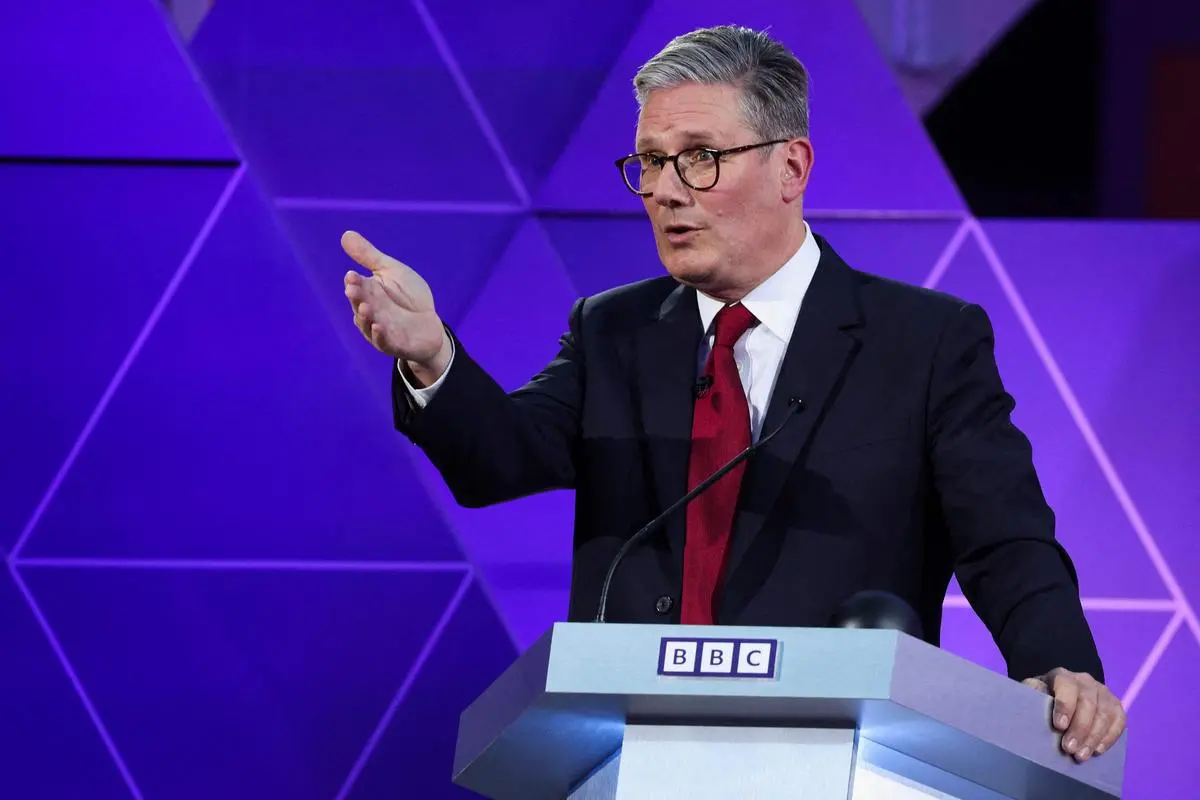
Keir Starmer, the 61-year-old Labour leader, is the clear favorite in the opinion polls to become Britain's next prime minister after the general election on 4 July. A former human rights lawyer and director of public prosecutions, Starmer has run a deliberately low-key campaign, presenting himself as the candidate of 'seriousness' after 14 years of Conservative government. His methodical drive to recentre Labour has persuaded many voters that he is ready for Downing Street, even as critics describe him as cautious, austere and lacking charisma.
The contest marks a remarkable turnaround. When Starmer succeeded Jeremy Corbyn in early 2020, Labour had just suffered a historic electoral defeat. Few observers saw the former lawyer as a future prime minister. He was viewed as uncharismatic, too centrist for parts of the activist base, and often associated with a pro-European London elite disconnected from working-class voters who had backed Brexit. Four years later, he has moved the party back toward the political centre without the feared explosion, and without much sentiment for those who refused to fall in line.
Key facts
- Full name: Keir Rodney Starmer.
- Born: 2 September 1962 in London.
- Party: Labour.
- Role: Leader of the Labour Party since April 2020; Member of Parliament for a north London constituency since 2015.
- Election: UK general election on 4 July 2024; polls favor Labour and Starmer for prime minister.
- Background: Human rights lawyer, former director of public prosecutions for England and Wales, knighted in 2014.
- Family: Married to Victoria; father of a daughter and a son.
- Personal interests: Arsenal supporter; played violin as a child with Norman Cook, later known as Fatboy Slim.
Starmer's public image is built on discipline rather than drama. He has insisted that his priority is 'country first, party second', a mantra aimed at drawing a line under years of Conservative scandals. His manifesto is openly pro-business and fiscally cautious, with few spectacular spending promises. The approach reflects what he calls the serious condition of public finances. It also carries a risk: that the campaign may seem too small, too managerial, too lacking in ambition. Starmer rejects that charge. 'I am running to be prime minister, not circus director,' he has said.
The strategy has been tested on the campaign trail. During a recent television debate, a member of the public told him, 'You look like a political robot.' The remark briefly unsettled him. Yet his response has been to try to soften his severe style, rolling up his sleeves as he travels the country and repeatedly stressing his modest origins. 'My father was a worker and my mother a nurse,' he says, a line that also explains the unusual first name given in tribute to Keir Hardie, the founder of the Labour Party. He has spoken of being embarrassed to bring friends home because the carpet was worn and the windows cracked. He used the same memory when presenting Labour's official programme, which he described as pro-enterprise.
Born on 2 September 1962, Keir Rodney Starmer grew up in a small London house with a brother and two sisters. His father was distant, and his mother suffered from a rare joint disease that at times left her unable to walk for years. The household was not wealthy, and Starmer has drawn on that experience to present himself as someone who understands financial strain. As a child, he took violin lessons with Norman Cook, a former bassist with the Housemartins who later became famous as Fatboy Slim. The detail is often cited to show a cultural hinterland behind the lawyer's formal manner.
After studying law at Leeds and then Oxford, Starmer built a legal career on civil liberties and social justice. He represented trade unions, fought McDonald's in a long-running libel case, and campaigned against the death penalty in the Caribbean. Gavin Millar, a lawyer who worked with him and remains a friend, describes him as 'very meticulous, very hard-working, very focused on the files.' Millar believes those qualities would follow him into 10 Downing Street. He also says Starmer would remain attached to fundamental values he has always believed in: equality, human rights, social justice, and reducing the gap between rich and poor.
In 2003, Starmer began to move toward more established roles, helping to rebuild policing in Northern Ireland after the Troubles. In 2008 he became director of public prosecutions for England and Wales. In that job he oversaw prosecutions against members of parliament who abused their expenses, journalists accused of phone hacking, and people involved in the 2011 riots in England. The role gave him a reputation for careful, evidence-led judgment, but also for a certain distance from the cut and thrust of party politics. He was knighted by Queen Elizabeth II in 2014, though he rarely uses the title 'Sir'.
Starmer entered politics relatively late. He was elected as a Labour MP for a north London constituency in 2015, two weeks after the death of his mother. Despite his criticisms of Jeremy Corbyn, he became Labour's spokesperson on Brexit, the issue on which he had voted to remain. He took over the party leadership in April 2020. Almost immediately, he attacked the antisemitism that had spread within Labour's ranks, leading to the suspension of his predecessor. The move was divisive but central to his project of making the party electable again.
His path to power has not been without criticism. Some on the left argue that he has abandoned the transformative ambitions that rallied Labour members under Corbyn. Centrists and swing voters, by contrast, see a leader who has restored competence and discipline. The Conservatives have tried to portray him as a flip-flopper, a lawyer who argues both sides and a metropolitan politician who cannot connect with ordinary people. Starmer's answer is to avoid loud ideological promises and to emphasise management, stability and public service. In a campaign dominated by exhaustion with the government, that may be enough.
The personal cost is rarely far from his mind. If elected, Starmer will face an enormous in-tray: strained public services, weak growth, pressure on the health service, and a party that still contains internal divisions. Yet he says his main worry is not the scale of the task but the effect on his daughter and son, who have been kept out of the campaign along with his wife, Victoria. 'They are at a difficult age. My only fear is the impact this will have on them,' he has said. He has promised to keep Friday evenings for his family, a commitment the Conservatives have mocked by calling him a future 'part-time' prime minister.
Starmer's allies reject that caricature. They point to a career built on long investigations, difficult reforms and methodical preparation. His campaign has been designed to reassure rather than excite, to avoid the mistakes that have damaged Labour in previous elections and to present a steady alternative to Conservative turmoil. Whether that is enough to deliver a majority will be decided by voters on 4 July. For now, the lawyer who once argued human rights cases is asking the country to trust him with the most established office in British politics, and to see his lack of showmanship as a qualification rather than a weakness.
Source:SudOuest.fr News