

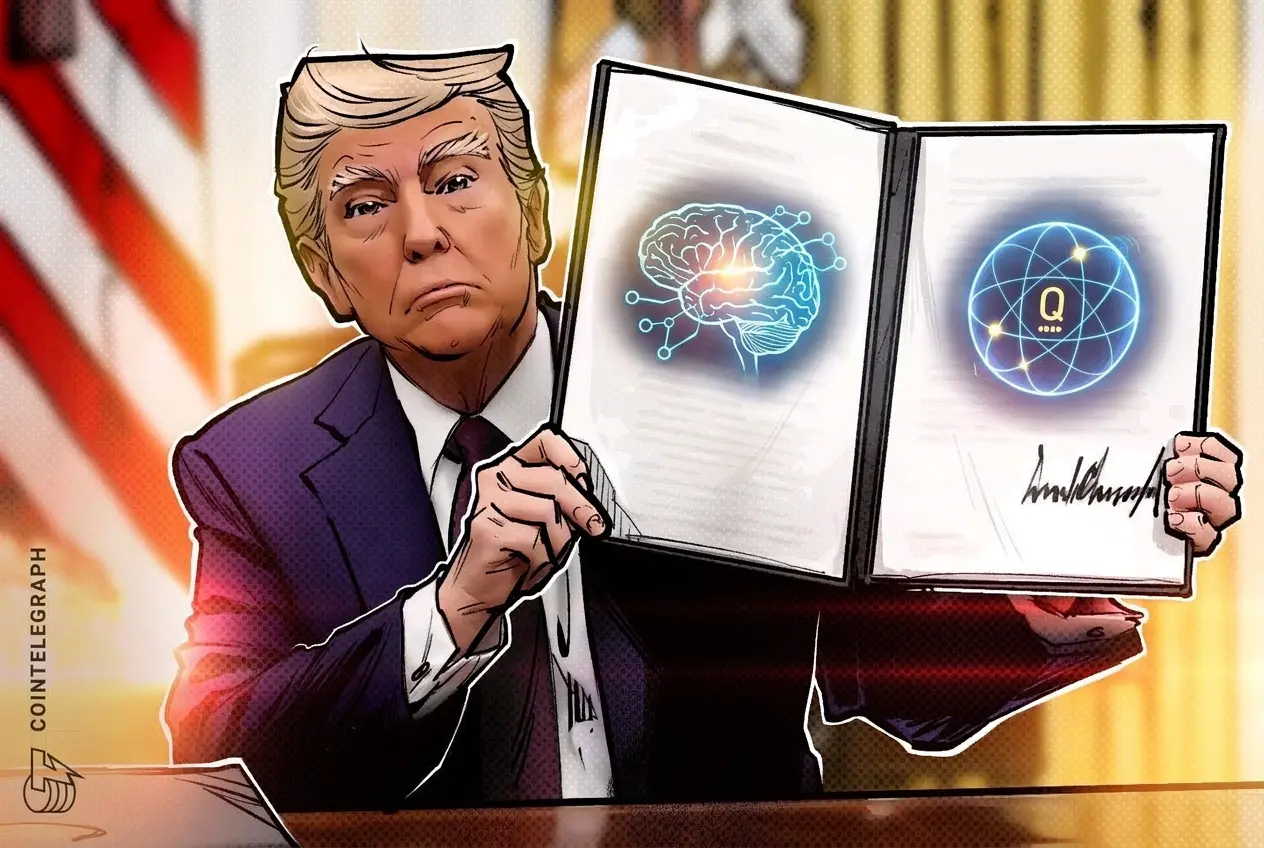
The White House has announced a sweeping set of science and technology initiatives worth more than $6 billion, placing quantum computing and artificial intelligence at the center of a new federal research push. The package includes a $215 million quantum computing competition led by the Department of Energy and $2.4 billion in private-sector AI commitments from 11 technology companies. The announcements arrive as policymakers, financial regulators and the cryptocurrency industry grapple with the long-term security risks that advanced quantum machines could pose to public-key cryptography.
At the core of the quantum effort is the Quantum Genesis Q Competition, which the Department of Energy says will offer up to $215 million in planned funding to companies developing fault-tolerant quantum computers. First announced in September, the program uses milestone-based awards and incentive prizes to reward teams that demonstrate increasingly powerful quantum systems. The department has identified eight scientific applications to guide the competition, with research priorities spanning chemistry, materials science, subatomic physics and applied mathematics.
Quantum Genesis Q Competition Targets Fault-Tolerant Systems
Fault tolerance is a critical threshold in quantum computing. Today’s quantum processors are noisy and error-prone, limiting the length and complexity of calculations they can perform. A fault-tolerant quantum computer would be able to correct errors as they occur, enabling reliable execution of long algorithms. That capability is widely viewed as necessary for solving certain classes of problems that are intractable for classical computers.
The Department of Energy’s decision to focus on fault tolerance signals that the federal government is looking beyond early-stage experiments toward practical, scalable systems. The competition’s milestone structure is designed to reward incremental progress rather than only final breakthroughs. Companies could receive funding as they demonstrate improved qubit coherence, higher gate fidelities, better error correction and larger logical qubit counts.
The eight scientific applications selected by the department are expected to guide use cases in fields where quantum simulation and optimization could offer advantages. In chemistry, quantum computers could help model molecular interactions for drug discovery and catalyst design. In materials science, they could aid the search for better batteries, superconductors and semiconductors. Subatomic physics research could benefit from quantum simulations of particle interactions, while applied mathematics could see advances in optimization, cryptography and linear algebra.
Why Quantum Computing Matters for Cryptocurrency Security
The quantum push has direct implications for blockchain-based assets that rely on public-key cryptography. Most major cryptocurrencies use elliptic curve cryptography to secure wallets and transactions. A sufficiently powerful quantum computer running Shor’s algorithm could, in theory, derive a private key from an exposed public key. That would allow an attacker to steal funds from a vulnerable address.
On Sept. 23, three European Union financial watchdogs warned that the development of more powerful quantum computers could undermine cryptographic systems used to secure blockchains and financial transactions. The warning added to a growing debate among cryptographers, blockchain developers and regulators about how quickly the industry should migrate to post-quantum cryptography.
For now, no quantum computer capable of carrying out such an attack exists. Current systems are far too small and error-prone to break widely used public-key cryptography. But the trajectory of research and the scale of government funding have prompted urgent planning. Some experts compare the risk to a storm on the horizon: it may not arrive tomorrow, but the cost of preparing after it hits could be catastrophic.
The cryptocurrency sector has already begun exploring defensive measures. Developers are investigating quantum-resistant signature schemes, including lattice-based, hash-based and code-based cryptography. Some networks have proposed voluntary migrations to new address types, while others are researching how to protect dormant coins whose public keys may already be exposed. The challenge is not only technical but also social: coordinating upgrades across decentralized communities can take years.
AI Commitments Reach $2.4 Billion Across 15 Federal Agencies
The White House also announced that 11 technology companies pledged $2.4 billion in AI tools and compute credits to support research at 15 federal agencies. The commitments include $1 billion from Nvidia, $500 million from AMD, $200 million from OpenAI and $150 million each from Anthropic and Google. The remaining contributions come from other firms participating in the initiative.
The AI resources are intended to accelerate federal research in areas such as climate modeling, healthcare, materials discovery, cybersecurity and national security. Compute credits could allow government scientists to train large models, run simulations and analyze massive datasets without building new data centers from scratch. AI tools may also help agencies automate routine tasks, improve forecasting and identify patterns in complex systems.
The pledge reflects a broader trend of public-private collaboration in artificial intelligence. As AI models grow larger and more expensive to train, access to cutting-edge compute has become a strategic asset. The federal government has increasingly sought partnerships with chipmakers, cloud providers and AI labs to maintain competitiveness. The arrangement also raises questions about procurement, data governance, security and the influence of private companies over public research priorities.
Federal Science Push Extends Beyond Quantum and AI
The more than $6 billion in science initiatives includes funding beyond the quantum competition and AI commitments. The package touches on national laboratories, university research programs and workforce development. While the White House has emphasized quantum and AI, the broader push reflects a desire to strengthen United States leadership in critical and emerging technologies.
The Department of Energy’s national laboratory system is expected to play a central role in both quantum and AI research. National labs operate some of the world’s most powerful supercomputers and host advanced quantum research facilities. They also convene multidisciplinary teams that can bridge basic science and applied engineering.
The initiative arrives amid global competition in quantum technology. China, the European Union, the United Kingdom, Japan and Canada have all launched major quantum programs. The United States has responded with the National Quantum Initiative, which was signed into law in 2018 and has funded research centers, graduate training and standards development. The CHIPS and Science Act of 2022 further expanded federal investment in semiconductors, AI, quantum information science and other emerging fields.
Fault-tolerant quantum computing remains a long-term goal. Experts disagree on timelines, with some predicting meaningful systems within a decade and others warning that the engineering challenges could take much longer. The uncertainty has not stopped governments and companies from investing heavily. The potential rewards include breakthroughs in drug discovery, energy, logistics, finance and cryptography.
Crypto Industry Weighs Bunker Mode and Proactive Measures
The quantum threat has sparked debate within the cryptocurrency industry. Some prominent figures have advocated for what has been called crypto bunker mode, a defensive posture that prioritizes privacy, decentralization and quantum-resistant upgrades. Others argue that bunker mode is overly pessimistic and that the industry should proactively adopt new cryptographic standards.
One related discussion has focused on the rapid advance of AI mathematics and its potential to accelerate quantum research. If AI can help discover new quantum algorithms, improve error correction or optimize hardware designs, the timeline for quantum threats could shorten. That possibility has added urgency to conversations about post-quantum migration.
Institutions are also moving toward tokenized onchain futures, according to industry participants. Major financial firms have signaled that blockchain-based settlement and asset issuance will play a growing role in capital markets. If those predictions are correct, the security of public-key cryptography becomes not just a crypto-native concern but a systemic financial stability issue.
Consumer adoption is advancing as well. Wallet providers and payment networks are adding support for stablecoin transfers and onchain payments. As more value moves onto blockchains, the cost of a cryptographic failure grows. That helps explain why quantum warnings from financial regulators are being taken seriously by parts of the crypto industry.
What the Funding Means for Research and Security
The Quantum Genesis Q Competition is structured to encourage private companies to push the boundaries of quantum hardware and software. Milestone-based awards can provide predictable funding while maintaining accountability. Incentive prizes can attract teams that might not otherwise participate. The combination is meant to accelerate progress without picking a single winner too early.
The AI commitments similarly aim to lower barriers for federal researchers. Compute credits and AI tools can be deployed quickly, while larger infrastructure investments take years. The $2.4 billion pledge is not a direct government appropriation, but it could have a significant impact by giving agencies access to commercial technology that would be difficult to replicate in-house.
For the crypto industry, the most important signal may be the federal government’s sustained interest in quantum computing. Even if fault-tolerant machines remain years away, the direction of travel is clear. Governments and companies are investing in the technologies that could one day challenge existing cryptographic standards. In response, blockchain networks, wallet providers and financial institutions are likely to accelerate research into post-quantum cryptography.
The White House announcements also highlight the convergence of AI and quantum computing. AI can help design quantum hardware, optimize error correction and analyze experimental results. Quantum computers, in turn, could eventually accelerate certain AI workloads. The two fields are becoming intertwined in research budgets, corporate strategies and national security planning.
As the Department of Energy moves forward with its competition and federal agencies begin to receive AI resources, the coming months will reveal which teams and technologies advance. The outcomes will matter far beyond government laboratories. They could shape the security of digital assets, the competitiveness of major industries and the balance of technological power among nations.
Source:Cointelegraph News