

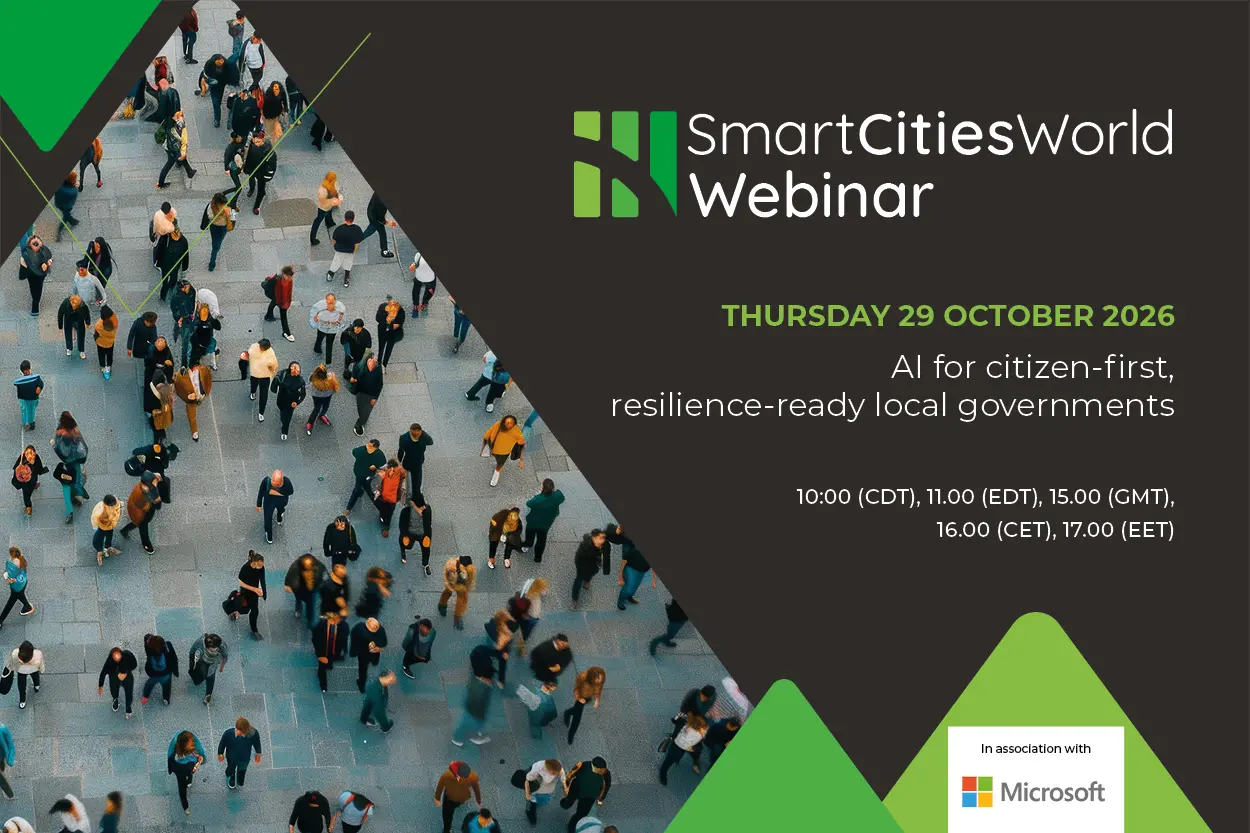
A webinar on 29 October will examine how connected data and artificial intelligence can help local governments become more citizen-first and resilience-ready, with a programme focused on practical decision-making rather than technology for its own sake.
The session will explore how AI, edge computing and computer vision can help cities turn growing volumes of urban data into smarter, faster decisions and more responsive services. It will also consider how connected data can improve citizen engagement, break down departmental silos and enable faster, better-informed decisions across public services.
Key facts at a glance
- Event date: 29 October.
- Core theme: AI for citizen-first, resilience-ready local governments.
- Main topics: Connected data, citizen engagement, departmental silos, faster decision-making, edge computing and computer vision.
- Urban context: Cities are balancing climate change, infrastructure resilience and digital transformation.
- Summit link: A 2026 smart-city summit during London Climate Action Week will explore how these agendas intersect and how cities can translate strategy into practical action.
- City innovation examples: Malaysia’s first Southeast Asian Smart City Expo in Kuala Lumpur; Singapore’s continuing work to build its reputation as one of the smartest nations; and Sunderland’s use of digital infrastructure and low-carbon innovation to build a resilient, future-focused economy.
- Expert perspectives: Professor Jung Hoon Lee on the Global Smart City Index, the emerging “AI super gap” between cities, and why the next phase of urban innovation depends on data platforms, AI-ready infrastructure and effective governance; Gareth Tang on the evolution of urban AI applications and projects already making a significant impact.
- Other themes: Smart sensor networks for indoor safety and situational awareness; cognitive cities and more responsive urban systems; and daily and weekly editorial newsletters covering news, city interviews, special reports and guest opinions.
Why local governments are focusing on citizen-first AI
Local authorities are under pressure to deliver more with less. Budgets are tight, demand for services is rising and residents expect public services to be as responsive as the digital tools they use in daily life. At the same time, cities are collecting more data than ever from sensors, cameras, transport systems, utilities, planning records and emergency services. The challenge is not simply to gather that data but to use it in ways that improve outcomes for residents and strengthen public trust.
A citizen-first approach means starting with the needs of people rather than the capabilities of technology. AI can help councils identify patterns in service demand, target maintenance, improve accessibility and communicate more clearly with residents. But it can also amplify bias, exclude people who lack digital access and create new layers of opaque decision-making if it is adopted without safeguards. The 29 October discussion is expected to explore how local governments can capture the benefits of AI while keeping human oversight, accountability and equity at the centre.
Turning urban data into faster, better-informed decisions
Connected data and AI can give local governments a more complete picture of how a city is performing. Traffic flows, air quality, energy use, waste collection, flooding risk and social care demand can be monitored and analysed together rather than in separate departmental systems. When data is shared responsibly, councils can spot problems earlier, allocate resources more accurately and respond to incidents with greater speed.
Edge computing and computer vision add another layer. Edge computing allows data to be processed closer to where it is generated, reducing latency and bandwidth costs while potentially improving privacy by keeping more raw data local. Computer vision can help analyse camera feeds for traffic management, infrastructure defects, public safety and environmental monitoring. These tools are not plug-and-play solutions. They require careful design, clear use cases, robust procurement and ongoing evaluation to ensure they deliver public value rather than unnecessary complexity.
Smart sensor networks are also part of the picture. Indoor sensors can detect risks early, improve situational awareness and support healthier, more secure and sustainable buildings. In public buildings, schools, hospitals and transport hubs, such systems can help facilities teams respond to air-quality problems, occupancy pressures or equipment failures before they become serious. The same principle applies across the city: small streams of data, properly integrated, can support faster and better-informed decisions.
Breaking down silos while strengthening public trust
Departmental silos are one of the biggest barriers to joined-up local government. Housing, transport, planning, environmental services, social care and emergency response often hold separate datasets and work to different priorities. AI can help create a shared operational picture, but only if data governance, standards and incentives are aligned. Without that foundation, new technology can simply automate fragmented processes.
Breaking down silos also raises questions about privacy, consent and data ownership. Residents need to understand what data is being collected, why it is being used and how they can challenge decisions that affect them. Local governments will need transparent policies, data-sharing agreements, audit trails and human review for high-stakes decisions. Citizen engagement should not be a one-off consultation; it should be a continuous feedback loop that shapes how AI tools are designed, deployed and reviewed.
Resilience, climate pressure and infrastructure strain
Cities are confronting the combined pressures of climate change, infrastructure resilience and digital transformation. Heatwaves, flooding, wildfire risk, energy uncertainty and ageing infrastructure are testing the capacity of local authorities to anticipate shocks and recover quickly. AI can support resilience planning by modelling risk, prioritising maintenance, optimising energy use and helping emergency services coordinate responses. It can also help cities test scenarios and make better use of limited resources.
Yet resilience-ready government cannot rely on algorithms alone. AI systems need reliable connectivity, secure data platforms and skilled staff who can interpret their outputs. They also need fail-safes for when models are wrong, data is incomplete or systems go down. The most resilient approach is likely to combine AI with human judgement, clear operating procedures and strong relationships with communities. Technology can speed up decisions, but it cannot replace accountability.
City examples signal a wider shift
Several cities and regions are already testing how AI can support urban innovation. Malaysia is leading the way in AI-powered urban innovation at the first Southeast Asian Smart City Expo in Kuala Lumpur, signalling regional ambition to connect technology, investment and city leadership. Singapore is further building its reputation as one of the smartest nations in the world, with sustained investment in digital public services, urban mobility and data-driven governance. Sunderland is repositioning itself as a leading smart city, using digital infrastructure and low-carbon innovation to build a resilient, future-focused economy.
These examples matter because they show that the debate has moved beyond pilot projects. The question is increasingly how to scale successful experiments, sustain them financially and ensure they benefit residents rather than only technology vendors. The 2026 smart-city summit during London Climate Action Week is expected to bring urban leaders and partners together to explore how climate action, resilience and digital transformation intersect, and how cities can translate strategy into practical action.
Expert perspectives: from pilots to real-world impact
Professor Jung Hoon Lee is expected to continue an in-depth conversation about how AI is moving from pilots to real-world impact in cities worldwide. His contribution will touch on the latest Global Smart City Index, the emerging “AI super gap” between cities, and why the next phase of urban innovation depends on data platforms, AI-ready infrastructure and effective governance. The idea of an AI super gap highlights the risk that well-resourced cities pull ahead while others struggle to build the foundations for adoption.
Gareth Tang, president of urban solutions at an engineering group, is also set to explain how urban AI applications are evolving and to detail projects where AI is already making a significant impact. His perspective is likely to focus on the practical side of deployment: how cities move from concept to operation, how they measure success and how they manage the organisational change that comes with new technology. An on-demand trend report panel discussion on cognitive cities will further explore how urban systems can become smarter and more responsive.
What local leaders should watch
For local leaders, the webinar is likely to raise a set of practical questions. Who owns the data used by AI systems? How are vendors evaluated and contracted? What is the exit strategy if a platform fails or becomes too expensive? How are algorithms monitored for bias and performance? How are residents involved in decisions about deployment? And how are the benefits distributed across different communities?
Procurement will be a critical lever. Contracts that lock councils into closed systems can make it difficult to share data, switch suppliers or adapt to new needs. Modular contracts, open standards and clear requirements for interoperability can help local governments retain flexibility. Funding is another challenge. AI projects often require upfront investment in data infrastructure, cybersecurity, training and change management before savings or service improvements materialise. Smaller authorities may need shared services or regional partnerships to build capability.
Governance is equally important. Effective governance covers ethical principles, transparency, accountability, data protection and operational resilience. It also includes workforce development. Councils need staff who understand both public services and data science, and they need leaders who can ask the right questions about what an AI system can and cannot do. Citizen-first AI is not only about efficiency; it is about whether decisions become fairer, services become more accessible and public trust is strengthened.
Why the 29 October discussion is timely
The webinar comes as local governments face rising service demand, constrained budgets and growing expectations around digital delivery. AI may offer productivity gains and new insights, but it also requires careful stewardship. The 29 October session will connect policy to practice, exploring how connected data and AI can improve citizen engagement, break down silos and enable faster, better-informed decisions. It will also show how edge computing and computer vision can help cities turn growing volumes of urban data into smarter, faster decisions and more responsive services.
The wider programme points to a busy period for urban innovation. The 2026 summit during London Climate Action Week will examine how cities can translate strategy into practical action. Malaysia’s first Southeast Asian Smart City Expo in Kuala Lumpur will showcase AI-powered urban innovation. City profiles on Singapore and Sunderland will highlight different routes to smart-city development, while conversations with Professor Jung Hoon Lee and Gareth Tang will examine the shift from pilots to real-world impact. Smart sensor networks for indoor safety, cognitive-city panel discussions and daily and weekly editorial newsletters will keep the focus on how technology can support healthier, more secure, more sustainable and more responsive urban systems.
The webinar is scheduled for 29 October and will focus on practical steps local
Source:Smart Cities World News