

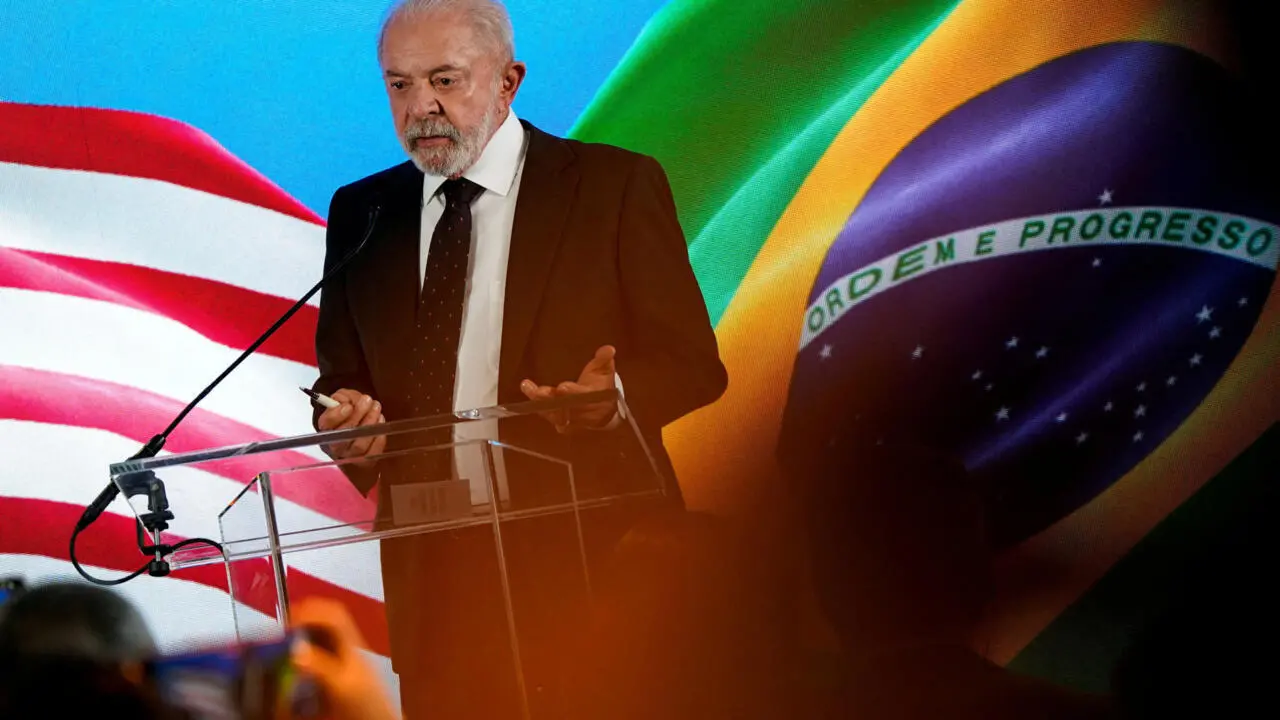
In a significant shift in Brazil's presidential campaign, President Luiz Inácio Lula da Silva has changed his primary target of attack. Instead of focusing on U.S. President Donald Trump, Lula now directs his fiercest rhetoric at U.S. Secretary of State Marco Rubio. This strategic pivot, announced during a rally this week by the Democratic Labour Party (PDT), an ally of Lula, marks a new phase in the race for the October 2026 elections.
Lula accused Rubio of openly supporting his main adversary, Senator Flávio Bolsonaro, the far-right candidate and son of former President Jair Bolsonaro. "If U.S. Secretary of State Marco Rubio wants to come and support my opponent, let him come! Let him set up his campaign committee! We will defeat them all in the name of defending democracy in Brazil," Lula declared before cheering supporters. The statement signals a deliberate shift in campaign messaging as Lula prepares to officially launch his bid for an unprecedented fourth term.
From Trump to Rubio: A Calculated Change
Until recently, Lula's campaign focused heavily on criticizing Donald Trump, particularly the imposition of a 25% additional tariff on several Brazilian exports. Those tariffs, which took effect in mid-2026, have strained trade relations and hurt key sectors of Brazil's economy, including steel, agriculture, and manufacturing. Lula had used these measures to portray Trump as an antagonist undermining Brazilian prosperity. Now, however, Lula has chosen to personalize the conflict by targeting Marco Rubio, who has become the most visible face of the Trump administration's diplomatic pressure on Brazil.
Analysts attribute this switch to both domestic and diplomatic calculations. On the one hand, Rubio has gained notoriety in Brazil for his vocal criticism of the Brazilian Supreme Court, his defense of sanctions against certain Brazilian officials, and his close ties with Bolsonaro's inner circle. The Secretary of State has hosted Eduardo and Flávio Bolsonaro, the former president's sons, at the White House in recent weeks, fueling Lula's narrative that Washington is interfering in Brazil's elections. On the other hand, by targeting Rubio instead of Trump, Lula avoids a direct confrontation with the sitting U.S. president—a pragmatic move if he intends to negotiate with Trump after a potential reelection. Lula's first term from 2003 to 2010 was marked by strong relations with the United States during the George W. Bush and Obama administrations. Preserving diplomatic flexibility is crucial for Brazil's future trade and foreign policy.
Sovereignty as a Campaign Theme
Lula's new strategy taps into deep-seated sentiments of national sovereignty. By framing the election as a contest between a Brazilian candidate (himself) and a foreign power (represented by Rubio and the Trump administration), Lula aims to rally voters who resent external interference. This resonates strongly with a segment of the electorate that believes Bolsonaro's camp has damaged Brazil's standing abroad and made the country vulnerable to U.S. economic coercion. The theme of sovereignty has become increasingly prominent in Lula's speeches, especially as the campaign approaches the first round on October 4.
The strategy also exploits growing public anger over the U.S. tariffs. Many Brazilians blame Bolsonaro for the deterioration of relations with Washington, arguing that the former president's aligning with Trump's far-right agenda provoked the trade war. Lula's campaign is capitalizing on this sentiment, accusing Flávio Bolsonaro of being a puppet of foreign interests. "They want to turn Brazil into a colony again," Lula often says, invoking historical resistance to foreign domination. This narrative could help Lula consolidate leftist voters and attract centrists dissatisfied with Bolsonaro's close ties to the U.S. administration.
Rubio's Role and Bolsonaro's U.S. Ties
Marco Rubio, the Cuban-American Secretary of State appointed by Trump in 2025, has long been a hawk on Latin America. He has advocated for hardline policies against leftist governments in Venezuela, Cuba, and Nicaragua, and has extended that approach to Brazil under Lula. Rubio has publicly criticized the Brazilian Supreme Court's decisions against Bolsonaro supporters and has called for the release of certain political prisoners. He also defended the U.S. sanctions imposed on Brazilian officials accused of corruption and human rights abuses—measures that Lula's government deems unilateral and illegitimate.
The close relationship between Rubio and the Bolsonaro family is no secret. Flávio Bolsonaro, a senator and now the official candidate of the far-right Liberal Party (PL), has embraced Rubio's support. His brother Eduardo, a federal deputy, traveled to Washington multiple times to lobby for Bolsonaro's cause. The White House meetings with Rubio and other Trump administration officials have been widely covered in Brazilian media, giving Lula ammunition to attack his opponent as an agent of foreign interests. Lula's campaign has released ads showing photos of the Bolsonaro sons with Rubio, accompanied by the tagline: "Who do they truly serve?"
Trade War and Economic Stakes
Underlying the political drama is a real economic conflict. The Trump administration's decision to impose 25% tariffs on Brazilian steel, aluminum, orange juice, sugar, and ethanol has hit Brazil's export-dependent sectors hard. Brazil retaliated with its own tariffs on U.S. goods, including soybeans, wheat, and automobiles, escalating a trade war that economists say benefits neither country. Lula has portrayed himself as the defender of Brazilian jobs and industries, contrasting his stance with Bolsonaro's apparent acquiescence to U.S. pressure.
The trade dispute has also affected Brazil's negotiations with the European Union and other partners. Lula's government has accelerated talks with the EU and China to diversify trade, but the uncertainty caused by the U.S. tariffs has dampened investment. By linking Bolsonaro to Trump's trade policies, Lula hopes to sway voters worried about their economic future. Polls show that economic issues, including inflation and unemployment, are top concerns for Brazilian voters. Lula's team believes that highlighting the external origins of Brazil's economic woes could reduce voter anger toward the incumbent and deflect blame onto Bolsonaro's camp.
Background on Lula and Bolsonaro
Luiz Inácio Lula da Silva, 80, remains a towering figure in Brazilian politics. First elected in 2002, he served two terms and oversaw a period of economic growth and poverty reduction. After a controversial conviction for corruption that was later annulled, he returned to power in 2023, defeating Jair Bolsonaro. His current term ends in 2027, but Brazilian law allows a return for a non-consecutive term, and Lula is seeking reelection. His platform focuses on social welfare, environmental protection, and economic nationalism.
Flávio Bolsonaro, 45, is a senator from Rio de Janeiro and the eldest son of Jair Bolsonaro. He has been his father's political heir since the former president lost the 2023 election and was subsequently barred from running due to legal issues. Flávio has adopted a similarly far-right agenda, emphasizing law and order, religious conservatism, and anti-communism. His campaign has received significant support from evangelical churches, agribusiness elites, and, as Lula claims, from the Trump administration. The younger Bolsonaro's candidacy represents an attempt to maintain the Bolsonaro family's grip on the right wing of Brazilian politics amid legal challenges and shifting public opinion.
The relationship between the Bolsonaro family and the Trump administration dates back to Jair Bolsonaro's presidency (2019–2022), when he aligned Brazil closely with Trump's foreign policy. After Trump's reelection in 2024, the ties deepened. Marco Rubio's appointment as Secretary of State further solidified this alliance. Lula, by contrast, has sought to rebalance Brazil's foreign relations, reducing dependency on the U.S. and strengthening ties with China, Russia, and the Global South.
Election Calendar and Outlook
The first round of Brazil's presidential election is scheduled for October 4, 2026, with a possible runoff on October 25. Lula is expected to officially register his candidacy in August. Flávio Bolsonaro will be formally launched as the PL candidate on July 25. Recent opinion polls show Lula with a narrow lead, but the race remains tight. The campaign is likely to be dominated by issues of corruption, economic management, and foreign influence. Lula's focus on Marco Rubio is a clear attempt to nationalize the debate and rally patriotic sentiment. Whether this strategy succeeds will depend on voters' perception of U.S. interference and the effectiveness of Bolsonaro's counter-narrative.
Lula's shift from attacking Trump to targeting Rubio also reflects a nuanced understanding of the international landscape. Trump remains popular among some Brazilian conservatives, and directly confronting him could backfire. Rubio, meanwhile, is less known to the average Brazilian voter, but Lula's campaign aims to make him a symbol of unwanted outside meddling. As the election heats up, expect more accusations and counter-accusations regarding foreign ties. The coming months will test whether Lula can maintain the momentum while avoiding alienating Washington entirely. For now, the Brazilian president has drawn a line in the sand: the election is not just about two candidates, but about Brazil's right to determine its own destiny without foreign interference.
Source:RFI News