

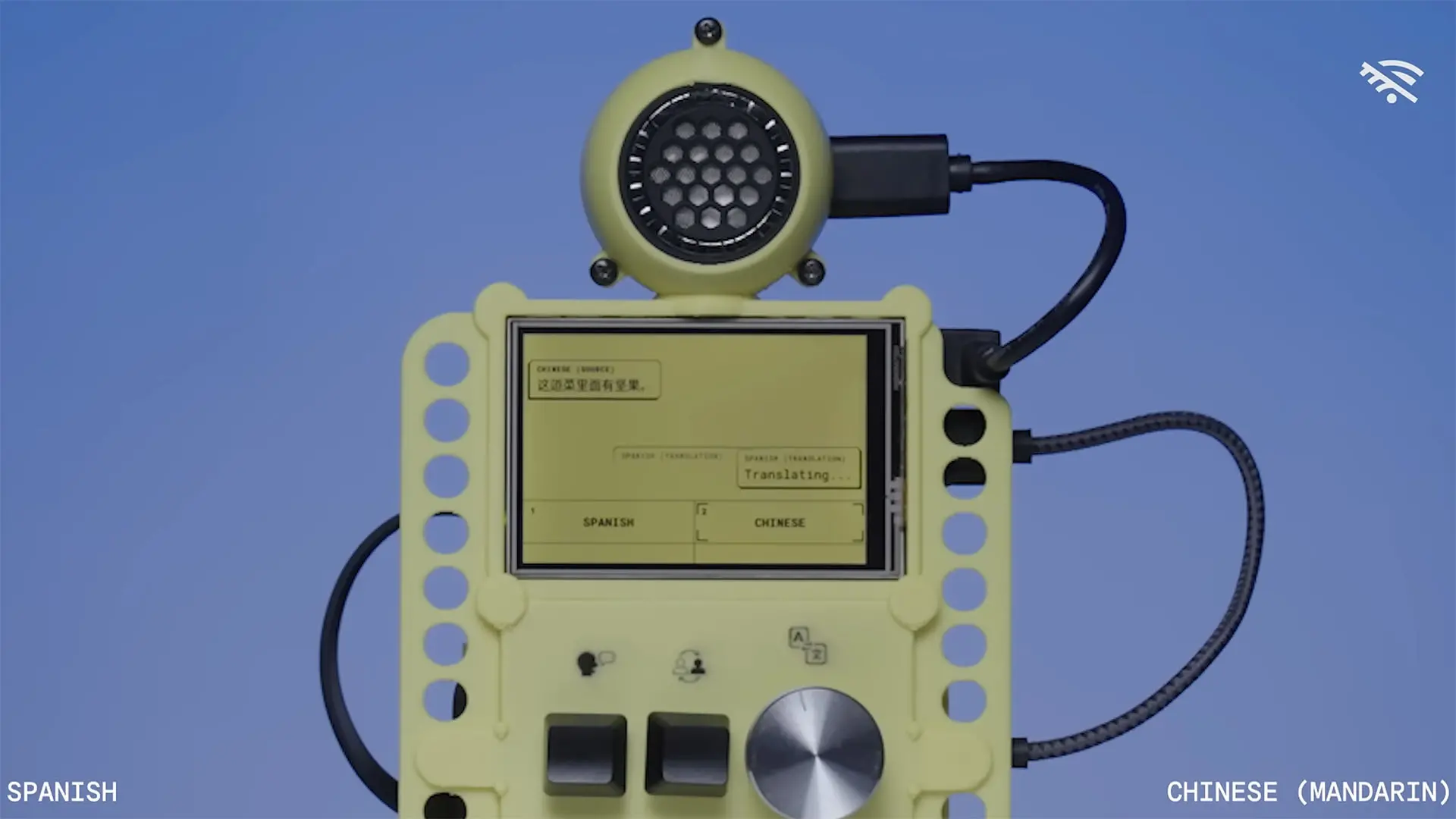
Google’s Gemma family of open models has been making waves for its ability to run on modest hardware, and a new project from a team of Google engineers proves just how far that potential goes. They have created a portable AI translator that works completely offline, using the Gemma 4 E4B model running on a Raspberry Pi 5. The project is not just a technical demo; it’s a fully functional device with a touchscreen, microphone, speaker, push-to-talk button, and a physical knob for switching languages. Best of all, the entire build is open source, with code and 3D-printing files available for anyone who wants to assemble their own.
Key facts at a glance
Before diving into the technical details, here are the most important points from the announcement:
- Google engineers used Gemma 4 E4B, a compact language model, to handle translations on-device.
- The hardware is a Raspberry Pi 5, a low-cost single-board computer widely used in DIY projects.
- The device includes a touchscreen display, a push-to-talk button, a microphone, a speaker, and a rotary knob for language selection.
- Google Antigravity was used for development, and LiteRT-LM served as the runtime for the Gemma model.
- Moonshine text-to-speech technology is used to audibly read out translations.
- All code and 3D-printing files are available on GitHub, making it possible for hobbyists to replicate the build.
Gemma 4 E4B: A small but powerful language model
The Gemma family was introduced by Google as a set of lightweight, open-source models designed for developers and researchers. Gemma 4 E4B is one of the latest iterations, offering a balance between performance and resource efficiency. Unlike huge cloud-based models that require massive server farms, Gemma 4 E4B can run on a device as small as a Raspberry Pi 5. This is made possible by aggressive quantization and model pruning techniques that shrink the model’s size while retaining enough linguistic capability to perform tasks like translation.
In this project, the Gemma 4 E4B model is responsible for translating spoken phrases from one language to another. The model processes audio input after it has been converted into text, then generates translated output text. Because the model runs locally, there is no need to send data to a remote server. This not only ensures privacy but also eliminates latency issues associated with network connections.
The choice of Gemma 4 E4B is significant because it demonstrates that powerful AI can fit into compact, energy-efficient form factors. While many cutting-edge models require cloud infrastructure, Gemma 4 E4B is optimized for edge computing. This opens up a new realm of possibilities for portable devices that need to work in remote locations or in environments where internet access is unreliable.
Hardware: Raspberry Pi 5 at the core
At the heart of the translator is the Raspberry Pi 5, the latest iteration of the iconic single-board computer. Released with a faster CPU and more memory than its predecessors, the Raspberry Pi 5 is capable of handling complex workloads such as running a language model. The board provides the necessary I/O options to connect peripherals like the touchscreen, microphone, speaker, and buttons.
The custom 3D-printed enclosure holds all the electronics together, giving the device a polished and portable form. The enclosure was designed specifically for this project and the files are available on GitHub, allowing users to print their own case on any standard 3D printer.
A small touchscreen is mounted on the front, showing the translated text in real time. The user holds down the push-to-talk button while speaking into the microphone. Once released, the audio is processed, translated, and displayed on the screen. A rotary knob allows the user to cycle through different target languages without having to navigate a menu. The speaker then reads the translation aloud using text-to-speech, making the device useful for face-to-face conversations across language barriers.
Software: LiteRT-LM and Moonshine TTS
The software stack is just as important as the hardware. The team used Google Antigravity, which appears to be an internal or newly released development platform, to streamline the workflow. Running the Gemma 4 E4B model is LiteRT-LM, a lightweight runtime designed specifically for on-device machine learning. LiteRT-LM allows efficient inference on low-power hardware, making it possible to run Gemma models without a dedicated GPU.
For speech output, the project utilizes Moonshine text-to-speech. Moonshine is a compact TTS engine that can generate natural-sounding speech on devices with limited processing power. The combination of LiteRT-LM and Moonshine enables the entire translation pipeline to run locally. From the moment a user speaks to the final audio output, every step happens on the Raspberry Pi 5.
The user interface is custom-built for the touchscreen, displaying both the original and translated text side by side. The interface is minimal and functional, designed to be used with one hand while on the go. The push-to-talk interaction model resembles a walkie-talkie, which is intuitive for most users.
Why offline translation matters
Most translation apps today, including popular services, rely on cloud processing. When you speak into a smartphone, the audio is typically sent to remote servers, transcribed, translated, and sent back. This requires an internet connection, which can be a serious limitation when traveling abroad in areas with poor connectivity, or when data roaming is prohibitively expensive. Moreover, voice data transmitted to the cloud raises privacy concerns, especially when the content is sensitive.
The Google engineers’ offline translator addresses both of these issues. Since everything runs locally, there is no need for cellular or Wi-Fi connectivity. Users can rely on the device in remote locations, on airplanes, or in disaster-stricken areas where infrastructure is damaged. The device also ensures that conversations remain private because no audio leaves the hardware.
This project’s emphasis on offline operation aligns with a broader trend in edge AI. As models become more efficient, more tasks that once required cloud servers are moving onto devices themselves. This shift reduces costs and increases reliability, while also opening the door to new use cases that demand immediate, private, and always-available intelligence.
Open-source everything: Build your own translator
A notable aspect of this project is its commitment to openness. All the code, configuration files, and 3D-printing templates have been published on GitHub. This means anyone with a Raspberry Pi 5, a compatible touchscreen, a few electronic components, and a 3D printer can recreate the device. The repository includes step-by-step instructions, wiring diagrams, and software build guides.
This open-source approach is in keeping with Google’s broader strategy for the Gemma model family. By making models and related tools freely available, Google encourages developers and hobbyists to experiment, create derivative works, and contribute improvements. The resulting ecosystem can accelerate innovation far beyond what a single internal team could achieve.
For makers and professionals alike, the project is a valuable learning resource. It demonstrates how to integrate a language model with embedded hardware, how to build a custom touchscreen UI in a constrained environment, and how to optimize TTS for low-latency performance. These are practical skills that will become increasingly relevant as edge AI matures.
Broader implications for portable AI devices
The success of this translator hints at a future where more mainstream consumer devices are powered by open-source language models running locally. Portable AI translators could become a common travel accessory, along with smart glasses that provide live subtitles, handheld devices for accessibility, and even industrial tools for field workers who need instant language support. The low cost of the Raspberry Pi platform keeps the barrier to entry very low.
There are also implications for companies looking to deploy AI in privacy-sensitive industries. Healthcare, legal services, and defense all require secure processing of spoken language. An offline device like this one is not only more secure but also independent of internet service providers and cloud vendors. It can be used in armored facilities, underground mines, ships at sea, or any other location where connectivity is not guaranteed.
Still, there are limitations that should not be overlooked. The Gemma 4 E4B model, while impressive, is significantly smaller than state-of-the-art translation models. It may struggle with rare language pairs, idiomatic expressions, or highly technical jargon. The Raspberry Pi 5’s processing power is also finite; translation latency could be noticeable for long sentences. Yet this project is not meant to replace enterprise-grade machine translation. It is a proof of concept that shows what is possible with today’s hardware and open-source AI, and where the future is heading.
As language models continue to shrink in size while gaining capabilities, the distinction between offline and online AI will blur. Eventually, even more complex tasks such as real-time simultaneous interpretation, multimodal translation, and conversational AI could run on pocket-sized devices. The Gemini model family, along with runtime optimizations like LiteRT-LM, is paving the way for that reality.
A closer look at the development process
Building a translator on a Raspberry Pi requires more than just downloading a model. The team had to ensure that the Gemma 4 E4B model was quantized to fit within the Pi’s memory constraints. Quantization reduces the precision of the model’s weights, using fewer bits per parameter. This process can compress a model to a fraction of its original size, making it feasible to run on a device with only a few gigabytes of RAM. The trade-off is a slight reduction in accuracy, but modern quantization techniques have minimized the impact.
The team also had to address audio quality. On-device speech recognition typically struggles with background noise and accents. Although the push-to-talk setup helps by isolating the user’s speech, the microphone and audio processing pipeline were configured to reduce echo and distortion. The success of the project depends on the entire chain: capturing clear audio, transcribing it accurately, translating it correctly, and speaking it aloud in a natural-sounding voice.
Making the device portable also meant managing power consumption. The Raspberry Pi 5, while efficient compared to a full desktop, still draws more power than a smartphone. The 3D-printed enclosure likely accommodates a battery pack, and the team may have implemented power-saving measures such as reducing screen brightness or using sleep modes between interactions. These details are part of the open-source documentation, allowing others to replicate the experience without having to reinvent the wheel.
The role of Google Antigravity
Google Antigravity is mentioned as the tool used for development. While not much is known about Antigravity from the announcement, it appears to be a platform that streamlines the process of building AI applications. It might include an integrated development environment, testing tools, or deployment assistance specifically tuned for Gemma models. The fact that the team used Antigravity suggests that Google is creating a more accessible pipeline for developers who want to move from prototype to product.
By combining Antigravity with Gemma and LiteRT-LM, Google is positioning itself as a leader in the edge AI ecosystem. The company has been promoting the idea that AI should be accessible on a wide range of devices, not just high-end servers. This translator is a tangible example of that vision. It takes the abstract concept of on-device intelligence and turns it into a physical object that fits in a pocket.
How to get started
If you are inspired to build your own translation device, the first step is to visit the GitHub repository linked in the original announcement. There you will find the necessary software packages, model files, and instructions for setting up the Raspberry Pi environment. You will need a Raspberry Pi 5 with at least 8GB of RAM, a compatible display, a USB microphone, a speaker, and the 3D-printed shell. The bill of materials is likely modest, making this an affordable weekend project for tech enthusiasts.
Having some familiarity with Linux command line is advisable, as installing dependencies and compiling the software requires some terminal commands. The project may also require a one-time setup to download the language model and install TTS voice data. After that, the device can run offline indefinitely. The repository includes troubleshooting tips for common issues such as port selection, audio device recognition, and model loading errors.
Open-source hardware projects like this one flourish because of community participation. Users are encouraged to fork the repository, submit pull requests with improvements, and share their own modifications. Someone might add support for more languages, create a smaller enclosure, improve the battery life, or integrate a camera for visual translation. The more people experiment, the better the underlying tools become.
The Google engineers’ portable translator is a clear demonstration that offline AI is not just a niche concept but a practical solution that can be implemented today. By leveraging Gemma 4 E4B on a Raspberry Pi 5, they have created a device that pushes the boundaries of what open-source hardware and software can achieve. It also serves as a stepping stone for a new generation of IoT and portable AI products that are private, immediate, and independent of cloud infrastructure. The fact that anyone can build it only accelerates the pace of innovation in this space.
Source:Android Authority News